Key discrepancies
Open the staged record-comparison sections and their source-linked pages.
SOURCE COMPARISON
A source-by-source comparison of statements made during the Saint Paul Parks exclusion process with the appeal-hearing record and other supporting materials. The purpose of this page is to make the underlying records easier to review directly and in context.
This page uses restrained record-comparison language. Source links open the underlying transcript passage or approved public record in a separate tab.
Comparison method
The internal issue map identifies questions to compare, but the evidence on this public page is the underlying source record: the appeal-hearing transcript, the restriction notice, message screenshots, city-related records, and redacted supporting documents already prepared for public review.
Full record access
This hub keeps the deeper record reachable without turning the main Transparency page into a legal-research dashboard.
Open the staged record-comparison sections and their source-linked pages.
Compare the letter’s printed effective date with the electronic signing and delivery record.
Review the maximum-duration and all-parks scope questions against the governing rule and record.
Review the post-hearing record-supply timeline and documentation limits.
Review the association, agency, and April 11 event-attribution record.
Review the notice language, hearing record, participant statements, and legal limits.
Review the public narrative, outcome reporting, and documented publication gates.
Open the chronological public timeline for the Saint Paul Parks matter.
Review source IDs, authority labels, and public/private boundaries.
Review the unannotated, privately received annotated, and City-produced annotated letter-source lineage.
Consolidated matrix items
These entries keep each issue searchable and source-linked without creating duplicate thin pages. Each card opens the existing page section where the supporting analysis is staged.
Matrix item A
Record / issue: During the appeal, the Parks Director said Josh was “obviously very different” because of “the following and what you do every day,” and said that was why the matter had “garnered the attention.”
Why it matters: The statement directly acknowledges that Josh’s public profile affected the attention surrounding the matter. The transcript does not establish whether profile or following affected the original decision, duration, scope, or later review, making the City’s internal communications and comparator records important.
Review the public-profile and attention analysis →Matrix item 15
Record / issue: The City’s later materials connected Josh to the April 11 gathering through his relationship with James Cowan Jr., the alleged presence of Josh’s cameraman, and social-media material associated with James’s account. The disclosed packet contains no instruction, payment, planning message, authorization, or directive from Josh showing that he organized or controlled the gathering.
Why it matters: A relationship, another person’s presence, or social-media association does not by itself establish agency, direction, or personal responsibility for another person’s conduct.
Review the association and agency analysis →Matrix item 16
Record / issue: The original CAD identifies James Cowan as the caller and does not name Josh, mention a sibling, describe filming or a disputed video, identify a consent issue, or attribute yelling to Josh. A later City staff summary adds those Josh-specific details, changes the incident date, and says Josh called police, while the original Ethan statement underlying the summary was not produced.
Why it matters: The original police-created record and the later City summary are different source layers. Details absent from the CAD should not be presented as findings contained in the police record.
Review the CAD and later-summary comparison →Matrix item 17
Record / issue: Josh received no prior warning, request to stop, removal order, citation, shorter exclusion, or identified opportunity to correct the alleged conduct. The maximum citywide exclusion was the first Parks enforcement action communicated to him. The notice was dated and stated effective April 6, while the visible electronic signature was completed April 8; delivery and receipt remain unverified.
Why it matters: The absence of prior warning or corrective opportunity—and the gap between the claimed effective date and the documented written notice—make the factual basis, immediacy, and severity of the action especially important.
Review the prior-warning and notice-timing record →Matrix item 18
Record / issue: The exclusion imposed the maximum six-month duration across all Saint Paul Parks and Recreation property. Josh had no prior warning, citation, removal order, shorter exclusion, or identified Parks violation, and the reviewed materials contain no written analysis explaining why the maximum duration and citywide scope were necessary.
Why it matters: The breadth and severity of the restriction magnify the need for verified facts, consistent standards, and a documented explanation of why less restrictive alternatives were considered inadequate.
Review the citywide-scope and proportionality analysis →Matrix item 19
Record / issue: The City’s later packet contains extensive social-media screenshots and photographs documenting the April 11 gathering, but the material does not independently place Josh at the event or show that he planned, financed, promoted, directed, authorized, or controlled it. The two later complaints also give materially different accounts of Josh’s alleged involvement.
Why it matters: Evidence that a gathering occurred, that Josh knew some participants, or that another person associated with him attended does not establish that Josh was the organizer or responsible actor.
Review the event-evidence source-family analysis →Matrix item 20
Record / issue: The exclusion purportedly took effect before the signed notice was created and delivered. The referenced gathering occurred later; additional complaints were received after the exclusion; foundational filming, consent, event-attribution, and duration questions were discussed during the appeal; supporting records were supplied afterward; and the City then rescinded the exclusion.
Why it matters: The chronology makes it necessary to distinguish the record supporting the original decision from material later received, developed, or used during the appeal and rescission review.
Review the synthesis chronology →Staged discrepancies
01 — First completed discrepancy
At approximately 9:28–10:52, the Parks Director used phrases including “I think,” “I believe so,” “he-said-she-said,” and “maybe even some hearsay” while explaining reported information supporting the exclusion. He also said the referenced documentation was not with him.
Review the exact hearing excerpts →01 — Record comparison
At the City-designated appeal hearing, the Parks Director was asked to explain the factual basis for an already-effective 180-day exclusion. In describing one alleged interaction, he said he did not know the residents’ names, used uncertain and secondhand framing, acknowledged possible hearsay, and said the referenced documentation was not with him. Josh immediately denied the described interaction.
“Um, so a couple things. Um, I can just note—and I don't know residents' names—residents have claimed that there have been, um, issues with the filming, or giving—that, “I did not give permission, but yet I was still filmed,” or there was one instance where I think it was a sibling of one of the residents was upset, um, about you filming one of their sisters or something like that. That escalated maybe into a more heated conversation. I don't know.”
Josh Liljenquist: “With me?”
Parks Director: “I believe so.”
Josh Liljenquist: “I—I never had a conversation with a sibling.”
“Yeah, a sibling, um, was in the parking lot, and there was an exchange between you both. So that was one. Um, I can understand on the event stuff, like, I—I feel like I am in the middle playing a lot of he-said-she-said of who's involved, right? Um, and it sounds like, for some of those names, there might be affiliation between some of those different groups. Um, maybe even some hearsay. Um, but trying to break that all down has been admittedly complicated.”
“I believe, um, we can get you some documentation on that. I don't have it with me, but I can—it's public.”
Josh’s position is that he could not meaningfully answer an unidentified allegation when the official describing it was uncertain whether it involved him and did not have the referenced documentation available at the hearing. His concern is not based on one isolated phrase; it is based on the combined lack of names, uncertain description of the alleged encounter, acknowledged secondhand information, and absence of the supporting document when he was asked to respond.
“We provide due process by notice and an opportunity to be heard. This is your opportunity to be heard.”
Read the City attorney’s statement at 21:05.
Because the City itself characterized this meeting as Josh’s opportunity to be heard, Josh contends that the factual basis needed to be presented with enough specificity and reliability for him to understand and answer it.
This section documents what was said during the appeal hearing and Josh Liljenquist’s concern about the process. It does not independently determine whether the underlying allegation was true or state that a court found a due-process violation. Hearsay may be treated differently in administrative proceedings than in criminal trials; the concern presented here is the specificity, reliability, and availability of the information when Josh was asked to respond.
Following the appeal and a subsequent review, the Parks Director wrote on April 22, 2026 that he was “rescinding your ban from our parks, effective immediately.”
The rescission letter does not expressly admit wrongdoing, decide that every allegation was false, or announce a legal ruling.
02 — Second completed discrepancy / working Point 9
At the appeal hearing, the City did not identify a named supporting source or present the referenced supporting record while Josh Liljenquist was expected to answer the accusations. The record also shows later follow-up through counsel and limits what can be concluded from that sequence.
Review the supporting record →02 — Record comparison / working Point 9
Saint Paul described the April 17 meeting as Josh Liljenquist’s opportunity to be heard and as the final internal appeal step. Yet when his attorney requested the incidents, dates, people, reporters and conduct supporting the exclusion, the Parks Director did not identify a named complainant, said he did not know resident names, acknowledged possible hearsay, said the referenced documentation was not with him, and offered to send information later. R-04 R-05
The later records show supporting material being transmitted through Josh’s counsel after the hearing. They do not establish that the City possessed no information or intentionally concealed evidence. They create a narrower and more important procedural question: when was the substance of the material evidence disclosed so Josh could meaningfully answer it? R-09 R-10 SC-03 E8-01
Direct finding: The transcript does not establish that Saint Paul possessed no information. It does establish that no named supporting source or referenced supporting record was presented during the hearing in which Josh was expected to answer the accusations. R-04 R-05
Legal-status note: No court has ruled that this hearing violated due process. The legal sources below explain the governing standards and why the record raises a serious procedural-due-process question.
HL-001 · Hearing context and pre-decision standard
Issue: At 1:30, the Parks Director described the meeting as the official appeal and invited Josh to explain why the exclusion should not happen or provide additional context. The record shows that the written exclusion had already taken effect. A post-deprivation hearing does not automatically violate due process; the timing and adequacy of the available safeguards depend on the protected interest, risk of error, value of added safeguards, and government burden. R-01 R-05 L-03 SC-04 MN-05
“give their part of why they think this shouldn't happen or provide any additional context”
“my role today is to listen … offer any additional context or perspective”
| Required decision-time element | Published source | Record question |
|---|---|---|
| Identified person and written basis | §170.10(e) requires written notice specifying the basis and period. | What specific conduct, date, source, and rule supplied the written basis? |
| Reasonable cause | §170.10(e) requires reasonable cause to believe the identified person intentionally disrupted orderly operation of a park, program, or event. | Which information existed when the exclusion decision was made? |
| Duration analysis | §170.10(e) lists seriousness, nature and extent of disruption, prior prohibited acts, prior requests to leave, and prior withdrawals or exclusions. | Where is the contemporaneous factor analysis supporting six months? |
| Later information | Later records may inform review, but they are not evidence that existed before the original decision. | Was each item part of the original decision record, the appeal record, or only later review? |
Mandatory counterpoint: Saint Paul had legitimate safety and access interests and could argue that prompt action followed by an informal review was appropriate. The City also rescinded the restriction after the hearing. Those facts matter under Mathews; they do not identify what supported the original §170.10(e) findings. L-01 L-02 R-11 SC-04
Authority-version gate: The current official online text located for this implementation contains the extended-exclusion standard and duration factors, but does not display the post-exclusion appeal procedure described at the hearing. The hearing’s existence and the City’s description of it are established by the transcript and notice. The historical April 2026 code text authorizing and defining that appeal remains pending verification; this page does not attribute unstated appeal terms to the current online ordinance. R-01 R-05 L-01
HL-002 · Notice and specificity
Issue: The Director invited context “related to what’s outlined in the letter.” Counsel responded that the letter outlined “some vague … accusations.” This section tests notice specificity; it does not make a separate void-for-vagueness claim. R-01 R-05 SC-02 E8-01
“related to what's outlined in the letter”
“it outlines some vague, um, accusations”
| Letter allegation | Date or conduct identified | Rule identified | Support disclosed in notice | Hearing / later record |
|---|---|---|---|---|
| Harass, record, and profit from vulnerable adults without permission | No participant, recording, date, post, or revenue source identified. | §170.10 and disturbance language. | No exhibit or named firsthand source attached. | The hearing narrowed disturbance toward alleged harassment “not necessarily the videoing”; supporting identities and records remained unresolved. |
| Intended participation in an unlicensed April 11 event | April 11 identified; no planning act, organizer role, or permit record attributed to Josh. | §170.10; event/permit theory. | No planning message, payment, instruction, or permit search attached. | Later event materials show a gathering but do not independently establish Josh’s planning, control, attendance, or remote role. |
| Denied an express request for information | No refused question, deadline, or separate communication identified. | Presented as event-related basis. | No quoted refusal attached. | The April 3 exchange records denial of involvement and two offers to help; another communication remains possible but unidentified. |
| Repeated or serious disruption supporting 180 days citywide | No incident list or prior enforcement history identified. | §170.10(e) duration factors. | No factor worksheet or comparator record attached. | The City referenced discretion, policies, and guidance without a case-specific factor analysis in the reviewed record. |
The notice cited §170.10 and used concepts including disruption of peace, orderly operation, and intentional disruption. The adopted rules provide related general-conduct language. R-01 L-01 L-06
The separate question is which dates, incidents, people, actions, reports, recordings, complaints, communications, or revenue facts were identified as satisfying those legal standards.
“those are the two sort of actual, specific things we can talk about in this letter”
“we’re kind of at a loss of how to combat that”
Phrases such as “disrupted the peace” or “orderly operation” may identify the City’s legal conclusion. The factual-basis question is which underlying conduct constituted that basis. Repeating ordinance language is not inherently improper; the issue is whether it summarized sufficiently identifiable conduct or substituted for missing factual detail.
“that’s the language of the—the ordinance”
“exactly what his conduct was that was so disorderly or unpeaceful”
| Measure | Record status |
|---|---|
| Number of incidents | No complete incident count identified in reviewed predecision material. |
| Dates and locations | The notice does not list a repeated series of dated Josh-specific incidents. |
| Original sources | Departmental source chain remains incomplete; see HL-010. |
| Warnings or requests to leave | No supporting record identified in the material reviewed to date. |
| Police contacts naming Josh | The reviewed CAD does not identify Josh; later prose requires provenance review. |
Mandatory counterpoint: Administrative notice can be less formal than a charging instrument, and due process is context-specific. The City could argue that the letter, Josh’s counsel, and the opportunity to speak supplied adequate practical notice. The unresolved question is whether the allegations were specific enough to permit a meaningful factual response to the material grounds actually relied upon. SC-04 E8-01
Contemporaneous City communication
On April 3—before the signed exclusion was delivered—Deputy Director David Hoban asked whether Josh had involvement or information concerning a proposed concert at the Fish Hatchery encampment. Josh denied knowing about the concert, expressed confusion, volunteered to ask around, and asked: “what can I do to help?” Hoban replied that the City was “just following up on the rumor.” Josh again offered to determine whether the event was “a rumor or a real thing.” R-03
The later exclusion notice nevertheless treated Josh’s response to the information request as part of the event-related rationale. R-03 R-01
During the appeal, Josh’s attorney specifically pointed to these texts as evidence that Josh denied involvement while offering assistance. The Director later stated that Josh had communicated that he was not affiliated with the event. R-04 R-05
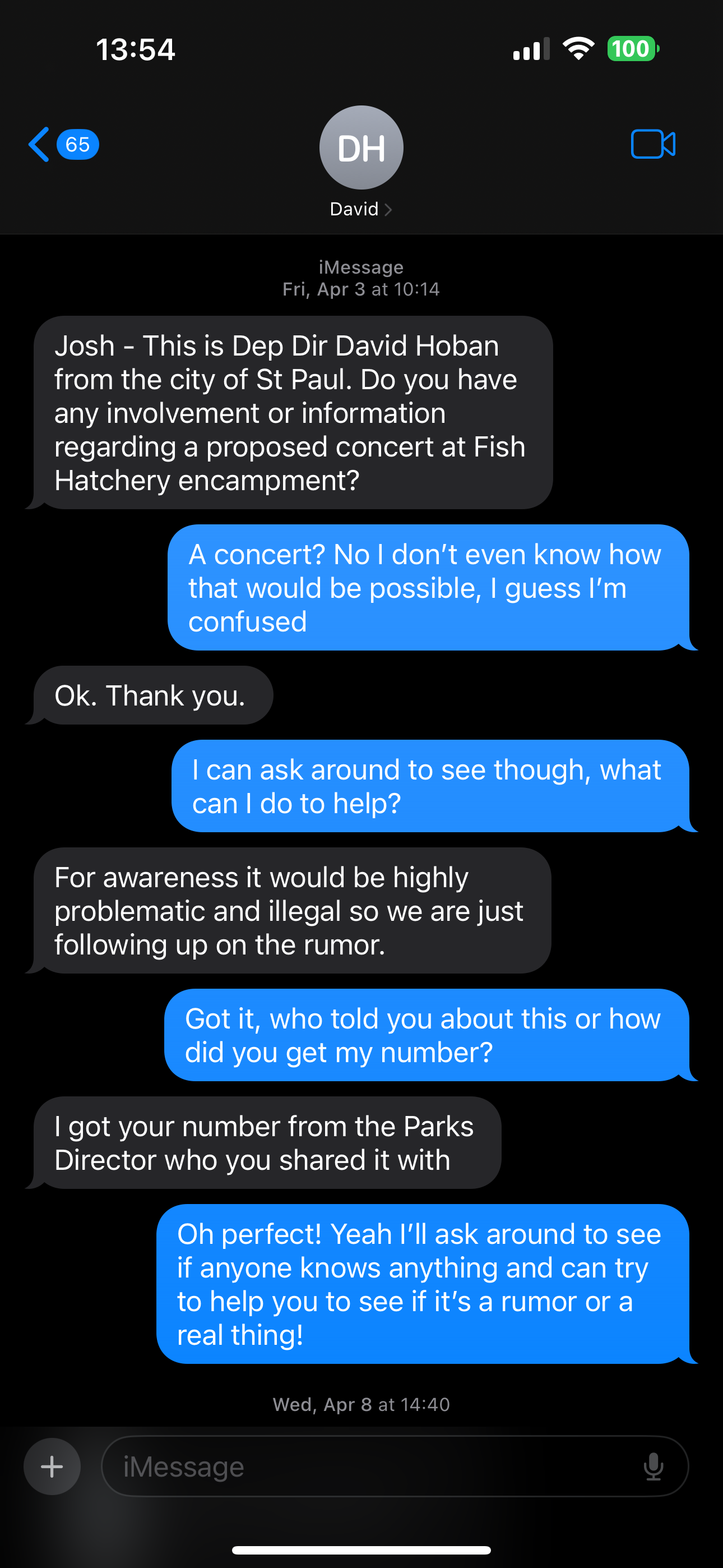
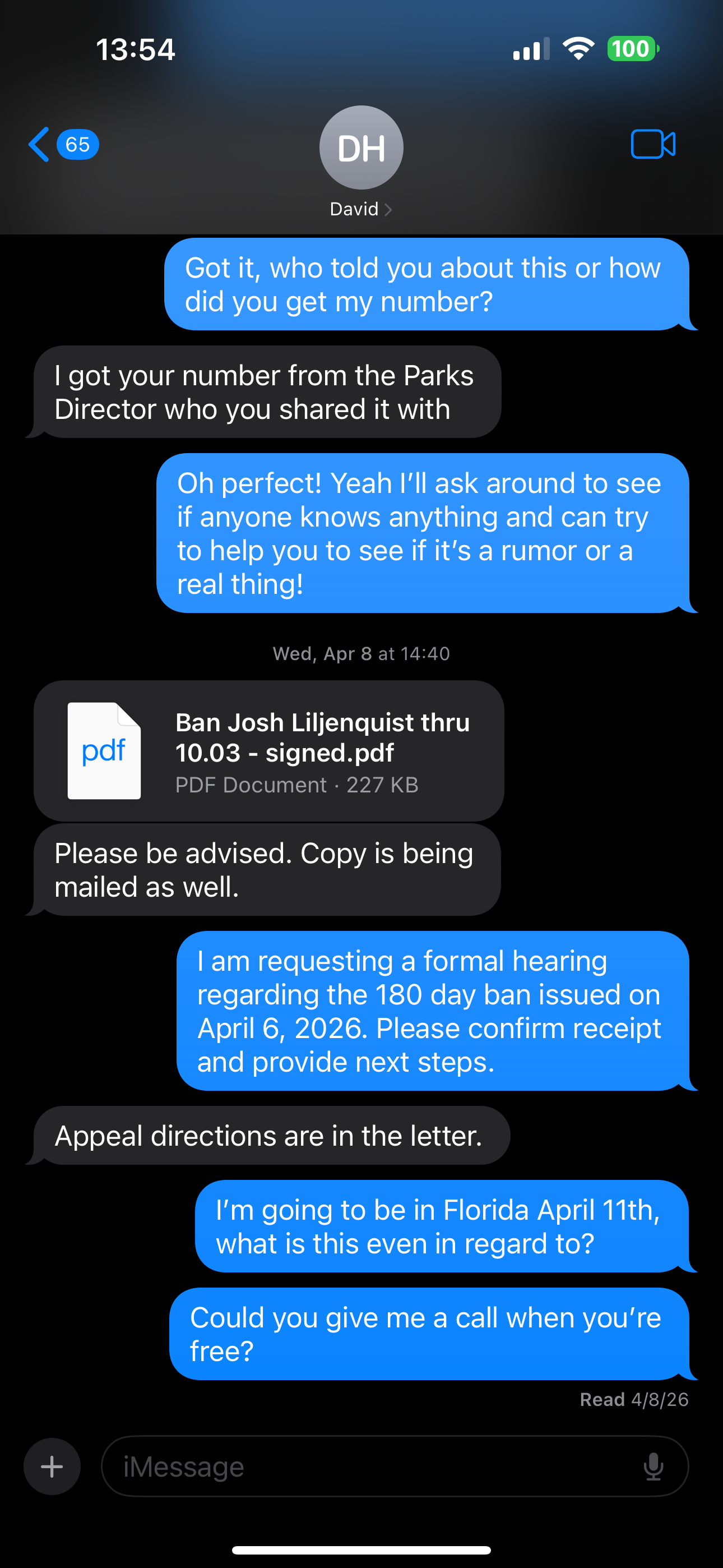
| April 3 contemporaneous City exchange | Later exclusion narrative | Sources |
|---|---|---|
| Hoban asks about a proposed concert and calls the information a rumor. | The notice presents intended participation in an unlicensed event as part of the exclusion basis. | R-03 R-01 |
| Josh denies knowledge and involvement. | The notice associates Josh with the event theory. | R-03 R-01 |
| Josh asks what he can do to help. | The notice references denial of an express information request. | R-03 R-01 |
| Josh offers twice to ask around. | That cooperation is not reflected in the notice’s event summary. | R-03 R-01 |
Possible City interpretation: The City could argue that Josh did not ultimately provide the organizer’s identity or that “denying” referred to denying possession of information rather than refusing cooperation. The displayed texts themselves do not show a refusal. If another communication did, that record and its disclosure timing are material unresolved questions.
Legal framework
Procedural due process is flexible, but the Supreme Court and Eighth Circuit repeatedly describe a minimum framework of meaningful notice, an explanation of the evidence, and an opportunity to respond. SC-01 SC-02 E8-01
Mathews v. Eldridge evaluates the private interest, the risk of error and value of added safeguards, and the government’s interest and burden. SC-04
In Brock v. Roadway Express, five Justices agreed that failure to disclose the substance of supporting evidence was constitutionally deficient. The plurality did not require preliminary cross-examination where prompt complete review was available. SC-03
An informal civil administrative appeal does not automatically carry the Sixth Amendment right to confront every accuser. Depending on the facts, the City may protect a vulnerable source’s identity. The central question is whether the substance and specificity of the material adverse evidence were disclosed enough to permit meaningful rebuttal. SC-03 SC-05 E8-02
The exclusion applied to every Saint Paul Parks and Recreation property for 180 days—the six-month maximum identified in the City framework. The Eighth Circuit has explained that longer deprivations may require additional procedural safeguards under Mathews. L-01 L-02 E8-02
Government may sometimes act immediately to address an urgent safety risk, but the reliability of the initial basis and promptness and adequacy of later review matter. SC-01 SC-07 SC-08
Analysis / inference
If Saint Paul relied on additional material evidence, the unresolved question is when its substance was disclosed so Josh could answer it. SC-03 SC-02 E8-01
If the known record was the complete basis, the unresolved question is what supported the “routinely” allegation, the event attribution, the claimed information denial, and the maximum citywide duration. R-01 R-03 L-01
If April 12, April 15, April 20 or other later material was used to sustain the restriction, the unresolved question is whether Josh was given a meaningful chance to answer that material before the appeal decision. R-06 R-07 R-09 R-10
The City ultimately rescinded the restriction. The current public record does not identify which facts controlled that result or establish that undisclosed post-hearing evidence was used to affirm the ban. R-11
Analysis / inference
| Factor | Record supporting Josh’s concern | City’s strongest response | Source IDs |
|---|---|---|---|
| Private interest | 180 days; all Parks and Recreation property; misdemeanor exposure; outreach, speech and assembly burden | Temporary administrative restriction; public-safety purpose | R-01 L-01 P-01 P-02 |
| Risk of error | Broad notice; unknown names; uncertain sibling account; possible hearsay; absent record; later complaints; CAD mismatch | Multiple departments may possess information; informality; source confidentiality | R-01 R-04 R-05 R-06 R-07 R-08 R-09 |
| Value of safeguards | Incident dates, source substance, document access, response to later material, written findings | Administrative burden and need for speed | SC-03 SC-04 E8-01 |
| Government interest | Not applicable | Vulnerable-resident safety, orderly operations, fast mitigation, confidentiality | L-01 L-02 R-04 |
| Outcome | City rescinded after appeal | City may argue appeal corrected the initial action | R-11 |
The documented facts support a serious procedural-due-process question. This table is analysis, not a court holding. SC-04
City-position analysis
Unresolved record question
Authority index
The source index distinguishes primary City records, third-party allegations, later summaries, binding authority, Minnesota precedent, persuasive park-ban cases, independent reporting and analysis. It labels Norris as a preliminary-injunction decision with no final merits judgment and Nelson as unpublished and nonprecedential.
Saint Paul had already imposed a 180-day citywide parks exclusion when Josh Liljenquist appeared for the City’s official appeal hearing. At the beginning of the substantive discussion, Josh’s attorney asked the City to identify the specific incidents, dates, times, people involved, reporters, and conduct supporting the exclusion. R-04 R-05
The City did not identify by name any person as the complainant, alleged victim, witness, resident, sibling, person allegedly filmed without permission, or firsthand Parks, DSI, or police source. The Parks Director said that he did not know the residents’ names, described portions of the information as “he-said-she-said” and “maybe even some hearsay,” said the referenced documentation was not with him, and offered to send supporting information later.
Near the end of the hearing, Josh again asked who the person was. The Director referred to a public police report, offered to send it, and said that he did not know names off the top of his head. By that point, Josh’s attorney was still stating that he had not heard what Josh allegedly did to disturb the peace.
Direct finding: The transcript does not establish that the City possessed no information. It does establish that the City did not identify a named supporting source or present the referenced supporting record during the hearing in which Josh was expected to answer the accusations.
At approximately 7:00, Josh’s attorney explained why the general language in the notice was not enough to permit a factual response:
“We don’t have any specific incidents, dates, times, people involved, the reporters who reported this to the director and the office, um, or exactly what his conduct was that was so disorderly or unpeaceful.”
“we’d like to know who those people are”
The request was not limited to formal discovery or a complete investigative file. Counsel asked for the basic factual particulars necessary to understand and answer the City’s allegations.
The Parks Director began his response by stating:
“I don’t know residents’ names”
He referred generally to residents who reportedly objected to filming and to an uncertain interaction involving “a sibling” and “one of their sisters or something like that.” Josh denied having a conversation with a sibling.
The Director then described the event information as:
“a lot of he-said-she-said”
“maybe even some hearsay”
“I believe, um, we can get you some documentation on that. I don’t have it with me”
The transcript therefore records that the City’s explanation lacked both an identified source and the referenced record when Josh was being asked to respond.
The Assistant City Attorney described the process in the following terms:
“we provide due process by notice and an opportunity to be heard. This is your opportunity to be heard”
At the end of the meeting, she described the hearing as “the kind of final step of—of the process dictated by the ordinance” and explained that the Director could affirm, rescind, or reconsider the length of the exclusion.
The Assistant City Attorney said the hearing was the final internal appeal step dictated by the ordinance and that the ordinance “doesn’t give a timeline” for the post-hearing decision. That statement is relevant to process timing, but it does not establish the legal deadline, the legal effect of a later decision, or whether another source supplied a decision timeline.
The unresolved record issue is practical: if the City needed additional time or records after the hearing to decide whether the exclusion should stand, what evidence was Josh expected to answer during the hearing itself?
The notice and hearing transcript describe an informal appeal before the Parks Director and state that the Director could affirm, rescind, or reconsider the length. The current official online text of §170.10 located for this implementation does not display those appeal terms. The historical April 2026 provision defining the appeal remains pending verification, so this page does not attribute additional procedure to the current online ordinance.
The documented concern is narrower and concrete: the City called this Josh’s opportunity to be heard, but it did not identify the supporting people or present the referenced record while he was in the hearing trying to answer the allegations.
At approximately 23:21, Josh’s attorney stated:
“I’m still sort of waiting to hear what it is he did that disturbed the peace.”
“I think he’s entitled to hear that.”
The Director responded that Josh had communicated he was not affiliated with the event and offered to follow up regarding the sibling interaction:
“I’m happy to send that information for your review.”
Josh then asked:
“who was the person? Do you guys know the name?”
The Director answered that the police report was public information, said:
“I can—the police report is public information.”
“I can—I can send it.”
“I don’t—I don’t know names off the top of my head.”
This sequence is the central Point 9 record. It shows that the alleged person, sibling, or participant was not identified by name during the appeal discussion, even after direct requests near both the beginning and the end of the meeting. That does not prove the City lacked identifying information anywhere else; it shows that the identity and supporting documentation were not supplied in the room when Josh was asked to respond.
Compare the notice’s recurring harassment language with the single disclosed incident.
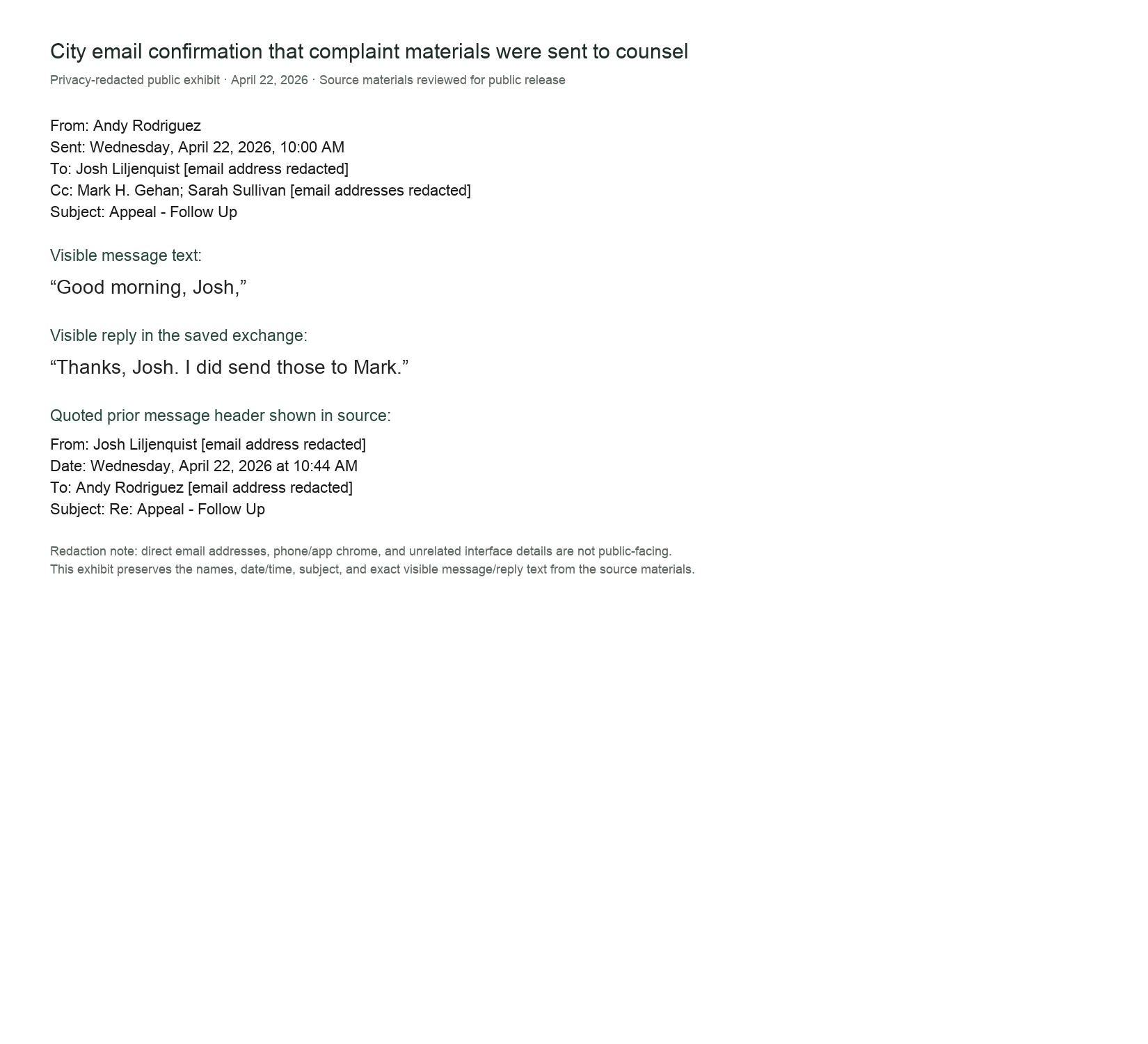
The appeal hearing occurred before the later-disclosed complaint-material transmission. On April 22, Josh asked how he would receive the materials discussed at the hearing. Parks Director Andy Rodriguez replied: “Thanks, Josh. I did send those to Mark.”
Sending records to authorized counsel can constitute delivery through counsel. The issue documented here is timing: the records were not presented while Josh was in the hearing expected to answer the factual basis.
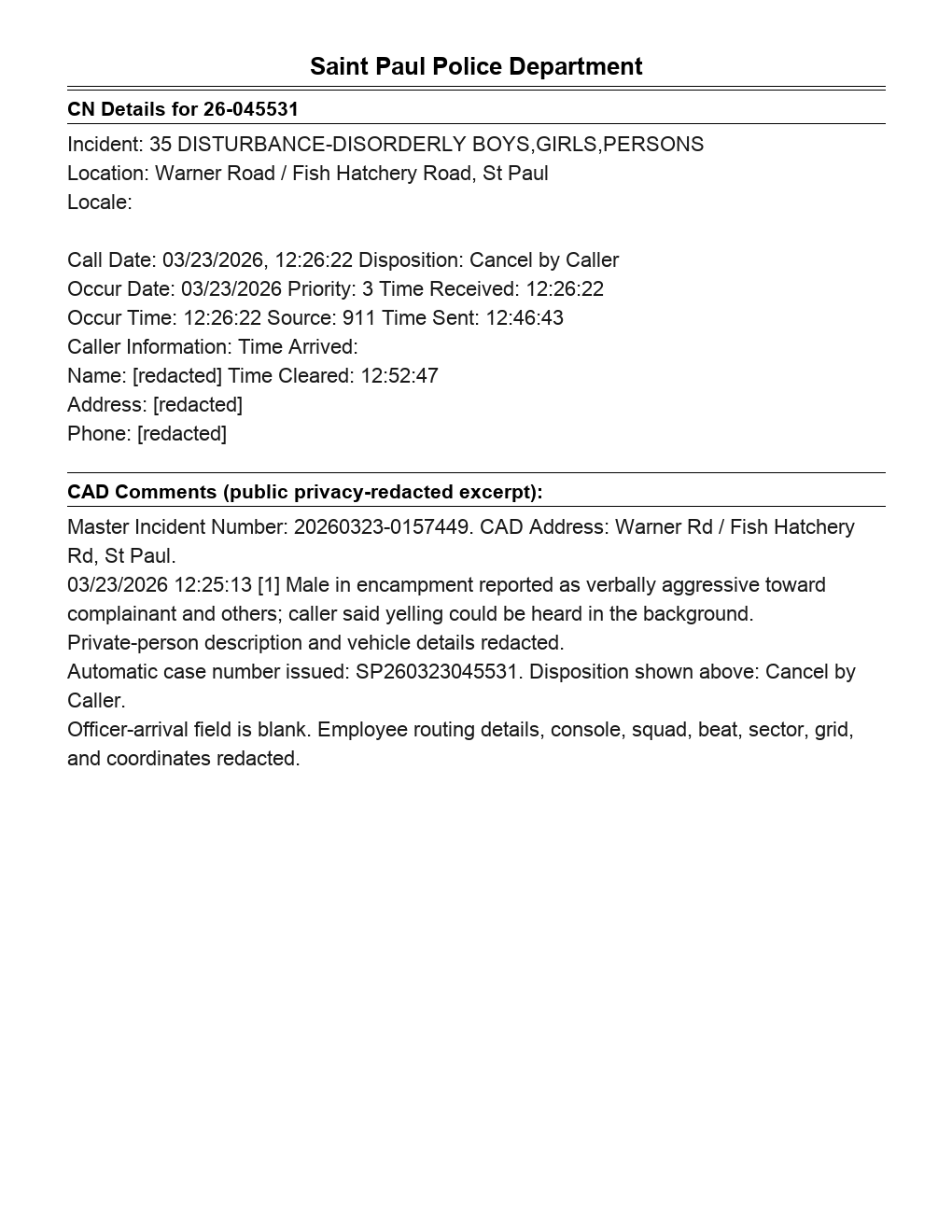
CAD CN 26-045531 records a March 23, 2026 caller report concerning an unidentified male near Warner Road and Fish Hatchery Road. The CAD does not name Josh Liljenquist. Its disposition is “Cancel by Caller,” and its officer-arrival field is blank.
| Question | What was said at the hearing | What the later-produced record shows | What remains unresolved |
|---|---|---|---|
| Who made the underlying allegation? | The Director said he did not know residents’ names and referred generally to a sibling and sister. | The CAD names James Coan–Volunteer as caller but does not identify the person described in the hearing as a complainant, sibling, sister, or alleged filming subject. | The original resident, sibling, or witness statement has not been identified in the reviewed public materials. |
| What incident was being discussed? | An uncertain parking-lot exchange connected to filming someone’s sister. | CAD CN 26-045531 records an unidentified male acting aggressively and a threat report. | The CAD does not mention Josh, a sibling, sister, filming, permission, a video, social media, profit, or a vulnerable adult. |
| Was Josh identified in the police record? | The Director spoke as though the interaction involved Josh. | The CAD does not name Josh in the caller, suspect, or comments. | A separate source would be necessary to connect the CAD to Josh and to the sibling/video narrative. |
| What did the later staff account add? | The detailed account was not presented during the hearing. | The April 20 email supplies a narrative attributed to “Ethan,” including Josh, James, a sister/video dispute, and yelling. | The original Ethan statement, exact words, date, interview method, and provenance were not included in the reviewed item. |
| When were the records supplied? | The Director promised later follow-up. | Headers and the April 22 reply show delivery through counsel after the hearing. | The reviewed record does not establish whether Josh was invited to submit a response before the appeal decision. |
The current official online text of Saint Paul Legislative Code §170.10 requires an extended-exclusion notice to specify its basis and period, supplies decision and duration factors, and caps the period at six months. It does not display the post-exclusion appeal procedure described in the notice and hearing transcript.
The record establishes that the City conducted the appeal and described the Director’s review role. The exact historical April 2026 code language authorizing and defining that role remains pending verification; this page therefore separates the documented hearing from the currently displayed ordinance text.
The U.S. Supreme Court has held that combining investigative and adjudicative functions does not, without more, establish unconstitutional bias. Due-process requirements are also flexible and depend on the affected interest, risk of error, usefulness of additional safeguards, and government burden.
The public record here therefore supports a serious procedural-fairness concern rather than a final legal conclusion: the City described the meeting as Josh’s opportunity to be heard, yet the people, incident particulars, and referenced record needed to answer a remaining accusation were not identified and presented during that meeting.
Minnesota Rules chapter 1400 should not be presented as the governing procedure. Rule 1400.5010 limits those contested-case rules to cases conducted by the Office of Administrative Hearings under Minnesota Statutes chapter 14. The supplied record identifies this as an informal municipal appeal under Saint Paul’s ordinance, not an OAH contested case.
Anonymous or secondhand information is not automatically unusable in an informal administrative setting. Minnesota and administrative-law sources instead make reliability, corroboration, timing, disclosure, and the ability to answer the substance important. Rule 1400.8607 is included only as non-governing context because no reviewed source establishes that this Parks appeal was a Chapter 14 contested case. L-14 L-15 MN-02 MN-08 MN-09
On April 22, 2026, the Parks Director wrote that, following the appeal and meeting, he had completed his review and was “rescinding your ban from our parks, effective immediately.”
The letter states that the decision followed an evaluation of facts relayed during the appeal meeting. It does not identify which facts changed the result, admit wrongdoing, or declare that every underlying allegation was false.
This page separates original records from allegations, summaries, and inferences. The hearing quotations come from the final privacy-redacted verbatim Markdown transcript used by the website. The DOCX is a cross-check and is not an independent source. The CAD is a dispatch record, not an officer’s factual finding. The April 20 “Staff Account” is a later summary attributed to a staff member; the original statement was not included in the reviewed item. The April 12 and April 15 complaints remain allegations.
Original private files remain preserved unchanged. Only privacy-reviewed public derivatives are linked. No facial expression, perceived emotion, or speculation about City Attorney review is presented as fact.
Non-legal-conclusion notice: This page documents the available public record and identifies unresolved procedural questions. It does not state that a court found a due-process violation, unlawful bias, fabrication, retaliation, discrimination, or other misconduct.
03 — Third completed discrepancy
Were the same standards applied consistently to comparable filming, amplified sound, and organized activity at Pig’s Eye Park?
Review the comparable-activity timeline →03 — Record comparison
Central question: Were the same standards applied consistently to comparable filming, amplified sound, and organized activity at Pig’s Eye Park?
Saint Paul’s later evidence packet repeatedly centered James Cowan Jr., material posted through James’s social-media account, and complaints connecting Josh Liljenquist to an April 11 gathering through relationship, association, or alleged physical presence. The reviewed packet does not disclose an instruction, payment, planning message, authorization, permit application, agency agreement, or directive from Josh showing that he planned, financed, promoted, attended, directed, or controlled the gathering.
Separate public posts from March through May 2026 document organized food distribution, crowds, microphones, substantial PA speakers, testimony and preaching, public creator filming within the encampment, performances, a stage-like platform, sound equipment, and promoted outreach activity at or around Pig’s Eye Park. Josh states that he personally knows the participants and understands that none obtained permits for the depicted activities. The public posts independently establish the visible activity; the reviewed records do not yet independently establish which activities legally required permits or what City enforcement occurred in each instance.
The comparison therefore raises testable questions about identity verification, agency, permit standards, warning and escalation practices, geographic scope, duration, and enforcement consistency. It does not by itself prove unlawful selective enforcement or wrongdoing by any comparator.
Four separate questions: Visible activity, whether a permit was obtained, whether a permit was legally required, and what enforcement occurred are different factual questions. Each requires its own support.
HL-006 · April 11 attribution
Issue: At 3:16, counsel addressed “this … unlicensed event at the park on April 11th” and stated that Josh had no role, was not tied to it, was not present, and was out of state. The current evidence must test both physical presence and any claimed remote planning, authorization, financing, promotion, agency, or control. R-01 R-03 R-05 R-12 R-13
“this, uh, unlicensed event at the park on April 11th”
“Josh had no role in that. He was not tied to it. Um, he was not present. He was out of state.”
| Evidence layer | What it supports | Material limitation |
|---|---|---|
| April 3 Hoban exchange | The City asked about a proposed concert; Josh denied knowledge or involvement, asked what he could do to help, and offered again to ask around after Hoban called it a rumor. | Does not prove no other communication or evidence existed. |
| Pre-booked travel and two photo files | The trip was booked months earlier; two separate April 11 files preserve metadata placing devices in southwest Florida. | Supports physical presence in Florida at documented times; does not establish location for every minute or independently rule out remote involvement. |
| Event promotion and photographs | Show that a gathering occurred and document visible activity and other participants. | Do not independently identify the legal organizer, permit status, or Josh’s direction or control. |
| April 12 and April 15 complaints | Record two later allegation theories. | Post-date the original exclusion and conflict on indirect association versus physical presence. |
| Appeal transcript | Records counsel’s denial and the Director’s later acknowledgment that Josh had communicated nonaffiliation. | Is advocacy and hearing dialogue, not an adjudicated factual finding. |
Later hearing acknowledgment: At 23:42, the Parks Director said Josh had communicated that he was not affiliated with the event. That hearing statement supports the attribution question, but it is not a final adjudication of every event-related fact.
The Council-adopted 2025 Parks Rules describe permit requirements for specified special events and exclusive uses. Separately, the extended-exclusion rule concerns reasonable cause that a person violated general-conduct rules by intentionally disrupting a park, program, or event. If the concern was a future event requiring a permit, the record must identify why the separate extended-exclusion authority was applied to Josh before that event.
Thomas v. Chicago Park District confirms that government may regulate future park events through a content-neutral permit system with adequate standards. It does not decide whether this particular notice, attribution, or exclusion was justified.
| Required fact | Record status | Still needed |
|---|---|---|
| Exact event and event type | An April 11 concert or gathering was alleged. | The operative event description and rule classification. |
| Exact permit or license | The notice said “unlicensed” but did not identify a permit or license by name. | Rule, issuing department, and applicant duty. |
| Responsible organizer | The reviewed record does not establish Josh as organizer. | Application, advertising, logistics, payment, direction, or agency record. |
| Application or search | No application or permit-search result identifying Josh is shown in the material reviewed to date. | Search terms, date range, custodian, and result. |
| DSI documentation | The notice attributes information to DSI without identifying the document. | Original DSI record, author, creation date, and date Parks received it. |
The notice characterized Josh as “denying an express request for information.” The April 3 exchange shows the City asking about a rumored concert, Josh denying involvement, asking “what can I do to help?”, Hoban saying the City was “just following up on the rumor,” and Josh again offering to ask around. The remaining legal question is whether any identified rule required more.
Mandatory counterpoint: Evidence of Florida travel is relevant to physical presence, but it is not a complete alibi for a remote organizer theory. Conversely, relationship with attendees, the presence of a photographer who had worked with Josh, or posts by another account do not by themselves establish agency or control. The City’s actual attribution evidence and timing remain the central questions.
The submitted materials span March 25 through May 10, 2026—before the April 6 exclusion, during the exclusion period, and after the April 22 rescission. They show public social-media recording interfaces, people filming or appearing in posted camp footage, public-facing creators or performers, visible loudspeakers or microphone/stage setups, food distribution tables, organized outreach activity, vehicles, and groups or crowds in the Pig’s Eye Park camp context.
This section states only directly observable conduct from the submitted materials. It does not accuse any depicted person of misconduct and does not call any gathering unpermitted without permit records.
The purpose of this comparison is not to accuse other individuals, outreach groups, organizations, performers, or creators. It is to test whether similar categories of public activity at the same location and timeframe were evaluated and enforced consistently.
| Category | City theory concerning Josh | Comparator material | Responsible question |
|---|---|---|---|
| Public recording / creator activity | Notice and reporting emphasized recording and alleged profit | April 15 Exit Fame creator filming, May 2 shelter recording, Kelly Rashaw public reel | Were recording, consent, commercial-use, and permit standards evaluated consistently? |
| Amplified sound / microphones | City referenced disruption and event activity | April 12 testimony microphone and PA speaker; May 3 microphone/platform/audio equipment; May 10 multiple large PA speakers | What rule or permit applied, and what warning or enforcement occurred? |
| Organized gatherings / distribution | City referenced an intended unlicensed event | March 26 exact-location community event; April 12 organized outreach; May 10 crowd and distribution setup | Which activities required permits, and how were organizers identified? |
| Performance / promoted activity | City tied Josh to concert-type activity | April 11 performer outreach/church promotion; May 3 saxophone and microphone performance; April 3 microphone performance | What direct evidence connected Josh to planning, financing, promotion, direction, or control? |
| Enforcement outcome | Josh received a maximum six-month citywide exclusion | No comparable maximum action is disclosed in the reviewed comparator materials | What City contact, warning, citation, removal, or exclusion occurred for each comparator? |
| Date | Submitted evidence | Observable activity | Relation to April 6 exclusion and April 22 rescission | Unresolved enforcement question |
|---|---|---|---|---|
| March 25, 2026 | 3_25_2026 Comparable Outreach and Preaching Activity.mp4 | Public social-media video showing outreach/preaching content in a camp setting, with captions and a public-post interface visible. | Before the April 6 exclusion. | What standards applied to public-facing outreach/preaching activity before the exclusion? |
| March 26, 2026 | 3_26_2026 Organized Food Distribution With Loudspeaker.mp4; IMG_2369.PNG; IMG_2370.PNG | Food tables, packaged meals, drinks, a public social-media interface, and a post location/search label for Pig’s Eye Regional Park community event are visible. | Before the April 6 exclusion. | Were permits, permissions, complaints, or enforcement records associated with this organized food distribution? |
| April 11, 2026 | 4_11_2026 Comparable Public Figure Activity.mp4; IMG_2367.PNG; IMG_2368.PNG | Public-facing performer/creator profile and group images at the camp location are visible in a social-media interface. | During the exclusion period and on a date referenced in the April 6 exclusion letter. | What standards were applied to public-facing creator or performer activity on the same date family? |
| April 12, 2026 | 4_12_2026 Loud Speaker Testimony.mp4; 4_12_2026 Comparable Outreach and Public Activity.PNG | A person speaking near a pickup truck, visible loudspeaker equipment, camp structures, and a public social-media interface are visible. | During the exclusion period. | Were amplified-sound permissions, warnings, complaints, or enforcement actions recorded? |
| April 15, 2026 | 4_15_2026 Public Creator Filming at Camp.mp4 | Public creator filming inside the camp setting, with social-media captions and people/tents visible. | During the exclusion period, before the April 22 rescission. | How did the City handle comparable public recording activity while the exclusion remained in effect? |
| April 16, 2026 | 4_16_2026 Loud Speakers in Background.mp4 | A public social-media video/photo interface, camp setting, food/outreach context, and visible equipment are present. | During the exclusion period, before the April 22 rescission. | Were any warnings, permits, complaints, or enforcement records tied to this activity? |
| May 2, 2026 | 5_2_2026 Comparable Public Recording Activity.mp4 | Public recording inside a tent/camp setting with social-media captions and visible filming/posting interface. | After the April 22 rescission. | Were comparable recording standards applied after Josh’s ban was rescinded? |
| May 3, 2026 | 5_3_2026 Rapper Rapping with Loud Speakers.mp4; 5_3_2026 Loud Speakers 2.mp4; 5_3_2026 Saxophone on Stage.mp4; IMG_2361.PNG; IMG_2362.PNG; IMG_2363.PNG | Public social-media video/screenshots show performance-style activity, visible stage/platform elements, food/outreach tables, and people gathered near vehicles and equipment. | After the April 22 rescission. | What records show whether amplified sound, performance, or organized outreach activity was authorized or enforced? |
| May 10, 2026 | 5_10_26 Loud Speakers, Stage, and Crowd.mp4; 5_10_26 Loud Speakers and Stage.mp4; 5_10_26 Loud Speakers.mp4; IMG_2371.PNG; IMG_2372.PNG; IMG_2373.PNG | Public social-media/live interfaces show vehicles, tables, visible speaker equipment, cabling, and groups/crowds in a camp/park setting; a stage is not clearly established in the reviewed frames. | After the April 22 rescission. | What City records would show whether comparable sound, crowd, and distribution activity was treated consistently? |
Public creator filming in the camp setting, with social-media captions and people/tents visible.
Source status: submitted evidence reviewed; public clip or still not surfaced pending rights and privacy review.
Public recording inside a tent/camp setting with a visible social-media posting interface.
Source status: submitted evidence reviewed; public clip or still not surfaced pending rights and privacy review.
Food tables, packaged meals, drinks, and a public post interface are visible.
Source status: submitted evidence reviewed; public clip or still not surfaced pending rights and privacy review.
Public-facing profile/group imagery and separate loudspeaker/testimony footage are visible.
Source status: submitted evidence reviewed; public clip or still not surfaced pending rights and privacy review.
Performance-style activity, stage/platform elements, and people gathered near equipment are visible.
Source status: submitted evidence reviewed; public clip or still not surfaced pending rights and privacy review.
Visible speaker equipment, tables, vehicles, and groups/crowds are visible; a stage is not clearly established in the reviewed frames.
Source status: submitted evidence reviewed; public clip or still not surfaced pending rights and privacy review.
The April 12 complaint did not identify a direct organizing act by Josh. Its express theory was that Josh remained involved through “close association,” his relationship with James, and the alleged presence of his cameraman.
The complaint identifies the purported organizer as “James Collins Jr.” Other disclosed materials identify James Cowan Jr., “James Cowen Jr.,” or “James Coan.” The reviewed records use several materially different versions of the apparent comparator’s name and do not explain whether every reference identifies the same person.
Sender status: pseudonymous sender who expressly requested anonymity. A displayed return email address is not the same as verified identity.
The April 15 complaint advanced a materially different account from the April 12 complaint. Rather than connecting Josh indirectly through James and a cameraman, it alleged that Josh was physically present. The reviewed photographs do not independently label Josh as present, and the travel record places him in Florida during the April 11 timeframe.
Sender status: unverified or pseudonymous sender who requested anonymity. The unresolved problem is verified identity and reliability, not the literal absence of a reply channel.
The later complaints do not provide one consistent account of Josh’s involvement. One advances an association theory; the other alleges direct presence. Neither existed when the original exclusion was purportedly made effective.
| Question | April 12 complaint | April 15 complaint |
|---|---|---|
| Theory connecting Josh | “Close association,” relationship with James, and alleged cameraman presence | Direct physical presence |
| James name used | “James Collins Jr.” | “James Cowen Jr.” |
| Organizer identified | James is expressly called organizer | Organizer and alleged attendees are not clearly separated |
| Sender presentation | “Anonymous Pigseye”; requests anonymity | “Business Phone” Gmail account; requests anonymity |
| Timing | After April 6 and after the April 11 gathering | After April 6 and after the April 11 gathering |
| Could inform original April 6 decision? | No | No |
| Independent verification in the message | Not established | Not established |
The available event materials do not present one clear, stable identification of the alleged event. The underlying flyer identifies Redeeming Love Church in Maplewood as the venue. The Pig’s Eye reference appears in a separate added caption or strip whose author, creation date, and transmission path are not established. The composite should not be described as an authenticated original Pig’s Eye event flyer without additional provenance.
A public April 11 Nicky Gracious post thanks James Cowan Jr. and Exit Fame in connection with outreach in “The Trenches,” then separately says, “Come see us this evening at Redeeming Love Church” for music and performers. That supports a relationship between James and visible activity, but does not establish Josh’s direction, merge the church concert and Pig’s Eye outreach into one legally defined event, or identify who supplied the City’s event theory. R-13 E-01 E-02 E-03
| Source layer | What it supports | What remains unresolved |
|---|---|---|
| Underlying flyer | Communities Coming Together event promotion tied to Redeeming Love Church / Maplewood context. | Whether the flyer itself was originally a Pig’s Eye event notice. |
| Added Pig’s Eye caption / strip | Shows someone later associated the event language with Pig’s Eye Park. | Who added the caption, when, and from what original source. |
| Secondary event listing and organization pages | Provide current public context for the venue and named organizations. | They do not authenticate the composite image or prove the complete April 2026 event history. |
The hearing transcript separates several observable categories: outreach groups serving food, people using a microphone and speaker, testimony or religious expression, a trailer or speakers, and the videographer’s attributed belief that one organizer did similar outreach weekly. Those categories matter because food distribution, testimony, religious expression, amplified sound, organized events, and permit status are separate questions. R-05 L-02 SC-13 P-05
| Category | Record support | Limit |
|---|---|---|
| Outreach and food distribution | The transcript and comparator materials describe outreach groups and visible food distribution. | Visible outreach does not establish permit status, City knowledge, or enforcement outcome. |
| Testimony / religious expression | The transcript describes people using a microphone and speaker to give testimonies. | This is not a religious-retaliation claim and does not prove constitutional protection for each depicted activity. |
| Amplified sound | Comparator materials show or describe microphones, speakers, PA equipment, or performance setups. | Amplified-sound authorization and any enforcement response require City records. |
| Weekly organizer claim | The transcript contains an attributed belief that an organizer did similar outreach weekly. | The statement remains attributed/source-gated and is not published as a verified schedule without supporting records. |
The legal authorities cited here are conditional context. They show that public-forum speech, religious expression, and food sharing can raise First Amendment questions in some circumstances. They do not establish that Saint Paul violated the First Amendment, that every activity was permit-exempt, or that any comparator was legally similarly situated. Additional City records remain necessary.
The submitted City Evidence Supporting Comparator folder contained 51 submitted files, 31 unique byte streams, 30 unique images, one unique PDF, and 20 exact duplicate submissions. File count is not corroboration count. Duplicate files, several captures from one social-media account, a composite graphic, and a screenshot of the City’s own notice remain derivative or connected source families.
| Record family | Submitted files in current ZIP | Unique available items | Main limitation |
|---|---|---|---|
| April 12 complaint attachments | 6 | 5 | One exact duplicate; referenced 14-minute video absent |
| April 15 complaint attachments | 41 of 42 listed | 22 | 2384.jpg missing; numerous exact duplicates and derivative screenshots |
| City-forwarded record screenshots | 3 | 3 | Screenshots of messages rather than native .msg or .eml files |
| CAD CN 26-045531 | 1 | 1 | Names James as caller; does not contain the later Josh-specific narrative |
The attachment repeating the City’s allegation through a social-media screenshot of the City’s own notice is classified as circular derivative material. It does not independently corroborate that allegation.
“The submitted materials document other public-facing filming, amplified sound, organized outreach, stages and crowds at Pig’s Eye Park. Josh’s concern is whether materially comparable activity was handled under the same standards that the City applied to him.”
The available evidence does not yet answer whether the circumstances were materially equivalent. These materials alone do not establish:
At approximately 14:50 in the appeal hearing, the Parks Director said Josh was “obviously very different” because of “the following and what you do every day,” and added that this was why the matter had “garnered the attention.” The statement is relevant because it expressly connects Josh’s public profile to the attention the case received. It does not, standing alone, prove that Josh’s following caused the exclusion or a harsher penalty. The unresolved records question is whether Josh’s audience size, media profile, or anticipated publicity influenced the decision to issue, broaden, publicize, defend, or maintain the exclusion.
“You're obviously very different, just given the following and what you do every day, right? So it's just—that's why it's garnered the attention, obviously, and other things.”
The later City packet repeatedly linked Josh Liljenquist to the April 11 gathering through his relationship with James Cowan Jr. and through the alleged presence of a person described as Josh’s cameraman. The April 12 complaint names “James Collins Jr.” as the organizer and refers to the nonprofit Where Purpose Is Found; the surrounding packet appears to be referring to James Cowan Jr., but the City materials do not explain the surname discrepancy. The complaint then attempts to connect Josh through his relationship with James and the alleged presence of Josh’s cameraman.
The packet documents association. It does not disclose an instruction, payment, planning message, permit application, performer arrangement, equipment directive, authorization, agency agreement, or other record from Josh showing that James or Ben acted on Josh’s behalf in organizing or controlling the gathering.
Josh states that he gave James no instructions concerning the event, supplied no money, brand, account, equipment, performers, or authorization, and did not know the event details because he was scheduled to be in Florida. Josh also states that Ben’s role was taking photographs, not organizing the gathering. Those are firsthand statements and remain attributed unless separately confirmed by James and Ben.
| Record | What it establishes | What it does not establish |
|---|---|---|
| James-account Facebook/mobile screenshots | James’s account displayed extensive material from the April 11 gathering. | That Josh directed the posts, authorized the gathering, or controlled James. |
| April 12 complaint | Alleges that “James Collins Jr.” organized the event and links Josh through relationship and cameraman presence. | That the writer had firsthand knowledge of Josh directing James; why the surname differs. |
| April 15 complaint | Alleges Josh and James were physically present. | How the writer knew Josh was present; the allegation conflicts with the April 12 indirect-association theory. |
| Event photographs | Show a gathering, food distribution, performers, microphones, loudspeakers, canopies, and a trailer/platform. | Who legally organized, financed, permitted, or controlled the event. |
| Annotated selfie | Contains user-added labels identifying James and a “cameraman.” | Independent proof of identity, agency, or Josh’s direction. |
| Packet as a whole | Shows relationships and participation by other people. | A direct act by Josh planning, financing, directing, attending, or controlling the gathering. |
This section does not state as established fact that James legally organized or co-organized the event, arranged performers, supplied food, or acted as Josh’s agent; that Ben acted as Josh’s agent; that the event lacked every required permit; or that any participant violated the law. Those remain unresolved unless supported by original event records or independent first-person declarations.
The City-provided packet documents that a substantial gathering occurred at Pig’s Eye Park on April 11. The images show food distribution, tables and canopies, attendees, performers or speakers, microphones, loudspeakers, and a trailer or platform. They do not independently establish permit status, the legal organizer, who financed the gathering, or what role any specific person had in planning it.
Of the 30 unique images in the City packet, 20 were mobile or Facebook screenshots associated with James Cowan Jr.’s account. The packet therefore does not contain 20 independent witnesses to Josh’s involvement; it contains multiple captures from one principal social-media source family.
The April 12 and April 15 complaints conflict. The April 12 writer advances an indirect theory based on Josh’s relationship with James and the alleged presence of Josh’s cameraman. The April 15 writer directly alleges that Josh was physically present. The supplied images do not label Josh as present and do not resolve the conflict.
The packet contains no planning instruction, payment record, authorization, agency message, or directive from Josh. The responsible conclusion is not that the images identify the legal organizer. It is that the later event evidence did not establish Josh’s planning, financing, direction, attendance, or control.
Source-family note: Multiple screenshots of one account, repeated views of one gathering, and duplicate copies do not become independent corroboration merely because they appear as separate files.
The reviewed materials are grouped by source family rather than counted as one source per uploaded file, screenshot, URL, or screen recording. Probable event clusters remain provisional until original URLs, captions, dates, or first-person records confirm the relationship.
| Source family | Date support | Visible or stated activity | Principal limitation |
|---|---|---|---|
| COMP-MAR25-OUTREACH-PREACHING | March 25 | Outreach, food distribution, religious speech | Exact date/location and permit/enforcement status unresolved |
| COMP-MAR26-NEEKO-PIGSEYE-DISTRIBUTION | March 26 | Coordinated food distribution and supplies at an interface-labeled Pig’s Eye Regional Park community event | Permit requirement and enforcement outcome unresolved |
| COMP-APR03-RAPPER-MIC-PERFORMANCE | April 3 visible post date | Handheld-microphone performance or speech in encampment-like area | Prior filename indicating May 3 should not control the date |
| COMP-APR11-NICKY-JAMES-OUTREACH | April 11 | Public thanks to James Cowan Jr. and Exit Fame plus separate evening Redeeming Love Church promotion | Does not establish Josh’s direction or legal organizer status |
| COMP-APR12-ADELL-PIGSEYE-OUTREACH / COMP-APR12-ACE-MIC-TESTIMONY | April 12 | Organized outreach, supplies, microphone testimony, and PA-style speaker | Probable cluster pending original-link confirmation |
| COMP-APR15-EXIT-FAME-CREATOR-FILMING | April 15 | Public creator filming among tents and participants; caption thanks James Cowan Jr. | Consent, monetization, permit, City knowledge, and enforcement unresolved |
| COMP-APR16-NIKOLLE-CAMP-ACTIVITY | April 16 | Public camp activity and washing-station post | Do not claim visible loudspeaker without further proof |
| COMP-MAY02-TENT-PUBLIC-RECORDING | May 2 | Public recording inside or around shelter | Location, permit requirement, consent, monetization, and enforcement unresolved |
| COMP-MAY03-JOY-PIGSEYE-PRAYER / COMP-MAY03-KAREN-STAGE-SAXOPHONE | May 3 | Prayer/outreach call plus microphone, platform, saxophone, mixer/audio equipment, cabling, and audience | Probable same-day cluster, not conclusively merged without original URLs |
| COMP-MAY10-SCOTT-MOTHERS-DAY-GATHERING | May 10 derived | Large gathering, line/crowd, tables, supplies, vehicles, and multiple PA speakers | Do not call a stage clearly visible; location and enforcement unresolved |
| COMP-KELLY-PUBLIC-RECORDING | Date unresolved | Publicly posted reel depicts identifiable people and encampment conditions | Camera/microphone not clearly visible in each still; source limits remain |
Josh states that he personally knows the participants depicted in the comparator materials and understands that none obtained permits for the activities shown. That statement is attributed to Josh. It should not be converted into an independently verified no-permit finding unless supported by participant declarations, a City permit-system search, DSI/Parks records, an authoritative no-records response, or another direct source.
This page does not infer that every microphone, camera, food distribution activity, prayer gathering, sermon, casual outreach activity, or public post required a permit.
Visible activity may be supported by posts, screen recordings, photographs, captions, location tags, and observable equipment or conduct. Enforcement outcome requires City records, warning or citation records, police or security records, participant declarations, communications, or an authoritative no-records response.
No comparable maximum citywide exclusion or similar enforcement is disclosed or presently identified in the reviewed materials. This is not the same as saying the City never enforced against anyone else.
| Date | Event or source | Correction / classification |
|---|---|---|
| March 23, 2026 | CAD CN 26-045531 identifies James as caller | Original CAD date; later staff summary uses March 24 |
| April 3, 2026 | Hoban rumor inquiry and separate public microphone/performance source visibly dated Apr 3 | Pre-decision City contact; correct misleading May 3 filename |
| April 6 / April 8, 2026 | Notice dated/effective April 6; electronic signature completed April 8 | Drafting, transmission, delivery, receipt, and any earlier notice remain unverified |
| April 12 / April 15, 2026 | Two post-decision complaints received | Association theory then conflicting direct-presence theory |
| April 20 / April 22, 2026 | Andy forwards CAD/staff-summary and complaint records April 20; formal rescission and production confirmation April 22 | Do not collapse all production to April 22 |
| May 3 / May 10, 2026 | May 3 prayer/audio-equipment cluster and May 10 crowd/distribution/PA-speaker source family | Do not move April 3 source to May 3 or call May 10 a clear stage example |
The preliminary text screenshot records James saying, “No. Nothing ever. Literally not a single thing in person text writing email NOTHING,” and records willingness to provide an affidavit. That screenshot alone is not used here for a categorical public statement because the initial question was not fully neutral and did not expressly cover phone calls, voicemail, social-media messages, whether James initiated contact, all relevant City departments, or the complete date range.
The categorical James no-contact claim remains source-gated until an approved signed or recorded declaration covers the relevant scope. Until then, this page preserves the anchor but does not publish the broad claim as established fact.
2384.jpg.1000033013.mp4 / complete 14-minute source..msg or .eml files and full email headers for the April 12 and April 15 complaints.Saint Paul’s rules refer to requirements applying to park users, including rules for amplified sound and permitting or written permission. Saint Paul Park Security describes its work as “fair courteous enforcement.” Those public pages are presented here as standards for comparison—not as proof that the City violated them.
All submitted videos in the Best Examples and Supporting Examples folders were reviewed. The screenshots folder contained 10 screenshot files, although the implementation prompt referenced seven; all 10 were inspected. No raw third-party media is surfaced publicly in this staged section.
| Type | Submitted file | Date represented | Review note |
|---|---|---|---|
| Video | 3_25_2026 Comparable Outreach and Preaching Activity.mp4 | March 25, 2026 | Public-facing outreach/preaching social-media video reviewed. |
| Video | 3_26_2026 Organized Food Distribution With Loudspeaker.mp4 | March 26, 2026 | Organized food distribution and public post interface reviewed. |
| Video | 4_11_2026 Comparable Public Figure Activity.mp4 | April 11, 2026 | Public-facing performer/creator social-media activity reviewed. |
| Video | 4_12_2026 Loud Speaker Testimony.mp4 | April 12, 2026 | Visible loudspeaker/testimony setup reviewed. |
| Video | 4_15_2026 Public Creator Filming at Camp.mp4 | April 15, 2026 | Public creator filming in the camp setting reviewed. |
| Video | 4_16_2026 Loud Speakers in Background.mp4 | April 16, 2026 | Public social-media post interface with camp/outreach context reviewed. |
| Video | 5_2_2026 Comparable Public Recording Activity.mp4 | May 2, 2026 | Public recording in a tent/camp setting reviewed. |
| Video | 5_3_2026 Rapper Rapping with Loud Speakers.mp4 | May 3, 2026 | Performance-style activity reviewed. |
| Video | 5_3_2026 Loud Speakers 2.mp4 | May 3, 2026 | Gathering near vehicles/tables/equipment reviewed. |
| Video | 5_3_2026 Saxophone on Stage.mp4 | May 3, 2026 | Stage/platform and saxophone/performance context reviewed. |
| Video | 5_10_26 Loud Speakers, Stage, and Crowd.mp4 | May 10, 2026 | Loudspeaker/crowd context reviewed; stage label treated as filename only. |
| Video | 5_10_26 Loud Speakers and Stage.mp4 | May 10, 2026 | Visible speaker/equipment context reviewed; stage label treated as filename only. |
| Video | 5_10_26 Loud Speakers.mp4 | May 10, 2026 | Visible loudspeaker and gathering context reviewed. |
| Screenshot | IMG_2369.PNG | March 26, 2026 | Food distribution screenshot reviewed. |
| Screenshot | IMG_2370.PNG | March 26, 2026 | Food distribution screenshot reviewed. |
| Screenshot | IMG_2367.PNG | April 11, 2026 | Public figure/activity screenshot reviewed. |
| Screenshot | IMG_2368.PNG | April 11, 2026 | Public profile screenshot reviewed. |
| Screenshot | IMG_2371.PNG | May 10, 2026 | Loudspeaker/crowd screenshot reviewed; stage not clearly established. |
| Screenshot | IMG_2372.PNG | May 10, 2026 | Loudspeaker/crowd screenshot reviewed; stage not clearly established. |
| Screenshot | IMG_2373.PNG | May 10, 2026 | Loudspeaker/crowd screenshot reviewed; stage not clearly established. |
| Screenshot | IMG_2361.PNG | May 3, 2026 | Performance/loudspeaker screenshot reviewed. |
| Screenshot | IMG_2362.PNG | May 3, 2026 | Performance/loudspeaker screenshot reviewed. |
| Screenshot | IMG_2363.PNG | May 3, 2026 | Performance/loudspeaker screenshot reviewed. |
Provenance: source packet recorded as Desktop/Park Ban/2. Comparator Comparison/4. Comparable Conduct Evidence at Same Park-20260623T221146Z-3-001.zip. SHA-256 hashes for reviewed submitted media are staged in the internal provenance record at content/transparency/comparable-activity-provenance.json.
04 — Evidence timing / working Point 10
During the appeal hearing, the Parks Director stated that anonymous emails concerning conduct had arrived “after the fact, after this letter came.” The disclosed evidence packet includes complaints dated April 12 and April 15, after the April 6 exclusion decision but before the appeal hearing.
Those later materials were not information available when the original April 6 exclusion decision was made. The record should distinguish the evidence supporting the original decision from material later received and potentially considered during the appeal or subsequent review.
Review the evidence-timing record →EVIDENCE TIMING
Saint Paul’s 180-day parks exclusion was dated April 6, 2026. Two complaint emails later included in the City-provided evidence packet were received on April 12 and April 15, after the exclusion and after the April 11 gathering referenced in the notice. During the appeal hearing, the Parks Director expressly described anonymous conduct-related emails as arriving “after the fact, after this letter came.” Those later materials could not have informed the original April 6 decision. Their inclusion in the City’s evidence packet strongly indicates that they were treated as relevant to explaining, defending, reviewing, or resolving the exclusion, although the available record does not disclose the precise weight assigned to them or clearly separate the original decision record from the later appeal record.
The April 12 and April 15 complaints postdate the April 6 exclusion. They therefore were not information available when the original exclusion decision was made.
The City-provided packet contained 52 submitted files, but only 31 unique byte streams. Twenty-one JPEG submissions were exact duplicates. The packet must not be described as 52 independent pieces of evidence.
The City selected, retained, and produced the later complaints and event materials in the evidence packet concerning the exclusion and appeal. That supports the inference that the City treated them as relevant to explaining, defending, reviewing, or resolving the exclusion.
The available records do not assign a numerical weight to each allegation, identify every record considered, or explain precisely how the Director used the April 12 and April 15 complaints.
During the hearing, the Parks Director referred to anonymous emails about conduct and said they had “come after the fact, after this letter came.” Later in the meeting, he reiterated that “these came after the fact.” The timing distinction is important: the later complaints may have been reviewed during the appeal, but they were not information available for the original April 6 decision.
“And, like, there are other things that I can, you know, share that is considered public information, like anonymous emails that I'm getting about conduct and things like that. It's, um—that come after the fact, after this letter came. So, like, I just—it's interesting to me, um, and I don't know who to respond to because they're anonymous.”
“Well, I'm saying these came after the fact.”
“I'm going to take what I—what comes out of this meeting and attempt to make an informed decision.”
The supplied transcript does not contain a separate [15:12] timestamp line; the words appear within the existing [14:50] Parks Director exchange, so the website preserves the stable #t-15-12-materials alias at that exchange.
The April 12 complaint alleges concerns anonymously or pseudonymously, and the April 15 complaint is also a complaint rather than a finding. An anonymous complaint should not be described as a factual adjudication. The record can show when the City received and produced the complaint; it does not, standing alone, establish the truth of each allegation.
The April 12 and April 15 complaints cannot be represented as information available for the original April 6 decision. That does not mean they were automatically inadmissible in an informal appeal, and this page does not claim the City intentionally backfilled evidence.
The City selected, retained, and produced the later complaints and event materials in the evidence packet concerning the exclusion and appeal. That supports the inference that the City treated those materials as relevant to explaining, defending, reviewing, or resolving the exclusion, while leaving unresolved the precise weight assigned to them.
The transcript contains the phrase “bike race or concert or others,” but the reviewed record does not identify where that theory originated or who supplied the specific event framing before the exclusion decision.
| Date | Record event | Classification |
|---|---|---|
| April 3, 2026 | Deputy Director David Hoban contacted Josh about a proposed concert, described the matter as a rumor, received Josh’s denial, and received Josh’s offers to help. | PRE-DECISION |
| April 6, 2026 | The exclusion letter states that the 180-day exclusion became effective. | CLAIMED ORIGINAL DECISION DATE |
| April 8, 2026 | The visible electronic signature was completed at 2:26:22 p.m. CDT. Review the April 6 / April 8 notice timeline | TRANSMISSION / RECEIPT UNVERIFIED |
| April 11, 2026 | The gathering depicted in later event material occurred. | POST-DECISION EVENT |
| April 12, 2026 | The City received the first supplied complaint. | POST-DECISION / PRE-HEARING |
| April 15, 2026 | The City received the second supplied complaint. | POST-DECISION / PRE-HEARING |
| April 17, 2026 | The appeal hearing occurred. | APPEAL STAGE |
| April 20, 2026 | Complaint material and the staff-account/CAD material were sent to counsel. | POST-HEARING DISCLOSURE |
| April 22, 2026 | The exclusion was rescinded; the supplied records show the materials being viewed by Josh that morning. | LATER REVIEW / OUTCOME |
The City-provided packet contained 52 submitted files, but the file count overstated the number of distinct sources. Twenty-one JPEG submissions were exact duplicates. The packet contained 31 unique byte streams in total: 30 unique images and one unique PDF. Repeated copies and multiple screenshots of the same underlying gathering do not become independent corroboration merely because they appear as separate files.
| Packet measure | Count |
|---|---|
| Submitted files | 52 |
| Unique byte streams | 31 |
| Unique images | 30 |
| Unique PDFs | 1 |
| Exact duplicate JPEG submissions | 21 |
The disclosed packet did not contain dozens of independent sources corroborating Josh Liljenquist’s involvement. Of the 30 unique images, 20 were mobile or Facebook screenshots documenting the April 11 gathering as posted on James Cowan Jr.’s account. The April 12 complaint described James as connected to organizing the gathering and attempted to connect Josh through association. The April 15 complaint also named James. The CAD identified James Cowan as the 911 caller while not naming Josh in its caller, suspect, or comments fields.
These materials should therefore be evaluated as connected or derivative source families. Repeated screenshots from one Facebook account, duplicate copies of the same images, and later complaints discussing the same gathering do not independently establish that Josh organized, financed, directed, attended, or controlled the event.
| Source family | Relationship to James Cowan Jr. | What it does not establish |
|---|---|---|
| Twenty Facebook/mobile screenshots | Displayed from James Cowan Jr.’s account and document the same April 11 gathering | That Josh organized, directed, financed, attended, or controlled the gathering |
| April 12 complaint | Describes James as connected to organizing the event and links Josh through association | Firsthand proof that Josh directed James or controlled the event |
| April 15 complaint | Names James and alleges Josh was present | How the writer knew Josh was present; the complaint conflicts with the indirect-involvement theory |
| CAD CN 26-045531 | Names James Cowan as caller | Josh’s involvement; Josh is not named in the CAD |
| April 20 staff narrative | Describes an incident involving James and Josh | The original Ethan statement was not supplied, and many narrative details do not appear in the CAD |
| Exclusion-letter screenshot | Repeats the City’s own accusation | Independent evidence proving the accusation |
05 — Fifth completed discrepancy
The supplied April 3 text exchange records Josh answering the question about his involvement or information and twice offering additional help. No later request, instruction, deadline, or refusal appears in the supplied written exchange.
Review the information-request record →05 — Information-request record
Displayed text record does not show a refused request; additional City records requested.
The exclusion notice says Josh Liljenquist’s alleged involvement in an April 11 unlicensed event included “denying an express request for information ↗ from the Deputy Director of Safety and Inspections about involvement in said event taking place.” In the April 3 exchange supplied by Josh, Deputy Director David Hoban self-identified by name and title and asked whether Josh had “Do you have any involvement or information ↗” about a proposed concert. Josh denied knowledge or involvement, then twice offered to help. The supplied written thread shows no later instruction, deadline, demand for specific information, or refusal. Josh states that no separate request was made. City records are still needed to identify the exact communication officials relied upon. R-03 R-01
Possible City interpretation: The City could argue that Josh did not ultimately provide the organizer’s identity or that “denying” referred to denying possession of information rather than refusing cooperation. The displayed texts themselves do not show a refusal. If another communication did, that record and its disclosure timing are material unresolved questions.
“including denying an express request for information from the Deputy Director of Safety and Inspections about involvement in said event taking place.”
The City said Josh denied an information request. The disclosed texts show him answering and offering to help.
The screenshot exhibit identifies the sender as “David” in the device thread, and the first message self-identifies the sender as “Dep Dir David Hoban from the city of St Paul.” The material content is rendered below as crawlable HTML so readers and search engines do not need to rely on the image alone.
The supplied April 3 text exchange records Josh answering the question about his involvement or information and twice offering additional help. No later request, instruction, deadline, or refusal appears in the supplied written exchange. Josh states that this was his complete written exchange with Hoban concerning the proposed concert. The public record reviewed does not rule out separate internal City communications.
The hearing transcript contains the relevant exchange about the text thread: Josh said “I asked how I could help,” counsel asked whether the Parks Director had “do you have a copy of the email or the text,” the Director answered “Yeah, I do,” counsel described Josh as “trying to offer some help” while denying involvement, the Director explained that “DSI manages encampments throughout the city,” and later said Josh was “not affiliated with this event.”
“Yeah, that's what I heard as well. Um, and with the text messages with [city official's name redacted], I asked how I could help and, like, how I could find the person, um, who was doing this.”
“Thank you for pointing that out. So, you do have in your letter also that he sort of refused to help or provide any information, and I—do you have a copy of the email or the text between [city official's name redacted] and Josh?”
“Yeah, I do.”
“Okay. Yeah. I—so I—it seemed, in my reading of those texts, [name redacted], is that he was trying to offer some help, but, uh, also denying involvement. And I, um, [city official's name redacted] seemed sort of appreciative of—of the idea that Josh was looking around to see what he could figure out, but it seemed very clear that Josh was saying, ‘I—this isn't me.’”
“And again, for context, I just want to, like, explain a couple things. DSI manages encampments throughout the city, right? This encampment just happens to be on parkland, right? So there is some—some co-working that has to involve, uh, myself, uh, and him, or other points of contact within each department. Um, so I just want you to know why my name's on this letter, um, and how these processes flow.”
“I think you've made your point. I think you—you've, uh, communicated that you were not affiliated with this event, right? Um, which was an unpermitted concert, whatever it was. Um, and, you know, for whatever occurred with that interaction, which I can follow up on, uh, regarding the sibling, you know, I'm happy to send that information for your review.”
The response “Yeah, I do” establishes that the Director possessed the exchange at the hearing. It does not establish when he first received or reviewed it. This page does not characterize a change of subject, silence, or failure to identify another request as an admission.
Core conclusion: The record establishes that Josh answered the question, denied having involvement or knowledge, and volunteered additional help. It does not establish that he completed a separate investigation; nor do the materials reviewed identify a later request he refused.
Legal framing: Minnesota arbitrary-and-capricious authority can make a conflict between a stated rationale and the record important, and Minnesota municipal-imputation cases can make attribution without a factual connection important. Those authorities do not decide Josh’s case; their relevance depends on whether the City relied on this exchange, whether another request existed, who received or reviewed the full thread, and whether the information-request allegation was material to the exclusion. MN-06 MN-07 MN-01 MN-04
An unredacted device capture was retained privately for provenance review; personal contact details are not published. The missing contact-card image is not used because the opening message’s self-identification and official-document context are stronger public evidence. The later screen recording concerning attachment state is reserved for a separate notice-timing or attachment-chronology issue and is not part of this cooperation analysis.
06 — Sixth completed discrepancy
The notice alleged a recurring pattern, but the appeal-hearing explanation and later-disclosed CAD/email materials identify one specific disputed sibling-related incident. Additional City records are needed to determine whether other incidents were relied upon.
Review the “routinely” record comparison →Discrepancy 6
Documented scope gap Additional City records needed Legal conclusion not established
The notice alleged a recurring pattern, stating that Josh “routinely” harassed, recorded, and profited from vulnerable adults without permission. At the hearing, however, the City identified one uncertain sibling-related interaction and did not have the referenced report, participants’ names, or incident details available. The materials supplied afterward—the CAD record and April 20 staff email—concern that same single disputed event.
One disclosed incident does not substantiate the frequency implied by “routinely.” If the City relied on additional incidents, the record reviewed does not show that their factual substance was identified before or during the appeal so Josh could meaningfully respond. That presents a serious procedural question, although the present sources alone do not establish a constitutional violation.
The later CAD production documents one March 23 disturbance call ↗, names James Coan—not Josh—as the caller, and does not mention Josh, a sibling, filming, permission, profit, or a vulnerable adult. The City’s April 20 email adds a witness-summary narrative about Josh but dates the event March 24 and still describes only that single disputed encounter. These records may support that one disturbance was reported; they do not substantiate the notice’s allegation that Josh “routinely” engaged in the stated conduct.
Caveat: These records do not prove that no other complaints or incidents existed. They show that the CAD and accompanying email disclosed for this incident do not document a recurring pattern.
“routinely breach[ed] the peace within the Park by going to the site to harass, record and profit from vulnerable adults residing there without said individuals’ permission.”
The notice describes recurring conduct, plural adults, and the combined allegations of harassment, recording, profit, and lack of permission. It does not identify dates, people, videos, payments, or separate incidents supporting the word routinely breach the peace ↗.
The defensible record statement is that the sibling-related account was the only concrete harassment incident articulated at the hearing. This page does not say the City expressly admitted it was the only possible basis.
The Parks Director described an alleged sibling-related parking-lot interaction using uncertain language including “I think,” “something like that,” “maybe,” “I don’t know,” and “I believe so.” He did not have names or documentation available and said he could supply it later.
“I—I'm still sort of waiting to hear what it is he did that disturbed the peace.”
“I think you've made your point. I think you—you've, uh, communicated that you were not affiliated with this event, right? Um, which was an unpermitted concert, whatever it was. Um, and, you know, for whatever occurred with that interaction, which I can follow up on, uh, regarding the sibling, you know, I'm happy to send that information for your review.”
“I mean, that is, you know, the language in the letter about harassing. That is where we tie to that disturbance of the peace, not necessarily the videoing.”
Josh Liljenquist: “who—and who was the person? Do you guys know the name?”
Parks Director: “I can—the police report is public information.”
Parks Director: “Uh, I can—I can send it.”
Parks Director: “I don't—I don't know names off the top of my head.”
The Assistant City Attorney’s statement tied the harassment language to disturbance of the peace, “not necessarily the videoing.”
Direct answer: Saint Paul’s exclusion notice accused Josh of a recurring pattern of harassing, recording, and profiting from vulnerable adults residing at Pig’s Eye Park. At the appeal, however, the concrete harassment explanation centered on one uncertain sibling-related parking-lot interaction. When Josh asked who the person was, no name was supplied in the hearing, the referenced record was offered for later review, and the later police CAD did not contain the sibling/video/vulnerable-adult narrative.
That Josh “routinely” went to Pig’s Eye Park to “harass, record and profit from vulnerable adults residing there” without their permission.
One uncertain sibling-related parking-lot interaction. The Director used qualifiers including “I think,” “maybe,” “I don't know,” “he-said-she-said,” and possible hearsay.
No name was supplied in the hearing exchange. When Josh asked, the Director referred to a police record, offered to send it later, and said he did not know the names “off the top of my head.”
The CAD did not name Josh, a sibling, a sister, filming, permission, a video, profit, or a vulnerable adult.
In a later April 20 City staff summary attributed to “Ethan.” The reviewed item did not include the original underlying statement, exact words, interview date, signature, or collection method.
It does not prove that no source or identity existed anywhere, that every allegation was false, that the later summary was fabricated, or that a court has found a constitutional violation.
The notice used broad recurring-pattern language. The hearing explanation narrowed to one disputed sibling/video incident with no names or report in the room. The later-produced CAD does not name Josh or mention sibling, filming, permission, profit, or vulnerable-adult status.
If Saint Paul relied on other incidents, the reviewed public record does not show that their factual substance was identified before or during the hearing so Josh could answer them meaningfully.
| Question | Ban Letter | Appeal Hearing | Police CAD | April 20 City Summary |
|---|---|---|---|---|
| Who was allegedly harmed? | “vulnerable adults” in plural. | Unnamed sibling/sister account; no name supplied. | Unidentified reported male; no vulnerable-adult status stated. | References “one of the other occupants” and a sister account, but no original witness statement is included. |
| What conduct was alleged? | Harass, record, profit, and lack of permission. | Harassment tied to disturbance, “not necessarily the videoing.” | Disturbance call; yelling reportedly heard; no filming, consent, or profit allegation. | Adds a summarized video/sister confrontation narrative attributed to Ethan. |
| How many incidents? | “Routinely” implies recurring conduct. | One concrete sibling-related interaction discussed. | One March 23 call. | Same apparent event, dated March 24. |
| Was Josh named? | Yes. | Yes, as the person being asked to answer the allegation. | No. | Yes, in a later Josh-specific staff summary. |
| What source layer is this? | Official notice allegation. | Hearing explanation and questions. | Dispatch record, not an adjudicated finding. | Later summarized staff account; underlying original statement not included. |
These records are different source layers. Details found only in the later summary must not be described as findings contained in the CAD. The Ban Letter is the operative allegation; the hearing is the City’s explanation and Josh’s opportunity to respond; the CAD is a dispatch record; the April 20 email is a later City summary. They should not be collapsed into one source or treated as independent corroboration of one another unless provenance supports that treatment.
This was not a minor wording dispute. Saint Paul’s written exclusion paired a highly stigmatizing official accusation with the maximum 180-day exclusion from every Saint Paul Parks and Recreation property and threatened misdemeanor consequences for re-entry. But when Josh used the appeal hearing the City itself called his “opportunity to be heard,” the factual theory became materially narrower and materially less certain.
Near the end of the hearing, counsel was still asking what Josh had actually done that constituted disturbing the peace. The Assistant City Attorney then tied the disturbance theory to alleged harassment, “not necessarily the videoing.” When Josh directly asked, “who was the person? Do you guys know the name?”, no person or sibling was identified by name in the hearing. The Director instead referred to a police record, offered to send it afterward, and said he did not know the names “off the top of my head.”
The issue is therefore not simply that an official could not recall a name from memory. The issue is whether Saint Paul had a sufficiently reliable, person-specific factual basis for the broad recurring-harassment allegation it placed in an official notice—and whether Josh received enough of that factual basis during the hearing the City itself designated as his opportunity to answer it.
What this establishes: The public record currently connects the notice’s broad language to one disclosed dispute record and one later staff summary. It does not substantiate the frequency implied by “routinely” or identify the complete source chain for the broader vulnerable-adults/profit/permission wording. It also makes the recording distinction visible: the hearing explanation tied disturbance to alleged harassment, not necessarily the videoing.
What this does not establish: It does not prove that no other reports existed, that every allegation was false, that the City fabricated a record, or that a court found a due-process violation.
The hearing was described as Josh’s opportunity to be heard. The record issue is practical: a person can answer an allegation more meaningfully when the source, incident, date, person, and supporting record are identified while the answer is requested.
This section does not claim formal discovery was required or that the City had to produce its entire file. It asks whether the factual basis supplied in the notice and hearing was specific enough to permit a meaningful response.
The notice, hearing, CAD, and later staff summary are different evidence layers. They should not be collapsed into one source or treated as independent corroboration of one another unless provenance supports that treatment.
The CAD is a dispatch record. The April 20 staff account is a later City summary. The reviewed public set does not contain Ethan’s original statement or a record showing when the decision-maker first reviewed the Josh-specific narrative.
CAD CN 26-045531 is a dispatch/CAD record, not an officer’s investigative report or factual adjudication. The public-redacted exhibit documents one March 23, 2026 disturbance call at Warner Road/Fish Hatchery. It names James Coan–Volunteer as caller/complainant, describes an unidentified male as verbally aggressive and threatening, records yelling heard by the call taker, and ends as Cancel by Caller, with the unidentified suspect reportedly no longer present. It contains no officer-arrival time and does not name Josh or Ethan. It does not mention a sibling, filming, permission, a video, profit, or a vulnerable adult.
Police CAD record CN 26-045531 — privacy-redacted PDF, opens in new tab ↗
The April 20 staff email ↗ attaches the CAD, calls the incident March 24 while the CAD records March 23, presents a summarized “Staff Account” attributed to Ethan, places Josh and James at the scene, alleges a confrontation concerning a video of someone’s sister, says Josh joined in yelling, says another occupant threatened Josh, and says Josh called police.
The supplied exhibit does not include Ethan’s original statement, surname, signature, exact words, interview date, or method of collection. The email’s detailed sibling/video narrative does not appear in the attached CAD. No original Ethan email, signed statement, exact quotation, interview date, or method of collection was included in the produced material.
April 20 staff account email — privacy-redacted PDF, opens in new tab ↗
The following table compares what is visible in the notice, hearing, CAD, and April 20 email without treating any difference as proof of fabrication.
| Question | Notice | Hearing | CAD | April 20 email |
|---|---|---|---|---|
| Frequency | “Routinely” | One concrete incident discussed | One call | Same apparent incident |
| Alleged target | “Vulnerable adults residing there” | Unnamed sibling/sister-related account | No sibling or sister | Sister/video narrative added |
| Josh identified | Yes | Spoken as though involved; Josh denies it | No | Yes |
| Harassment basis | Broad recurring allegation | One uncertain exchange | Not stated | Later narrative |
| Recording | Bundled into allegation | City says disturbance was “not necessarily the videoing” | Not mentioned | Video dispute alleged |
| Permission | Lack of permission alleged broadly | Unidentified reported filming concern | Not mentioned | Video dispute alleged |
| Profit | Expressly alleged | No specific proof identified | Not mentioned | Not mentioned |
| Vulnerable-adult status | Expressly alleged | Not established for sibling, sister, or alleged victim | Not mentioned | Not established |
| Source identity | Parks/DSI/Police generally | No person named in hearing | James listed as caller; unidentified male | Account attributed to “Ethan” |
| Source type | Official notice | Oral hearing statements | Dispatch/CAD record | Later summarized staff account |
| Availability at hearing | Notice available | Supporting record not presented | Offered for later sending | Sent after hearing |
| Evidentiary limit | Does not identify incidents or people | Qualifiers and missing identity | Does not contain later detailed narrative | Original underlying statement not produced |
Caveat: The differences do not by themselves prove fabrication. They establish that the detailed later narrative is not contained in the original CAD and depends on an unproduced underlying source.
March 23 in the CAD differs from March 24 in the email. The CAD lists James as caller, while the email says Josh called police. Josh is absent from the CAD but described in the later staff summary. The sibling, filming, consent, profit, and vulnerable-adult claims are absent from the CAD. These tensions matter because the notice used recurring-pattern language, but the disclosed materials currently point to one disputed event.
Neither branch conclusively proves illegality.
Procedural due process applies only if government action deprives a protected life, liberty, or property interest. If such an interest is implicated, the ordinary rule calls for notice and an opportunity to be heard appropriate to the nature of the case. Due process is flexible, and the precise safeguards depend on the circumstances.
The relevant question here is not whether the Constitution automatically required production of the City’s entire investigative file. It is whether the notice and appeal process communicated enough of the factual basis for the action to provide a meaningful opportunity to respond ↗.
Saint Paul Legislative Code §170.10 provides that a notice exceeding 24 hours “shall specify the basis ↗.” The notice and transcript separately document an informal appeal after a written request. The current online ordinance text located for this implementation does not display that appeal procedure, and this page does not claim the ordinance expressly requires full discovery or disclosure of every report.
Caution: These sources do not themselves establish that the exclusion violated the Constitution. Any definitive legal conclusion requires setting-specific legal analysis and attorney review.
The official notice did more than criticize Josh. It paired a highly stigmatizing accusation with an immediately effective legal exclusion from all Parks and Recreation property. Supreme Court and Eighth Circuit doctrine distinguish reputational injury alone from stigma coupled with alteration of a right or legal status. Whether this record satisfies every element of a constitutional stigma-plus claim is ultimately a legal question, but the combined reputational and legal consequences warrant explicit analysis rather than being dismissed as collateral publicity.
This is not presented as a court ruling. Article-specific defamation analysis would require exact wording, attribution, falsity, fault, privilege, correction history, and jurisdiction-specific review. The point here is narrower: when government action imposes a concrete restriction and uses serious characterizing language, readers need to see the primary record, the disclosed evidence, and the limits of both.
The stakes are broader than whether one exclusion was later rescinded. A municipal process sets a dangerous precedent if it permits officials to publish a broad and stigmatizing accusation, impose the maximum citywide restriction, and then defend the action at the only internal hearing through a narrower factual theory involving an unnamed person and a supporting record not presented in the room.
That structure magnifies the risk of error at every stage: the affected person cannot identify the incident, locate witnesses, test credibility, distinguish one source from another, or rebut a story whose operative details emerge only during the hearing. The risk becomes more severe when the original official wording is immediately available to journalists, search engines, and social platforms while the narrower and more qualified hearing explanation remains buried in a recording or later-produced documents.
Due process exists in part to prevent government from imposing severe consequences first and requiring a person to disprove a moving or inadequately disclosed factual theory afterward. Saint Paul’s own ordinance required reasonable cause, a specified written basis, and individualized decisionmaking. The website should therefore insist on a simple institutional principle: before government imposes a maximum citywide exclusion and publishes a severe factual accusation, it should be able to identify the operative incident, the evidentiary source, the legal standard, and the factual bridge connecting the person to the alleged violation.
No municipality should be permitted to transform a generalized report, an unnamed source, or a later summary into a public finding by repetition alone. Allegations must remain allegations; source layers must remain distinct; and the person affected must receive a real opportunity to understand and answer the case against him. This is analysis and policy implication, not a court holding.
Original source files remain in the governed Transparency source-document workflow. Public derivatives are privacy-reviewed exhibits. Personal contact details and unnecessary third-party identifiers are not published. No hearing audio was available in the accessible workspace during this pass, so the existing transcript disclosure that timestamps are approximate remains controlling.
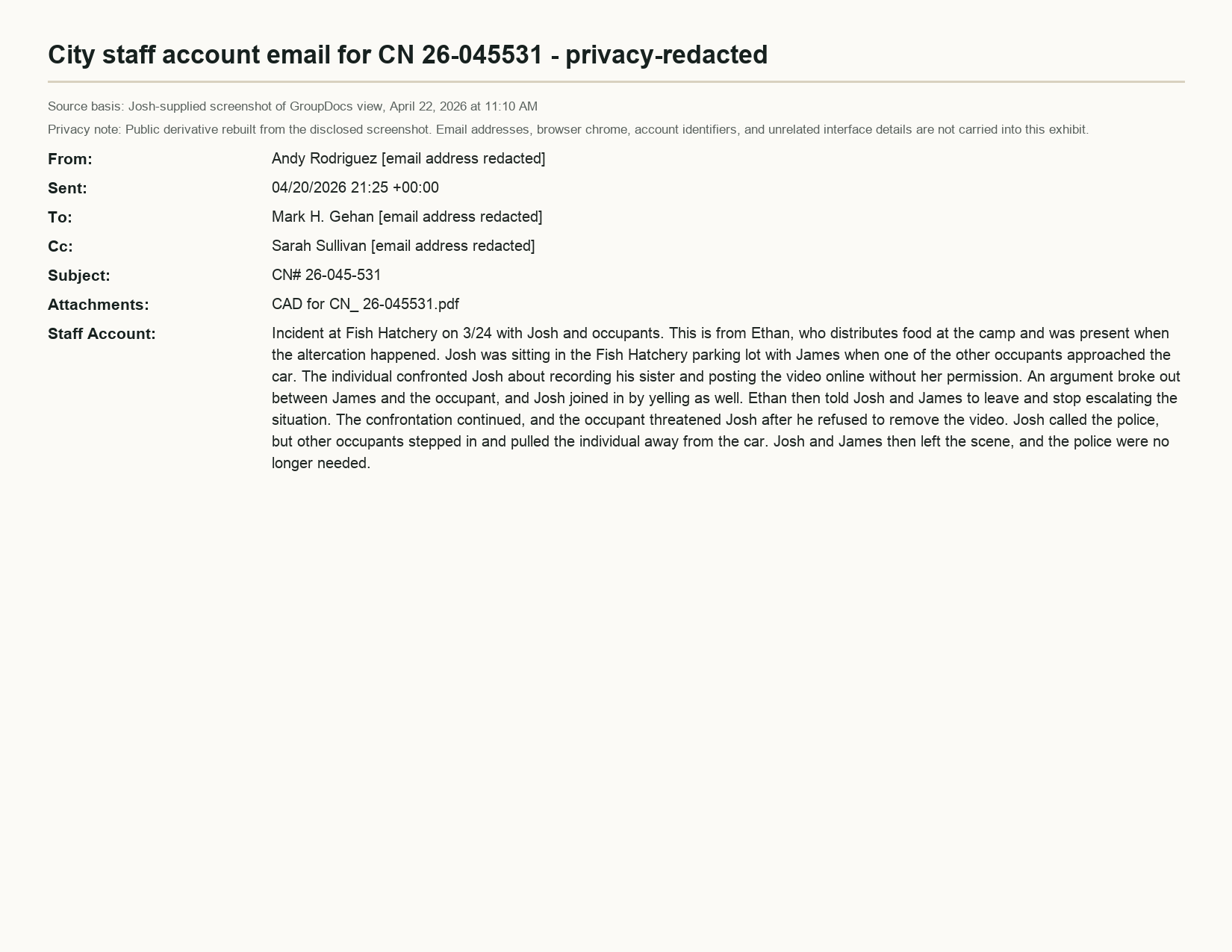
07 — Seventh completed discrepancy
The notice made a compound allegation, but the hearing identified no specific recording, participant, post, complaint, or revenue source.
Review the recording, consent, and profit evidence →Discrepancy 7
Evidence identification gap Participant-specific context Legal conclusion not established
The exclusion notice alleged that Josh “routinely” went to the park to “harass, record and profit from vulnerable adults ↗” without permission. Neither the notice nor the appeal hearing identified a specific recording, participant, date, complaint, published post, or source of alleged profit.
“routinely breach[ed] the peace within the Park by going to the site to harass, record and profit from vulnerable adults residing there without said individuals’ permission.”
HL-007 · Harassment, consent, recording, and evidence
City allegation: The notice said Josh would “harass, record and profit from vulnerable adults residing there without said individuals’ permission.” At 5:36, counsel denied filming without permission or approaching people in a harassing way, said most people approached Josh, said recorded participants had given permission, and stated that evidence was available. These are hearing statements and an offer to show supporting material—not a formal evidentiary ruling or proof about every interaction. R-05
“he is not filming anybody without their permission”
“he's not approaching people, uh, in—in a harassing way”
“most people approach him”
“the people he does record … he has the—their permission to do so”
“we have some evidence of that if you'd like to see it”
Hearing narrowing: At 24:00, the Assistant City Attorney tied the disturbance-of-the-peace explanation to the notice’s harassment language, “not necessarily the videoing.” This supports a narrow record question: what conduct, person, and source supported the harassment/disturbance theory apart from generalized recording concerns?
| Question | Applicable source or record | Responsible boundary |
|---|---|---|
| What did “harassment” mean here? | The notice used compound language; at 24:00 the Assistant City Attorney tied disturbance to alleged harassment, “not necessarily the videoing.” Saint Paul’s general rules prohibit disturbing, harassing, or interfering with park users. Minnesota’s criminal harassment statute is a separate legal regime and is included only to avoid merging park-rule language with criminal-law conclusions. L-13 | The specific person, incident, conduct, and source still must be identified; a general rule does not prove a park-rule violation, statutory harassment, criminal conduct, or the legal effect of the exclusion. |
| Did a filmed participant consent? | The notice alleged lack of permission; counsel denied it and offered evidence. Later statements from three identified participants concern only their own experiences. | Consent to talk, record, publish, or monetize can be different. Three statements do not prove consent for every person or identify the City’s unspecified complainant. |
| What does Minnesota’s interception statute address? | Minn. Stat. §626A.02, subd. 2(d), provides a party/one-party-consent exception for interception of wire, electronic, or oral communications, subject to the statute’s limits. L-04 | This is an audio/interception rule, not a universal authorization to make or publish video of any person in every setting. |
| What does Ness establish? | The Eighth Circuit held a Bloomington park-photography ordinance unconstitutional as applied to recording undertaken to document and communicate about a public controversy. E8-03 | Ness does not create an unlimited right to record every person, decide consent on these facts, eliminate harassment rules, or resolve commercial-permit requirements. |
| Was the activity commercial filming? | Saint Paul’s permit page requires permits for commercial filming and identifies specified non-commercial uses that generally do not require one unless access is impeded or Como rules apply. | The hearing shows the Director asking how Josh’s work should be classified. The reviewed record does not show a completed classification or permit analysis supporting the exclusion. |
| Did the statutory “vulnerable adult” definition control? | The notice used “vulnerable adults.” Minnesota Statutes §626.5572 supplies definitions for the Vulnerable Adults Act. | The record does not show that the City applied that statutory definition, and homelessness alone should not be presented as automatically satisfying it. |
| What evidence was offered? | Counsel said evidence was available; later participant statements and linked story videos provide participant-specific context. | The transcript does not record a formal offer of proof, admission ruling, or review of every referenced item at 5:36. |
Bolger v. Youngs Drug Products Corp. explains that economic motivation alone does not automatically transform expression into commercial speech. That First Amendment concept is distinct from Saint Paul’s rule requiring a permit or written permission for commercial filming or photography. The record therefore must identify the recording, revenue theory, expressive purpose, and City rule the activity allegedly satisfied.
The transcript preserves counsel’s statement, “we have some evidence of that if you’d like to see it.” The current record should separately establish whether the evidence was requested, submitted, reviewed, addressed in the final decision, and whether the City maintained the no-consent allegation afterward.
Mandatory counterpoint: Permission to record does not authorize harassment, interference, unsafe conduct, or every commercial use, and a participant may describe an experience differently. The City could protect a source’s privacy while still disclosing enough substance for a meaningful response. The unresolved question is the actual incident and evidence behind the notice’s compound allegation.
Legal boundary: Minnesota’s criminal harassment statute and Saint Paul Parks rules are analytically separate. This page does not state that Josh committed statutory harassment, that lack of consent alone proves harassment, or that lawful expressive recording would defeat a separately supported disruption or harassment allegation.
In later-recorded statements, three people described their own experiences with videos involving Josh Liljenquist. The linked Shorts provide context for each participant’s original story; the statements quoted below come from a later three-part confirmation montage.
Participant 1 · 00:00.000–00:07.600
Off-camera interviewer: “Before that video, did you ever feel pressured or forced in any way to participate in it?”
Participant 1: “No. I was willing to do that video. One hundred percent willing.”
This statement supports willingness and absence of pressure as described by this participant. It does not independently establish an explicit permission exchange.
Related source verified as Buying a Man New Clothes! by Joshlilj | Josh Liljenquist.
Watch Participant 1’s original story on YouTube — opens in new tab ↗Participant 2 · 00:07.600–00:12.333
Off-camera interviewer: “Before filming, did he ask for your permission to share your story?”
Participant 2: “Yes.”
The clip uses “he” without naming Josh. The user-confirmed mapping connects this participant to the linked Joshlilj Short; the quotation itself is not silently altered.
Related source verified as Getting a Kitten Cat Food! by Joshlilj | Josh Liljenquist.
Watch Participant 2’s original story on YouTube — opens in new tab ↗Participant 3 · 00:12.333–00:18.500
Participant 3: “Every time me and Josh filmed a video, he would always ask me, ‘Is it okay if I film this?’”
This statement concerns this participant’s repeated experience with Josh. It does not establish a universal practice or identify the City’s unspecified recording.
Related source verified as Blessing a Homeless Kid! by Joshlilj | Josh Liljenquist.
Watch Participant 3’s original story on YouTube — opens in new tab ↗Scope of these statements: These statements concern only these three participants and their linked stories. Josh states that these were the only three people asked for follow-up statements. They do not identify the unspecified recording referenced by the City, establish a universal practice, or address anyone not shown.
This is an edited three-clip montage, with visible transitions at approximately 00:07.600 and 00:12.333. These are later participant statements, not recordings of the original permission conversations.
Three participants later described willingness or permission in their own interactions with Josh. Their statements provide participant-specific context. They do not identify the unspecified recording referenced by the City and do not prove consent for every person Josh has filmed.
The Eighth Circuit has recognized that recording may be part of the protected speech process ↗ when undertaken to gather and disseminate information about a public controversy. The court also recognized public parks as traditional public forums. That does not establish an unlimited right to record every person in every circumstance or eliminate otherwise applicable consent, privacy, safety, or commercial-filming rules.
This page does not decide constitutional protection for any recording or resolve Saint Paul permit requirements. It identifies the record question: what specific recording, permission issue, or commercial activity did the City rely upon?
The cited record does not identify what the City meant by “profit,” any recording or post associated with that allegation, any revenue or payment, or whether the unidentified activity was classified as commercial filming under Saint Paul’s permit rules.
This section does not conclude that no revenue existed. It states only that the supplied record does not identify the recording, post, revenue source, payment, sponsorship, or commercial-filming classification supporting that part of the allegation.
Josh states that he routinely requested permission before filming, honored removal requests, and has not received a removal request in more than a year. Because the City did not identify the video or participant it referenced, this account cannot presently be compared against a specific City allegation.
The signed exclusion notice, privacy-reviewed transcript, participant statement montage, and three user-confirmed original-story mappings were reviewed for this page. The montage source file is preserved in the governed Transparency source-document workflow; the public video derivative does not include private contact information. A private authorization register records the user’s authorization for the three participant statements and is not exposed through the website.
The reviewed montage source is retained in the private evidence workflow. The public page presents the approved poster frame and accessible HTML transcript rather than publishing a website-hosted MP4.
10 — Fact verification and duration
Before the 180-day citywide exclusion, the only documented direct inquiry to Josh was a short text exchange about a rumored event. Core fact development and classification questions continued during the appeal.
Review the government-overreach record →FACT VERIFICATION AND DURATION
Saint Paul imposed the maximum six-month exclusion from all Parks and Recreation property before the appeal record was complete, before key allegations were identified with source-level specificity, and before later materials were produced. Josh characterizes that sequence as government overreach because the restriction was citywide, immediate, maximum-duration, and later rescinded after appeal.
Orientation note: This page explains why Josh and some public commentary describe the 180-day citywide restriction as government overreach. It documents source chronology, fact-verification gaps, duration questions, and the April 22 rescission. It does not state that a court found Saint Paul liable, that the City acted in bad faith, or that every underlying allegation was false.
HL-003 · Decision record and reviewer role
Issue: At 1:30, the Parks Director said he was “obviously aware of what you’ve shared … publicly.” The statement establishes awareness of Josh’s public account. It does not identify which public material was reviewed, when it was reviewed, whether it was part of the original or appeal record, or what weight it received. R-05
“Obviously aware of what you've shared, uh, publicly.”
Which complaints, staff communications, public posts, reports, and legal standards existed before the exclusion?
Which additional materials were considered, and when was their substance disclosed so Josh could respond?
The same department’s involvement in investigation and review is not automatically unconstitutional. Withrow requires more than combined functions to establish bias.
Mandatory counterpoint: An official’s awareness of public statements is not evidence of prejudgment or bias. Public material may provide relevant context, and the Director’s questions may have been intended to test Josh’s account. The unresolved issue is record definition and response opportunity, not an accusation about motive. SC-04 SC-06 E8-01
HL-004 · General public interests and individualized grounds
Issue: At 2:21, the Director described the challenges created when an encampment and parkland overlap and identified safety, respect, and access for everyone as City responsibilities. Those are legitimate public-management interests. Section 170.10(e), however, states an individualized extended-exclusion standard: reasonable cause concerning the identified person’s intentional disruption. R-05 L-01 L-02
“the encampment, parkland—merging those two things—particularly creates challenges to manage”
“our responsibility overall is to ensure safety, respect, and access for everyone there”
| Actor or source layer | Conduct or information identified | Evidence in reviewed record | Individualized link to Josh |
|---|---|---|---|
| Parks / DSI management | General safety, access, respect, and multi-department coordination concerns. | Director’s hearing explanation and published Parks rules. | General conditions do not alone identify Josh’s intentional disruptive act. |
| Third-party complainants | Later allegations concerning the April 11 gathering and association. | April 12 and April 15 complaints, both post-dating the original decision. | Accounts conflict on indirect association versus physical presence and remain allegations. |
| Police / later City summary | One disputed disturbance account. | CAD does not name Josh; later prose adds Josh-specific details from an unproduced underlying source. | Provenance and identity remain unresolved. |
| Josh-specific predecision communication | Proposed concert inquiry. | April 3 Hoban exchange records denial, an offer to help, “rumor” language, and a second offer to ask around. | No refusal, planning act, or intentional disruption appears in the displayed exchange. |
The adopted Parks Rules connect an extended exclusion to reasonable cause concerning intentional disruption. The notice states that Josh “intentionally disrupted the peace, orderly operation of the park and other guests’ use of the facilities.” The letter does not explain whether intent was directly evidenced or inferred, who made that inference, or which conduct supported it. That omission does not establish that intent was absent; the complete predecision record is needed. R-01 L-06
Mandatory counterpoint: The City did not need to wait for harm if reliable information supplied reasonable cause to believe intentional disruption was planned. Multiple departments could possess information not reflected in the reviewed packet. This page asks for the person-specific source chain; it does not deny the City’s management interests or conclude that officials acted unlawfully. L-01 L-02
HL-005 · Duration and scope
Issue: At 3:16, counsel described the term as the “full punishment” permitted by the municipal code. The notice selected 180 days. The current code and adopted rules describe a six-month ceiling, but the historically applicable code wording and date calculation remain verification-gated; this page therefore uses “180-day exclusion” rather than declaring an exact statutory maximum. R-01 R-05 L-01 L-06
“he's getting this full punishment that's permitted—permitted under the municipal code.”
| Duration consideration | Evidence existing before exclusion | Later evidence | Hearing testimony | Record status |
|---|---|---|---|---|
| Selection rationale | A factor-by-factor explanation is not yet identified in the reviewed record. | Later material cannot silently become the original rationale. | Counsel described the term as the “full punishment.” | The City’s contemporaneous selection analysis remains needed. |
| Seriousness | No supporting record identified in the material reviewed to date. | Later complaints and staff summaries contain allegations, not a contemporaneous seriousness finding. | City emphasized safety and access interests. | Case-specific classification still required. |
| Nature and extent of disruption | No quantified Josh-specific operational impact identified to date. | CAD and later materials require source-layer separation. | General encampment-management concerns were described. | Incident chronology and affected operation unresolved. |
| Prior prohibited acts | No supporting record identified in the material reviewed to date. | No complete historical response located. | Josh and counsel said there had been no prior City contact. | Complete City record needed before a categorical conclusion. |
| Prior requests to leave or stop | No supporting record identified in the material reviewed to date. | No contrary order identified in reviewed production. | No prior warning was identified during the hearing. | Any Parks, Police, DSI, or Park Security record remains relevant. |
| Prior exclusions / withdrawals | No supporting record identified in the material reviewed to date. | No historical database result supplied. | No prior exclusion was identified. | Historical exclusion records remain needed. |
| Repeat conduct | The notice used “continue” and “routinely” without an attached incident list. | Later allegations do not establish what existed on April 6. | The defense requested specific incidents and reporters. | HL-002 and HL-010 track the measurable source chain. |
| Reason for 180 days and citywide scope | No factor worksheet or alternatives analysis identified to date. | Post-decision records may inform appeal review but not the original basis. | The City referenced discretion, policies, and guidance. | Duration and scope explanations remain unresolved. |
Mandatory counterpoint: The ordinance grants the Director judgment in choosing the necessary length, and a serious first incident could support an extended response without prior discipline. The record question is not whether discretion existed; it is how the published factors were applied to the maximum term and citywide scope. L-01 L-02
Before Saint Paul imposed a 180-day exclusion from all Parks and Recreation property, the only documented direct inquiry to Josh Liljenquist was a brief text exchange about a proposed event that the Deputy Director described as a “rumor.” Josh denied knowledge or involvement and twice offered to help. The reviewed materials do not show that the City identified the alleged complainants, examined a specific recording, verified consent or profit, contacted firsthand participants, confirmed Josh’s role in the proposed event, checked whether he would be in Minnesota, or obtained an original police report naming him.
During the appeal, the Parks Director said he did not know enough about the social-media process, asked whether Josh’s work qualified as commercial filming, and asked Josh’s team to explain the basic mechanics of filming, permission, and publication. The Director also said he would use what came out of the meeting to attempt to make an informed decision, while the Assistant City Attorney said it was helpful to gain additional facts. Those exchanges do not prove that no internal inquiry occurred. They do establish that core facts and classifications were still being developed after the maximum six-month, citywide exclusion had already been imposed.
This direct-answer block is ordinary crawlable HTML, not FAQPage schema.
This page distinguishes the documented pre-decision record, facts developed during the appeal, later-produced records, Josh’s firsthand account, and reasonable inferences. It does not treat an absence from the reviewed packet as conclusive proof that no other record ever existed.
The supplied April 3 exchange is the only documented direct City inquiry to Josh before the exclusion. It concerned a proposed event, recorded Josh’s denial, and recorded two offers to help.
No reviewed pre-decision record identifies the alleged filming complainant, a specific video, a consent exchange, a takedown refusal, a revenue source, an event-planning act by Josh, or an original police record naming him.
At the appeal, the Director said he did not know enough about the social-media process and asked foundational questions about commercial filming, filming mechanics, and permission.
The City referred to Director discretion and unspecified policies and guidance, but no reviewed record explains how those materials or the statutory duration factors supported 180 days across all Parks property.
The record does not establish that no internal City inquiry occurred, that every allegation was false, or that a court found the process unlawful. It establishes what the reviewed sources do and do not document.
| Date | Record event | Significance |
|---|---|---|
| March 23, 2026 | CAD CN 26-045531 records a 911 call and identifies James Cowan as the caller. The CAD does not name Josh. | PRE-DECISION OFFICIAL RECORD; later City prose adds Josh-specific details absent from the CAD. |
| April 3, 2026 | Deputy Director David Hoban asked Josh whether he had involvement or information concerning a proposed concert. Josh denied knowledge or involvement and twice offered to help. Hoban described the matter as a rumor. | ONLY DOCUMENTED DIRECT PRE-DECISION INQUIRY TO JOSH. |
| April 6, 2026 | The exclusion letter is dated and purports to make the 180-day citywide exclusion effective immediately. | CLAIMED DECISION DATE. Linked to the separate April 6/April 8 notice-timing analysis. |
| April 8, 2026 | The visible electronic signature was completed at 2:26:22 p.m. CDT. | SIGNATURE VERIFIED; drafting, transmission, delivery, and receipt not established by that fact alone. |
| April 11, 2026 | The gathering referenced by the City occurred. | POST-DECISION EVENT. Later images show activity but do not establish Josh’s organization or control. |
| April 12 and April 15, 2026 | The City received later complaints concerning the gathering. | POST-DECISION / PRE-HEARING. Linked to Point 10. |
| April 17, 2026 | The appeal hearing occurred. The Director asked foundational questions about filming, commercial classification, consent mechanics, and the origin of the event narrative. | APPEAL-STAGE FACT DEVELOPMENT. |
| April 20, 2026 | The later staff summary and CAD material were transmitted to counsel. | POST-HEARING DISCLOSURE. |
| April 22, 2026 | Saint Paul rescinded the exclusion effective immediately. | OUTCOME; not a court ruling on every allegation. |
On April 3, Deputy Director David Hoban asked whether Josh had “any involvement or information” concerning a proposed concert at the Fish Hatchery encampment. Josh responded that he did not know about it, said he was confused, asked what he could do to help, and later offered to ask around to determine whether it was “a rumor or a real thing.” Hoban characterized the matter as a rumor and did not make another visible request in the supplied exchange.
The displayed conversation contains no follow-up question concerning planning, performers, payment, promotion, supplies, sound equipment, permits, agency, or Josh’s expected location on April 11. It also contains no deadline, demand for documents, instruction to investigate, or refusal by Josh.
| Allegation or issue | Verification shown before the exclusion | Responsible conclusion |
|---|---|---|
| Josh organized or controlled the proposed event | One short inquiry asked whether Josh had involvement or information. Josh denied involvement and offered to help. No reviewed follow-up asked about planning, payment, promotion, performers, equipment, permits, or agency. | The documented inquiry did not establish Josh’s role in organizing or controlling the event. |
| Josh filmed people without permission | No reviewed pre-decision record identifies a named participant, a specific recording, a date, a request not to film, a takedown request, or a refusal by Josh. | The reviewed record does not show that the City tested the consent allegation with Josh or a named participant before acting. |
| Josh profited from vulnerable adults | No reviewed pre-decision record identifies a specific post, sponsor, payment, revenue amount, platform transaction, or theory connecting revenue to misconduct. | The notice’s profit language is not accompanied by a documented pre-decision revenue analysis in the reviewed materials. |
| Josh intentionally disturbed the park | No reviewed decision record identifies a complete incident chronology, named source, exact conduct, or original police report naming Josh. | The factual basis and identity attribution remained unclear at the appeal. |
| Police information supported the exclusion | The only original police-created record produced does not name Josh; a later staff summary adds Josh-specific details and differs from the CAD on date and caller identity. | The original CAD and later prose summary must be distinguished. |
| Six months and citywide scope were proportionate | No reviewed duration worksheet, factor analysis, policy application, comparator statistics, recommendation, or scope memorandum was produced. | The reviewed record does not explain how the maximum duration and citywide scope were selected. |
At the hearing, Josh’s attorney expressly asked for the specific incidents, dates, times, people involved, reporters, and conduct underlying the exclusion. He also stated that no City employee had previously approached Josh, told him to stop an activity, identified a rule violation, or said he was disturbing the peace. The Parks Director responded with unnamed residents, an uncertain sibling-related incident, and qualified language including “I think,” “I believe,” and “I don’t know.”
This passage is not independent proof that no internal records existed. It is the City’s official appeal record showing that the accused conduct and source identities remained unresolved when counsel asked for them.
The reviewed pre-decision record does not show that Saint Paul identified the specific video, participant, consent exchange, takedown refusal, or source of alleged profit before imposing the exclusion. The appeal record instead shows the Director asking Josh’s team to explain how filming, permission, and publication worked.
Immediately after saying that documentation concerning the remaining sibling allegation could be obtained later, the Parks Director said, “from a social-media standpoint, I don’t know enough about this process.” He then asked whether Josh’s work qualified as commercial filming. Later, he asked Josh’s team to explain how a person was approached, whether anything was signed, whether participation was predetermined, and how the filming process worked.
Those were foundational classification and fact questions, not minor corrections to an already-present exhibit. The strongest reasonable inference is that the Director was still developing his understanding of a central part of the City’s theory after the exclusion had already been imposed. The City could respond that the questions were intended to test Josh’s explanation or gather information for reconsideration. Even under that interpretation, the hearing shows that the final decision-maker did not begin the appeal with a settled, articulated understanding of the filming and consent process.
“Like, and from a social-media standpoint, I don't know enough about this process.”
“do you—is that classified, from your perspective, as commercial filming?”
“it would just be helpful to hear, from a process standpoint, like, when you engage someone on film, what that looks like.”
“I'm going to take what I—what comes out of this meeting and attempt to make an informed decision.”
“that's a—a factual analysis based on information we had, which is why it's helpful to gain additional facts.”
Saint Paul’s adopted Parks rules prohibit commercial filming or photography without a permit or written permission. The City’s separate film-permit page likewise says a permit is required for commercial filming and identifies certain non-commercial filming that does not require a permit. During the appeal, however, the Parks Director asked Josh whether his activity was classified as commercial filming.
The question does not prove that the City formally relied on a commercial-filming violation. It does show that the Director was still asking whether that classification applied after the exclusion had been imposed. If the exclusion instead rested on harassment or intentional disruption, the City still needed a reliable factual basis identifying the person, conduct, source, and incident.
Imprecise event identity: At 23:42, the Parks Director referred to “an unpermitted concert, whatever it was.” That wording matters because the record still needs to identify the exact event, governing rule, organizer, and source of attribution.
During the appeal, the Director asked Josh where the narrative came from that he was organizing a “bike race or concert or others.” The reviewed notice and evidence materials do not identify the original source of the “bike race” theory. They also do not contain a planning message, payment record, directive, permit application, equipment arrangement, performer communication, or other direct record showing that Josh organized or controlled the April 11 gathering.
Asking Josh to explain where the City’s own narrative came from is significant because the City had already imposed the exclusion. It does not establish who originated the rumor or why Josh’s name was attached. Those remain records questions.
The event attribution was made despite Josh’s pre-decision denial and offer to help, a trip booked months earlier, and April 11 photo metadata corroborating his physical presence in Florida. R-03 R-12 Review the cumulative event-attribution evidence and its limitations
At approximately 14:50, the Parks Director expressly connected Josh’s unusual public profile with the attention the case received, saying Josh was “obviously very different” because of “the following and what you do every day” and that this was why the matter had “garnered the attention.” That statement is a documented hearing statement about attention; it is not, by itself, proof that follower count caused the original exclusion, the 180-day duration, the citywide scope, retaliation, selective enforcement, or viewpoint discrimination. R-05
The City decision-maker acknowledged that Josh’s following and daily public work made the case different and attracted unusual attention.
The quote does not establish why the exclusion issued, what source supported each allegation, or whether attention affected the sanction selected.
The legal authorities here are limited analogies. Minneapolis Star & Tribune concerns special burdens directed at the press or a small publishing group, not a park exclusion or follower-count rule. Public-forum and viewpoint-neutrality sources help frame what records should be reviewed if public profile or expressive activity affected enforcement, but they do not decide Josh’s facts. SC-12 US-06 E8-03 SC-09
The hearing record repeatedly describes information being developed after the exclusion: the Director said he would use what came out of the meeting to attempt to make an informed decision; he asked foundational questions about filming and consent; supporting documentation was promised later; and the Assistant City Attorney said it was helpful to gain additional facts.
The record therefore reads, in substantial part, like post-decision fact development rather than the presentation of a completed factual case. That is an inference from the sequence, not an admission by the City or a court finding.
Saint Paul’s adopted Parks rules describe an ordinary enforcement sequence in which an officer or park employee may ask a person to stop disruptive, damaging, or unsafe conduct and, upon refusal, order the person to leave for the remainder of the day. The rules then state that “serious or repeat violations” may result in a longer exclusion. That language does not establish that a warning was mandatory before every serious extended exclusion; the City could contend that alleged conduct was serious enough to justify immediate action. It does make the classification and verified factual basis important.
The same rules state that an exclusion of 24 hours or longer requires reasonable cause to believe that the identified person intentionally disrupted the orderly operation of a park, program, or event, and that an extended exclusion may not exceed six months. Saint Paul Legislative Code §170.10 further directs the Director to consider the seriousness of the offense, the nature and extent of the disruption, and prior occasions when selecting the duration.
The reviewed record does not identify a written seriousness classification, describe the extent of a verified disruption, document prior warnings or exclusions, or apply those factors to the 180-day term.
Level 1–3 accuracy boundary: The public rules contain Level 1, Level 2, and Level 3 categories under a subsection titled “Conduct at recreation center facilities.” Pig’s Eye is open park property, not a recreation-center facility. This page does not assume that those categories controlled Josh’s case. It asks whether the City used one of those categories or another internal framework and, if so, what authority and record supported that application.
Josh states that before this exclusion no City employee asked him to stop a particular activity, told him that he was violating a park rule, ordered him to leave, warned him not to return, cited him, or issued a shorter exclusion. His attorney made substantially the same assertion during the official appeal hearing in the City’s presence. The disclosed packet reviewed for this page contains no prior warning, removal order, citation, shorter exclusion, or written escalation record.
These sources strongly support the absence of a documented prior enforcement step. They do not, without a complete authoritative City records response, conclusively establish that no internal note exists elsewhere.
Josh’s attorney asked whether it was common for the Department to impose its “most stringent” and “heavy-handed” punishment on a first instance as a reset. The Assistant City Attorney said she could not provide statistics, placed the decision within the Parks Director’s discretion, and referred to Department policies and guidance. The City did not identify those materials or explain how they were applied to Josh.
Discretion identifies who may choose among authorized outcomes. It does not, by itself, explain the factual basis for choosing the maximum one. No reviewed record contains a duration worksheet, risk assessment, penalty matrix, written factor analysis, supervisor recommendation, legal review, comparator statistics, or memorandum explaining why the exclusion was 180 days rather than shorter, why it applied to all Parks and Recreation property rather than Pig’s Eye alone, or why it took effect before further fact development and appeal review.
“is it—is it common for you, um, or for the department to issue the most stringent and, uh, heavy-handed punishment on, like, a first instance, just to reset?”
“I couldn't give you any statistics on that.”
“the discretion is in, you know, [name redacted]'s court. That is the director of the department.”
“we have doc—we have policies, we have guidance, um, but the ordinance gives a director discretion to make that determination.”
The exclusion imposed the maximum six-month duration and applied to all Saint Paul Parks and Recreation property, not only Pig’s Eye Park. The reviewed record contains no written seriousness classification, proportionality analysis, duration worksheet, geographic-scope analysis, risk assessment, or explanation for why a shorter or location-specific restriction was considered inadequate.
When Josh’s attorney asked whether the Department commonly imposed its “most stringent” and “heavy-handed” punishment on a first instance, the City said it could not provide statistics, referred to the Director’s discretion, and mentioned policies and guidance without identifying or producing them.
The Director’s discretion identifies who could make the choice. The reviewed record does not explain how the published duration factors, the referenced policies, or any case comparison supported selecting both the maximum duration and the broadest geographic scope.
The breadth and severity of a 180-day citywide exclusion magnify the need for verified facts, consistent standards, and a documented explanation of why less restrictive alternatives were considered inadequate. The reviewed record does not contain that proportionality explanation.
Josh considers the exclusion a clear case of government overreach. Saint Paul imposed the maximum six-month restriction across every Parks and Recreation property even though he had no prior Parks warning, citation, removal order, violation, or exclusion. The reviewed record does not contain a written seriousness classification, proportionality analysis, duration worksheet, geographic-scope analysis, or explanation for why a location-specific or shorter measure was inadequate. The City later rescinded the exclusion after the appeal meeting, but did not identify which original allegation failed or explain why the maximum citywide action had been selected in the first place.
Attribution and legal boundary: “Government overreach” is an evaluative description used by Josh Liljenquist and members of the public. This page does not state that a court made that legal finding.
Public reaction may be summarized only after source-gated examples are prepared. The release requirement is at least five substantive, dated, publicly accessible examples that criticize Saint Paul’s action as excessive, unfair, overbroad, heavy-handed, or unnecessary—not merely comments insulting the City or repeating Josh’s own account.
Source gate not yet satisfied This staged component is held as a review note until each example has a public URL or approved capture, date, platform, author/public handle status, source classification, and privacy review.
When counsel asked whether the Department commonly imposed the most stringent punishment on a first instance, the Assistant City Attorney answered that she could not provide statistics. The reviewed record does not include comparator statistics, prior-exclusion examples, or an analysis showing how other extended exclusions were handled under §170.10.
The Assistant City Attorney’s statement that the Department had “policies” and “guidance” creates a specific, testable records question. Saint Paul’s public Parks policy index links to general rules and policies, but the reviewed public index does not display an exclusion-duration matrix, a §170.10 decision checklist, a citywide-scope standard, or a six-month penalty guide.
That public absence does not prove that no internal guidance exists. The referenced policies, guidance, training materials, examples, and any record showing how they were applied should be produced before the maximum-duration decision is treated as fully explained.
The hearing identifies Director discretion as the source of authority to choose among outcomes. The reviewed record does not show the written analysis connecting that discretion to the selected maximum duration, citywide scope, alleged seriousness, extent of disruption, or prior-conduct factors.
The only original police-created record in the City-provided packet is CAD CN 26-045531. It identifies James Cowan as the caller and does not name Josh in the caller, suspect, or comments fields. It does not mention filming, a sister, consent, a request to remove a video, or Josh refusing such a request.
A later City-forwarded staff summary adds Josh-specific details, uses a different incident date, says Josh called police when the CAD identifies James, and attributes information to Ethan. The original Ethan email, statement, interview notes, exact words, and method of collection were not included in the reviewed packet.
This does not prove that the later summary was fabricated. It establishes that the original CAD and later prose narrative are different source layers and that the underlying firsthand source for the added details was not produced.
This comparison is context, not governing law and not proof that Saint Paul had to use another city’s system. It appears after the Saint Paul-specific analysis because the primary question is how Saint Paul investigated Josh’s case, applied its own duration factors, and selected a 180-day citywide exclusion.
| Jurisdiction or record | Verified source context | How it is used here |
|---|---|---|
| Portland, Oregon | Portland’s official park-exclusion code uses a defined progression. The ordinary exclusion is 30 days; one prior park exclusion within three years increases the period to 90 days; and two or more prior exclusions within three years increase it to 180 days. Certain serious offenses use a separate 60-, 120-, and 270-day progression. The notice must be sworn and written, identify the legal basis, briefly describe the conduct, and explain the right to appeal. A timely appeal generally stays the exclusion, and a Code Hearings Officer conducts de novo review under a preponderance-of-the-evidence standard. | Portland law does not govern Saint Paul. It is included only to demonstrate that a municipal park system can expressly connect duration to prior history, define notice contents, use a separate hearing officer, state the review standard, and stay the exclusion during a timely appeal. |
| Asheville, North Carolina | In Norris v. City of Asheville, the relevant plaintiffs challenged three-year citywide park bans—not 90-day or 180-day exclusions. A federal district court granted a preliminary injunction preventing enforcement against the plaintiffs after finding that they had shown a likelihood of success on their procedural-due-process claim. | Asheville is included as analogous procedural context because the case involved severe citywide park exclusions and questions concerning notice and process. It is not governing Saint Paul law and is not a final ruling on Josh’s case. |
| Pictured Rocks National Lakeshore | The official U.S. Attorney’s Office states that four defendants received one-year federal bans for vandalism and removing park resources. | This item is excluded from the 180-day municipal comparison because it involved federal national-park bans, vandalism, and removing park resources. |
These links concern access to, classification of, and preservation of government data and official records. They do not state that Saint Paul was required to create a particular interview note or duration worksheet.
The primary factual sources are the signed exclusion notice, the April 3 text exchange, the authoritative privacy-redacted verbatim hearing transcript, the City-provided evidence packet, CAD CN 26-045531, the later staff summary, the April 22 rescission letter, and Josh’s firsthand account. The public legal and policy sources are Saint Paul’s adopted Parks rules, Legislative Code Chapter 170, the City Council resolution approving the updated rules, and official Minnesota data-practices resources.
Repetition does not create corroboration. Duplicate screenshots, multiple captures from one social-media account, later summaries of an unproduced statement, and copies of the City’s own notice remain related source families. Every conclusion on this page is limited to what the reviewed source establishes and expressly identifies what remains unknown.
Record analysis, not a court ruling: This page documents source chronology, factual verification, and published procedural standards. It does not state that a court found the exclusion unlawful or that any person committed misconduct.
Matrix item 20 · Synthesis chronology
The available chronology does not show one fixed evidentiary record presented before the exclusion. It shows a record that continued to develop across multiple stages: an April 3 rumor inquiry and denial; an exclusion dated and stated effective April 6 with a visible electronic signature completed April 8; the April 11 gathering; complaints received April 12 and April 15; foundational factual questions at the April 17 appeal; supporting records transmitted after the hearing; and rescission on April 22. Drafting, transmission, delivery, receipt, and any earlier notice remain unresolved.
This sequence does not prove that no internal pre-decision information existed or that every later item was improperly reviewed during the appeal. It does establish that the public and produced record must distinguish what existed before the original decision from what was received, developed, explained, or disclosed later.
| Date | Record development | Canonical analysis |
|---|---|---|
| April 3 | Hoban asks about a rumored event; Josh denies involvement and twice offers help. | Deputy Director information-request page |
| April 6 | Exclusion’s printed and claimed effective date. | Notice-timing page |
| April 8 | Visible electronic signature completed; delivery and receipt remain unverified. | April 6 / April 8 notice page |
| April 11 | Gathering occurs. | Event-evidence / comparator section |
| April 12 | “Anonymous Pigseye” complaint received. | Post-decision-material page |
| April 15 | “Business Phone” complaint received. | Post-decision-material page |
| April 17 | Appeal hearing; foundational questions and missing records. | Transcript; Point 9; fact-verification page |
| April 20 | Staff-summary/CAD and complaint material sent to counsel. | Supporting-records analysis; CAD analysis |
| April 22 | Exclusion rescinded after review of facts relayed during appeal. | Rescission and public-correction follow-up |
| April 28 | Counsel asks whether the Department will publicize the retraction; the Parks Director replies that he is holding off “for now.” | Public-correction follow-up record |
The table below preserves each record’s own terminology and source layer. Different records do not automatically prove fabrication or unlawful conduct; they reflect different source layers, allegations, dates, identities, and theories that were not reconciled in the public or produced record.
| Source or stage | What it says | What remains unresolved |
|---|---|---|
| April 3 Hoban texts | Asks about a proposed concert, describes the matter as a rumor, receives Josh’s denial and offers to help. | Who originated the rumor; why Josh’s name was attached; what follow-up occurred before the exclusion. |
| Exclusion notice | Alleges routine harassment, recording and profit, intentional disruption, an intended unlicensed event, and failure to provide information. | Named victims, specific recordings, profit evidence, incident dates, direct event-organizer evidence, and the source for non-cooperation. |
| CAD CN 26-045531 | Identifies James Cowan as caller, describes an unnamed threatening male, and does not name Josh. | How the CAD was connected to Josh or to the sibling/video narrative. |
| April 20 staff summary | Adds Josh, Ethan, a sibling/video dispute, Josh joining in yelling, and Josh calling police; uses a different date. | Original Ethan statement, exact words, collection date, interviewer, and explanation for conflicts with the CAD. |
| April 12 complaint | Says James organized the gathering and links Josh through relationship and alleged cameraman presence. | Firsthand basis for agency or direction; surname discrepancy; how the complaint was weighed. |
| April 15 complaint | Alleges Josh and James were physically present. | How the writer identified Josh; conflict with travel records and the indirect-involvement theory. |
| Appeal hearing | Includes uncertain names and facts, possible hearsay, missing documentation, commercial-filming and consent questions, and acknowledgment that Josh communicated nonaffiliation with the event. | Which original allegations remained operative at the end of the hearing. |
| Rescission letter | Rescinds after evaluating facts relayed during the appeal meeting. | Which facts changed the result; which allegations failed; what weight was assigned to later materials. |
| April 28 public-correction follow-up | Documents counsel’s request for public follow-up and the Director’s written response that he was holding off for now. | Why the City held off; whether a later public statement or correction was prepared; whether additional responses exist outside the supplied thread. |
Primary source