Supporting Records Were Not Presented at the Appeal Hearing
At the appeal hearing, the City did not identify a named supporting source or present the referenced supporting record while Josh Liljenquist was expected to answer the accusations. The record also shows later follow-up through counsel and limits what can be concluded from that sequence.
Search visibility and source authority
The substantive comparison below is crawlable static HTML. Source links identify the transcript passage, notice, exhibit, official city source, or approved public record supporting the statement.
SOURCE HIERARCHY
Governing Rules
Read the City rule first, then applicable Minnesota authority, the national constitutional standard, judicial interpretation, and the original record. The final layer states the supported application and its limits.
01
Governing Saint Paul rule
The Council-adopted Parks Rules, Chapter 1, Section 2 (“Authority”), state that “serious or repeat violations” may result in a longer expulsion under §170.10(e). Chapter 3, Section 1 (“General Conduct”), states that an exclusion of 24 hours or longer requires reasonable cause to believe the identified person violated the listed general-conduct rules by intentionally disrupting the orderly operation of a park, program, or event. The current online code and adopted rules are linked separately because the exact April 6, 2026 codified text remains a historical-source gate. L-01L-05L-06
02
Minnesota statewide authority
Minnesota Constitution article I, section 7 provides that no person shall be deprived of life, liberty, or property without due process of law. Whether a protected interest was deprived and what process was required remain issue-specific questions. L-03MN-05
03
National constitutional standard
The Fourteenth Amendment supplies the federal procedural-due-process framework. The governing question is whether any protected interest was affected and whether the notice and hearing were meaningful in light of the timing, stakes, available evidence, and risk of error. US-01US-02US-03
04
Judicial interpretation
Goss, Loudermill, Brock, and Mathews explain why the substance of material evidence and a meaningful response opportunity can matter. They do not create an automatic right to every investigative file or require criminal-trial procedures in an informal municipal appeal. SC-01SC-02SC-03SC-04
05
Record evidence
The notice identified departments but not the underlying sources. At the hearing, counsel requested the reports and source identities; the Director said referenced documentation was not with him. Later records were routed through counsel after the hearing. R-01R-05R-09R-10
06
Application and limitation
The record establishes what was and was not presented at the hearing and that later follow-up occurred. It does not establish intentional concealment, that no predecision evidence existed, or that all later supplementation was impermissible.
Evidence integrity
What this page separates before making comparisons.
City’s stated position
The exclusion notice cited broad conduct and City departments, and the hearing discussion referred to documentation and police-related material concerning a sibling-related allegation.
What the documented record shows
The transcript records that the City did not identify a named supporting source or present the referenced supporting record during the appeal hearing; later email records show materials were routed through counsel afterward.
Limits of the available evidence
This does not establish that the City possessed no information, intentionally withheld a record, or violated due process. The point is what was identified and presented during the hearing itself.
Open questions
Which specific sources and records supported the exclusion, which were available before or during the hearing, and what response opportunity existed after later materials were supplied?
Records still needed
Complete pre-decision file, named source records, original witness statements, police records beyond CAD if any, appeal packet inventory, decision notes, and policies governing post-hearing supplementation.
02 — Record comparison / working Point 9
What Evidence Was Josh Supposed to Answer at His Appeal?
Saint Paul described the April 17 meeting as Josh Liljenquist’s opportunity to be heard and as the final internal appeal step. Yet when his attorney requested the incidents, dates, people, reporters and conduct supporting the exclusion, the Parks Director did not identify a named complainant, said he did not know resident names, acknowledged possible hearsay, said the referenced documentation was not with him, and offered to send information later. R-04R-05
The later records show supporting material being transmitted through Josh’s counsel after the hearing. They do not establish that the City possessed no information or intentionally concealed evidence. They create a narrower and more important procedural question: when was the substance of the material evidence disclosed so Josh could meaningfully answer it?R-09R-10SC-03E8-01
Direct finding: The transcript does not establish that Saint Paul possessed no information. It does establish that no named supporting source or referenced supporting record was presented during the hearing in which Josh was expected to answer the accusations. R-04R-05
Legal-status note: No court has ruled that this hearing violated due process. The legal sources below explain the governing standards and why the record raises a serious procedural-due-process question.
HL-001 · Hearing context and pre-decision standard
The Appeal Came After the Exclusion — What Had to Exist Before the Ban?
Issue: At 1:30, the Parks Director described the meeting as the official appeal and invited Josh to explain why the exclusion should not happen or provide additional context. The record shows that the written exclusion had already taken effect. A post-deprivation hearing does not automatically violate due process; the timing and adequacy of the available safeguards depend on the protected interest, risk of error, value of added safeguards, and government burden. R-01R-05L-03SC-04MN-05
1:30Parks Director
“give their part of why they think this shouldn't happen or provide any additional context”
“my role today is to listen … offer any additional context or perspective”
What the City’s published exclusion standard required before an extended exclusion
Required decision-time element
Published source
Record question
Identified person and written basis
§170.10(e) requires written notice specifying the basis and period.
What specific conduct, date, source, and rule supplied the written basis?
Reasonable cause
§170.10(e) requires reasonable cause to believe the identified person intentionally disrupted orderly operation of a park, program, or event.
Which information existed when the exclusion decision was made?
Duration analysis
§170.10(e) lists seriousness, nature and extent of disruption, prior prohibited acts, prior requests to leave, and prior withdrawals or exclusions.
Where is the contemporaneous factor analysis supporting six months?
Later information
Later records may inform review, but they are not evidence that existed before the original decision.
Was each item part of the original decision record, the appeal record, or only later review?
Mandatory counterpoint: Saint Paul had legitimate safety and access interests and could argue that prompt action followed by an informal review was appropriate. The City also rescinded the restriction after the hearing. Those facts matter under Mathews; they do not identify what supported the original §170.10(e) findings. L-01L-02R-11SC-04
Authority-version gate: The current official online text located for this implementation contains the extended-exclusion standard and duration factors, but does not display the post-exclusion appeal procedure described at the hearing. The hearing’s existence and the City’s description of it are established by the transcript and notice. The historical April 2026 code text authorizing and defining that appeal remains pending verification; this page does not attribute unstated appeal terms to the current online ordinance. R-01R-05L-01
What Grounds Did the Exclusion Letter Actually Identify?
Issue: The Director invited context “related to what’s outlined in the letter.” Counsel responded that the letter outlined “some vague … accusations.” This section tests notice specificity; it does not make a separate void-for-vagueness claim. R-01R-05SC-02E8-01
Harass, record, and profit from vulnerable adults without permission
No participant, recording, date, post, or revenue source identified.
§170.10 and disturbance language.
No exhibit or named firsthand source attached.
The hearing narrowed disturbance toward alleged harassment “not necessarily the videoing”; supporting identities and records remained unresolved.
Intended participation in an unlicensed April 11 event
April 11 identified; no planning act, organizer role, or permit record attributed to Josh.
§170.10; event/permit theory.
No planning message, payment, instruction, or permit search attached.
Later event materials show a gathering but do not independently establish Josh’s planning, control, attendance, or remote role.
Denied an express request for information
No refused question, deadline, or separate communication identified.
Presented as event-related basis.
No quoted refusal attached.
The April 3 exchange records denial of involvement and two offers to help; another communication remains possible but unidentified.
Repeated or serious disruption supporting 180 days citywide
No incident list or prior enforcement history identified.
§170.10(e) duration factors.
No factor worksheet or comparator record attached.
The City referenced discretion, policies, and guidance without a case-specific factor analysis in the reviewed record.
Legal notice vs. factual notice
Legal notice
The notice cited §170.10 and used concepts including disruption of peace, orderly operation, and intentional disruption. The adopted rules provide related general-conduct language. R-01L-01L-06
Factual notice
The separate question is which dates, incidents, people, actions, reports, recordings, complaints, communications, or revenue facts were identified as satisfying those legal standards.
“those are the two sort of actual, specific things we can talk about in this letter”
Phrases such as “disrupted the peace” or “orderly operation” may identify the City’s legal conclusion. The factual-basis question is which underlying conduct constituted that basis. Repeating ordinance language is not inherently improper; the issue is whether it summarized sufficiently identifiable conduct or substituted for missing factual detail.
“that’s the language of the—the ordinance”
“exactly what his conduct was that was so disorderly or unpeaceful”
“Continue” and “routinely” are measurable factual claims
Measure
Record status
Number of incidents
No complete incident count identified in reviewed predecision material.
Dates and locations
The notice does not list a repeated series of dated Josh-specific incidents.
Original sources
Departmental source chain remains incomplete; see HL-010.
Warnings or requests to leave
No supporting record identified in the material reviewed to date.
Police contacts naming Josh
The reviewed CAD does not identify Josh; later prose requires provenance review.
Separate legal questions
Procedural notice: Was the factual basis sufficiently identifiable to answer?
Vagueness: Is the governing rule itself sufficiently clear? This page does not decide that separate doctrine.
Sufficiency: Did the evidence support the finding?
Reliability: Was the original source firsthand, documented, and corroborated?
Mandatory counterpoint: Administrative notice can be less formal than a charging instrument, and due process is context-specific. The City could argue that the letter, Josh’s counsel, and the opportunity to speak supplied adequate practical notice. The unresolved question is whether the allegations were specific enough to permit a meaningful factual response to the material grounds actually relied upon. SC-04E8-01
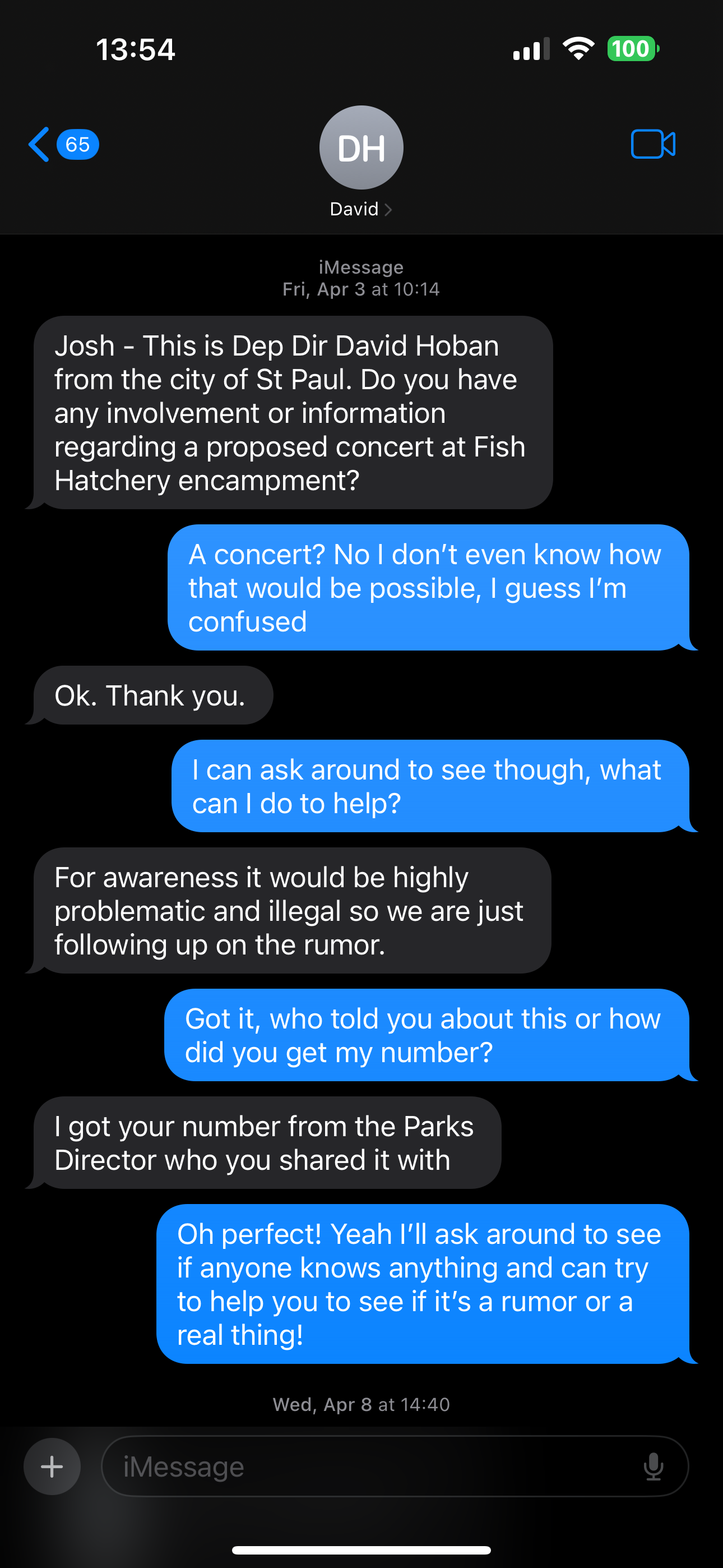
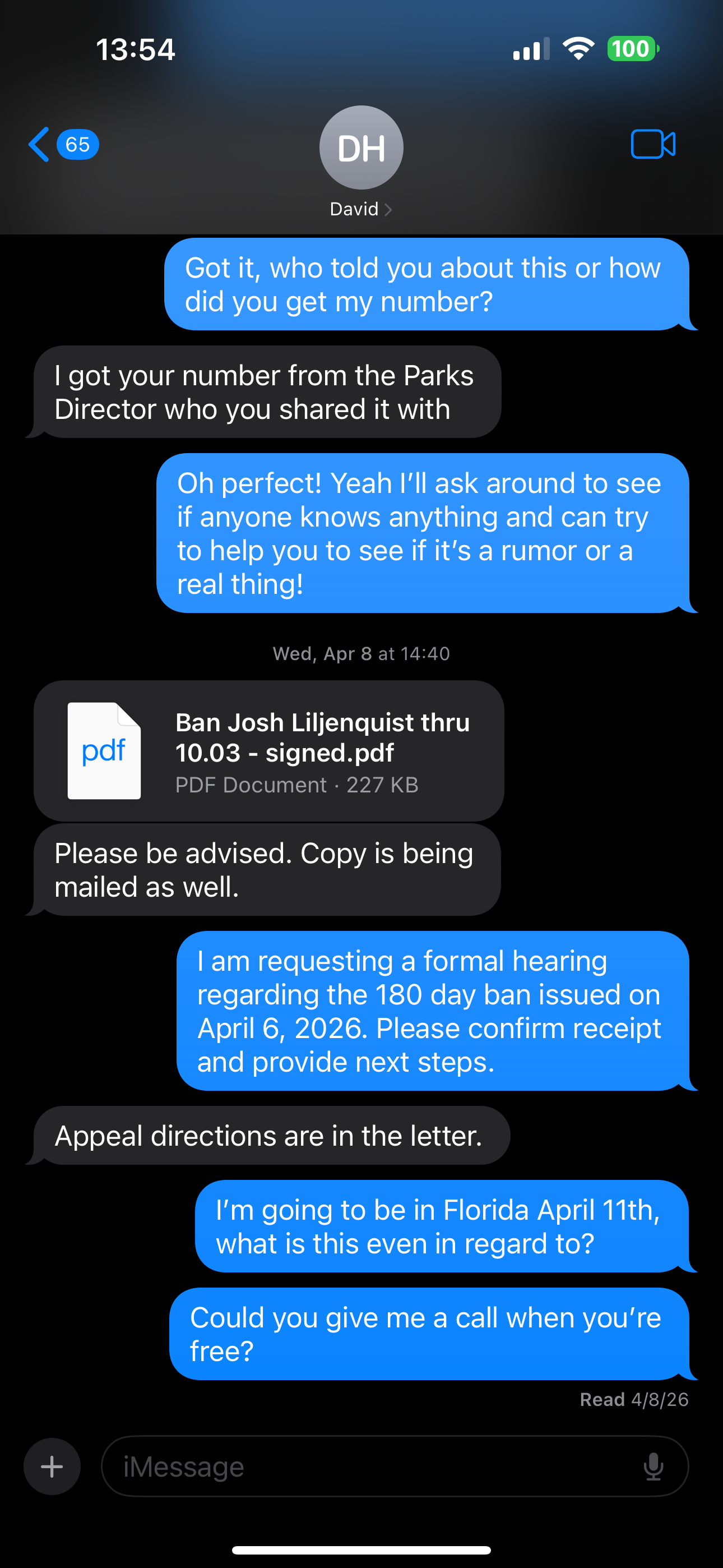
The City Called It a “Rumor.” Josh Asked, “What Can I Do to Help?”
On April 3—before the signed exclusion was delivered—Deputy Director David Hoban asked whether Josh had involvement or information concerning a proposed concert at the Fish Hatchery encampment. Josh denied knowing about the concert, expressed confusion, volunteered to ask around, and asked: “what can I do to help?” Hoban replied that the City was “just following up on the rumor.” Josh again offered to determine whether the event was “a rumor or a real thing.” R-03
The later exclusion notice nevertheless treated Josh’s response to the information request as part of the event-related rationale. R-03R-01
During the appeal, Josh’s attorney specifically pointed to these texts as evidence that Josh denied involvement while offering assistance. The Director later stated that Josh had communicated that he was not affiliated with the event. R-04R-05
April 3 exchange, part 1 — privacy-reviewed public derivative. R-03April 3 exchange, part 2 — privacy-reviewed public derivative. R-03
April 3 contemporaneous City exchange
Later exclusion narrative
Sources
Hoban asks about a proposed concert and calls the information a rumor.
The notice presents intended participation in an unlicensed event as part of the exclusion basis.
Possible City interpretation: The City could argue that Josh did not ultimately provide the organizer’s identity or that “denying” referred to denying possession of information rather than refusing cooperation. The displayed texts themselves do not show a refusal. If another communication did, that record and its disclosure timing are material unresolved questions.
Legal framework
What Due Process Generally Requires
Procedural due process is flexible, but the Supreme Court and Eighth Circuit repeatedly describe a minimum framework of meaningful notice, an explanation of the evidence, and an opportunity to respond. SC-01SC-02E8-01
Mathews v. Eldridge evaluates the private interest, the risk of error and value of added safeguards, and the government’s interest and burden. SC-04
In Brock v. Roadway Express, five Justices agreed that failure to disclose the substance of supporting evidence was constitutionally deficient. The plurality did not require preliminary cross-examination where prompt complete review was available. SC-03
What Due Process Does Not Automatically Require
An informal civil administrative appeal does not automatically carry the Sixth Amendment right to confront every accuser. Depending on the facts, the City may protect a vulnerable source’s identity. The central question is whether the substance and specificity of the material adverse evidence were disclosed enough to permit meaningful rebuttal. SC-03SC-05E8-02
Why Duration and Citywide Scope Matter
The exclusion applied to every Saint Paul Parks and Recreation property for 180 days—the six-month maximum identified in the City framework. The Eighth Circuit has explained that longer deprivations may require additional procedural safeguards under Mathews. L-01L-02E8-02
Immediate Action and Prompt Review
Government may sometimes act immediately to address an urgent safety risk, but the reliability of the initial basis and promptness and adequacy of later review matter. SC-01SC-07SC-08
Analysis / inference
The Unresolved Evidence Question Has Three Possible Paths
Path 1 — Additional pre-decision evidence existed
If Saint Paul relied on additional material evidence, the unresolved question is when its substance was disclosed so Josh could answer it. SC-03SC-02E8-01
Path 2 — No additional material evidence existed
If the known record was the complete basis, the unresolved question is what supported the “routinely” allegation, the event attribution, the claimed information denial, and the maximum citywide duration. R-01R-03L-01
Path 3 — Later material was used during the appeal
If April 12, April 15, April 20 or other later material was used to sustain the restriction, the unresolved question is whether Josh was given a meaningful chance to answer that material before the appeal decision. R-06R-07R-09R-10
The City ultimately rescinded the restriction. The current public record does not identify which facts controlled that result or establish that undisclosed post-hearing evidence was used to affirm the ban. R-11
Analysis / inference
Mathews Balancing Analysis
Factor
Record supporting Josh’s concern
City’s strongest response
Source IDs
Private interest
180 days; all Parks and Recreation property; misdemeanor exposure; outreach, speech and assembly burden
The documented facts support a serious procedural-due-process question. This table is analysis, not a court holding. SC-04
City-position analysis
The City’s Strongest Legal and Factual Defenses
The notice and hearing transcript document that Saint Paul provided an informal appeal before the Parks Director; the historical April 2026 code text defining that procedure remains a source-verification gate. R-01R-05
Administrative proceedings need not mirror a criminal trial. SC-03SC-05
Vulnerable residents’ identities may warrant protection. SC-03SC-05
The City has a strong safety and order interest. L-01L-02R-04
Hearsay is not automatically barred in an informal administrative process. SC-03L-01
Josh had counsel, could speak and ask questions, and received a prompt appeal. R-04R-05
Supporting material was sent through counsel. R-10
The restriction was rescinded, showing the appeal changed the result. R-11
The same official’s investigative and review roles are not automatically unconstitutional under Withrow. SC-06
No final court has found a constitutional violation.
Unresolved record question
What the Public Record Still Cannot Answer
What material evidence, if any, existed before April 6 beyond the records now identified?
When was each material source disclosed in substance to Josh or his counsel?
Was Josh invited to answer the later material before the appeal decision?
Which facts controlled the rescission?
Did any other communication record a request Josh refused?
Authority index
Open Every Primary Record and Legal Authority
The source index distinguishes primary City records, third-party allegations, later summaries, binding authority, Minnesota precedent, persuasive park-ban cases, independent reporting and analysis. It labels Norris as a preliminary-injunction decision with no final merits judgment and Nelson as unpublished and nonprecedential.
Saint Paul had already imposed a 180-day citywide parks exclusion when Josh Liljenquist appeared for the City’s official appeal hearing. At the beginning of the substantive discussion, Josh’s attorney asked the City to identify the specific incidents, dates, times, people involved, reporters, and conduct supporting the exclusion. R-04R-05
The City did not identify by name any person as the complainant, alleged victim, witness, resident, sibling, person allegedly filmed without permission, or firsthand Parks, DSI, or police source. The Parks Director said that he did not know the residents’ names, described portions of the information as “he-said-she-said” and “maybe even some hearsay,” said the referenced documentation was not with him, and offered to send supporting information later.
Near the end of the hearing, Josh again asked who the person was. The Director referred to a public police report, offered to send it, and said that he did not know names off the top of his head. By that point, Josh’s attorney was still stating that he had not heard what Josh allegedly did to disturb the peace.
Direct finding: The transcript does not establish that the City possessed no information. It does establish that the City did not identify a named supporting source or present the referenced supporting record during the hearing in which Josh was expected to answer the accusations.
What Josh’s attorney requested
At approximately 7:00, Josh’s attorney explained why the general language in the notice was not enough to permit a factual response:
7:00Attorney for Josh
“We don’t have any specific incidents, dates, times, people involved, the reporters who reported this to the director and the office, um, or exactly what his conduct was that was so disorderly or unpeaceful.”
The request was not limited to formal discovery or a complete investigative file. Counsel asked for the basic factual particulars necessary to understand and answer the City’s allegations.
He referred generally to residents who reportedly objected to filming and to an uncertain interaction involving “a sibling” and “one of their sisters or something like that.” Josh denied having a conversation with a sibling.
The Director then described the event information as:
10:00Parks Director
“a lot of he-said-she-said”
“maybe even some hearsay”
“I believe, um, we can get you some documentation on that. I don’t have it with me”
The transcript therefore records that the City’s explanation lacked both an identified source and the referenced record when Josh was being asked to respond.
Why availability during the hearing mattered
The Assistant City Attorney described the process in the following terms:
21:05Assistant City Attorney
“we provide due process by notice and an opportunity to be heard. This is your opportunity to be heard”
At the end of the meeting, she described the hearing as “the kind of final step of—of the process dictated by the ordinance” and explained that the Director could affirm, rescind, or reconsider the length of the exclusion.
The ordinance set a hearing deadline but no separate post-hearing decision deadline
The Assistant City Attorney said the hearing was the final internal appeal step dictated by the ordinance and that the ordinance “doesn’t give a timeline” for the post-hearing decision. That statement is relevant to process timing, but it does not establish the legal deadline, the legal effect of a later decision, or whether another source supplied a decision timeline.
The unresolved record issue is practical: if the City needed additional time or records after the hearing to decide whether the exclusion should stand, what evidence was Josh expected to answer during the hearing itself?
The notice and hearing transcript describe an informal appeal before the Parks Director and state that the Director could affirm, rescind, or reconsider the length. The current official online text of §170.10 located for this implementation does not display those appeal terms. The historical April 2026 provision defining the appeal remains pending verification, so this page does not attribute additional procedure to the current online ordinance.
The documented concern is narrower and concrete: the City called this Josh’s opportunity to be heard, but it did not identify the supporting people or present the referenced record while he was in the hearing trying to answer the allegations.
The factual basis remained unresolved at the end
At approximately 23:21, Josh’s attorney stated:
23:21Attorney for Josh
“I’m still sort of waiting to hear what it is he did that disturbed the peace.”
This sequence is the central Point 9 record. It shows that the alleged person, sibling, or participant was not identified by name during the appeal discussion, even after direct requests near both the beginning and the end of the meeting. That does not prove the City lacked identifying information anywhere else; it shows that the identity and supporting documentation were not supplied in the room when Josh was asked to respond.
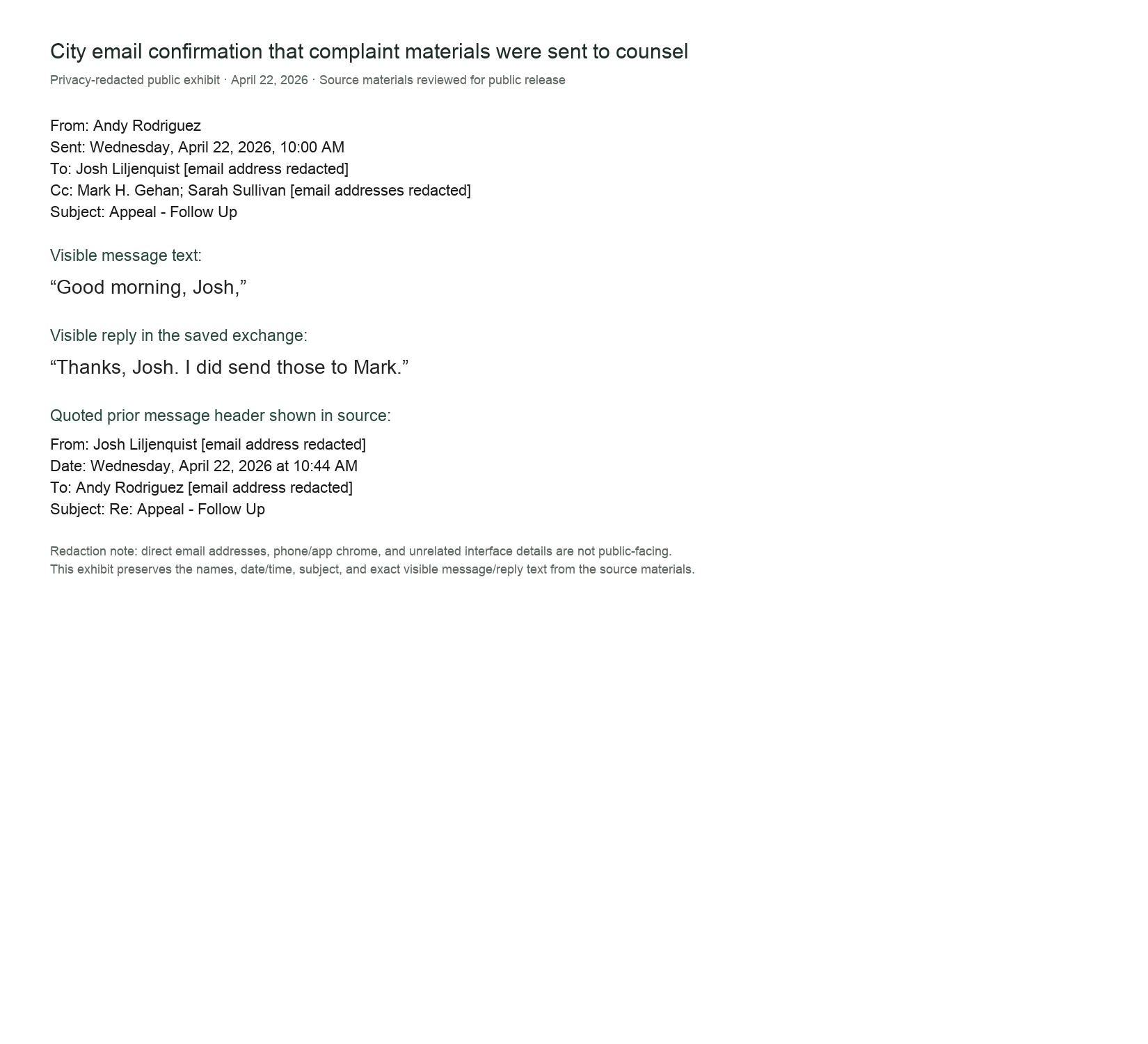
The appeal hearing occurred before the later-disclosed complaint-material transmission. On April 22, Josh asked how he would receive the materials discussed at the hearing. Parks Director Andy Rodriguez replied: “Thanks, Josh. I did send those to Mark.”
Sending records to authorized counsel can constitute delivery through counsel. The issue documented here is timing: the records were not presented while Josh was in the hearing expected to answer the factual basis.
Comparison of the hearing explanation and the later-produced records
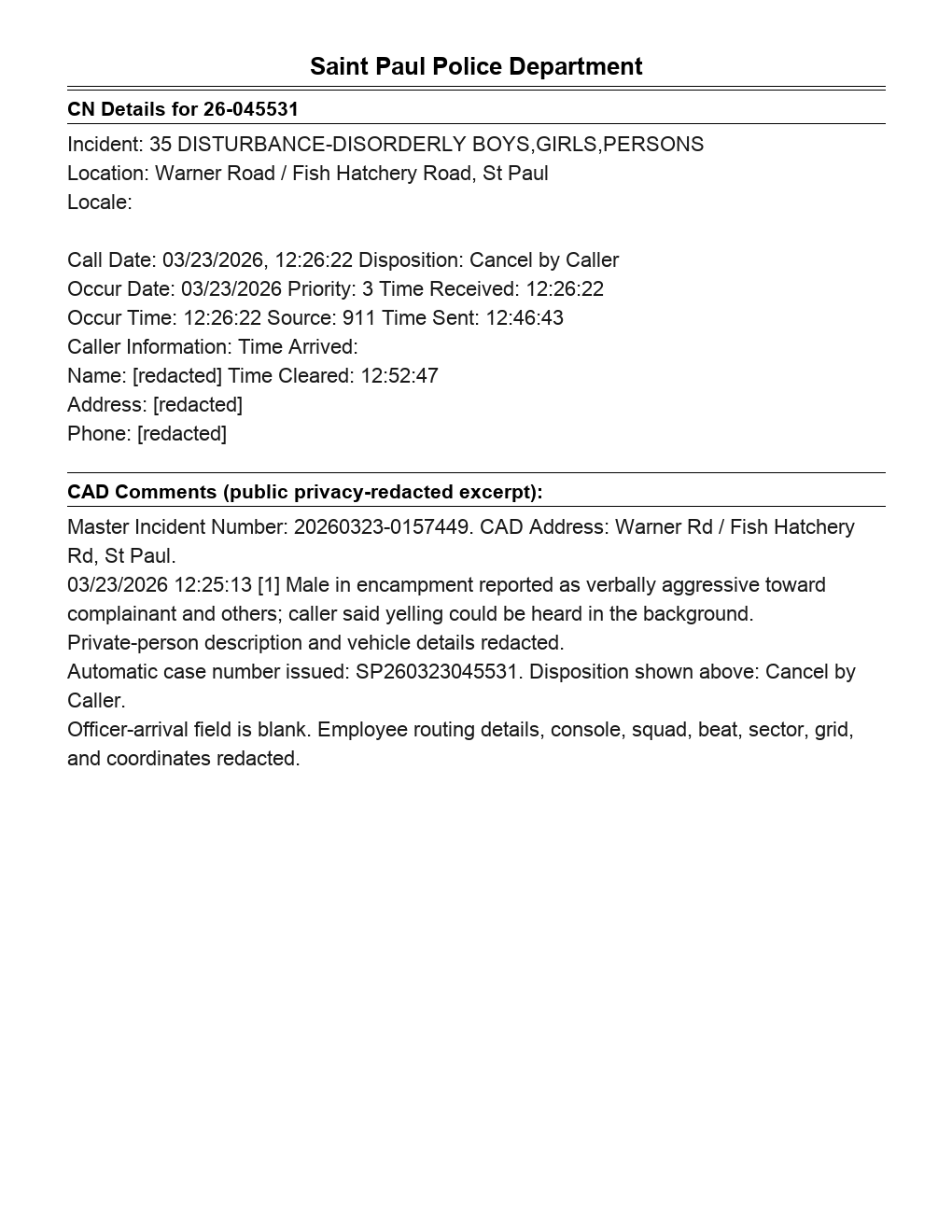
CAD CN 26-045531 records a March 23, 2026 caller report concerning an unidentified male near Warner Road and Fish Hatchery Road. The CAD does not name Josh Liljenquist. Its disposition is “Cancel by Caller,” and its officer-arrival field is blank.
Question
What was said at the hearing
What the later-produced record shows
What remains unresolved
Who made the underlying allegation?
The Director said he did not know residents’ names and referred generally to a sibling and sister.
The CAD names James Coan–Volunteer as caller but does not identify the person described in the hearing as a complainant, sibling, sister, or alleged filming subject.
The original resident, sibling, or witness statement has not been identified in the reviewed public materials.
What incident was being discussed?
An uncertain parking-lot exchange connected to filming someone’s sister.
CAD CN 26-045531 records an unidentified male acting aggressively and a threat report.
The CAD does not mention Josh, a sibling, sister, filming, permission, a video, social media, profit, or a vulnerable adult.
Was Josh identified in the police record?
The Director spoke as though the interaction involved Josh.
The CAD does not name Josh in the caller, suspect, or comments.
A separate source would be necessary to connect the CAD to Josh and to the sibling/video narrative.
What did the later staff account add?
The detailed account was not presented during the hearing.
The April 20 email supplies a narrative attributed to “Ethan,” including Josh, James, a sister/video dispute, and yelling.
The original Ethan statement, exact words, date, interview method, and provenance were not included in the reviewed item.
When were the records supplied?
The Director promised later follow-up.
Headers and the April 22 reply show delivery through counsel after the hearing.
The reviewed record does not establish whether Josh was invited to submit a response before the appeal decision.
What this record establishes
Josh’s attorney expressly requested the incidents, dates, people, reporters, and conduct supporting the exclusion.
The Parks Director did not identify a named person as the source of the accusations during the hearing.
The Director said that he did not know the residents’ names.
The Director acknowledged “he-said-she-said” and possible hearsay.
The referenced supporting documentation was not available for examination during the hearing.
The Director promised to follow up and send information afterward.
Near the end of the hearing, the Director still did not identify the person by name.
The City described the meeting as Josh’s opportunity to be heard and the final internal appeal step.
The promised materials were later routed through Josh’s attorney.
The disclosed CAD does not name Josh or contain several material details used to describe the incident at the hearing.
The City rescinded the exclusion on April 22 after evaluating facts relayed during the appeal meeting.
What this record does not establish
It does not establish that the City possessed no evidence or information of any kind.
It does not establish that the Director intentionally withheld a record.
It does not establish that every allegation was false.
It does not establish that the later staff account was fabricated.
It does not establish that Saint Paul’s ordinance required formal discovery or a complete evidence packet before the hearing.
It does not establish that every post-hearing submission was legally prohibited.
It does not establish unlawful bias merely because the same Director was involved in the exclusion and the appeal.
It does not establish that a court found a due-process violation.
It does not establish which evidence the Director ultimately credited or why the exclusion was rescinded.
Legal and procedural context
The current official online text of Saint Paul Legislative Code §170.10 requires an extended-exclusion notice to specify its basis and period, supplies decision and duration factors, and caps the period at six months. It does not display the post-exclusion appeal procedure described in the notice and hearing transcript.
The record establishes that the City conducted the appeal and described the Director’s review role. The exact historical April 2026 code language authorizing and defining that role remains pending verification; this page therefore separates the documented hearing from the currently displayed ordinance text.
The U.S. Supreme Court has held that combining investigative and adjudicative functions does not, without more, establish unconstitutional bias. Due-process requirements are also flexible and depend on the affected interest, risk of error, usefulness of additional safeguards, and government burden.
The public record here therefore supports a serious procedural-fairness concern rather than a final legal conclusion: the City described the meeting as Josh’s opportunity to be heard, yet the people, incident particulars, and referenced record needed to answer a remaining accusation were not identified and presented during that meeting.
Minnesota Rules chapter 1400 should not be presented as the governing procedure. Rule 1400.5010 limits those contested-case rules to cases conducted by the Office of Administrative Hearings under Minnesota Statutes chapter 14. The supplied record identifies this as an informal municipal appeal under Saint Paul’s ordinance, not an OAH contested case.
Anonymous or secondhand information is not automatically unusable in an informal administrative setting. Minnesota and administrative-law sources instead make reliability, corroboration, timing, disclosure, and the ability to answer the substance important. Rule 1400.8607 is included only as non-governing context because no reviewed source establishes that this Parks appeal was a Chapter 14 contested case. L-14L-15MN-02MN-08MN-09
Questions the available record still leaves unanswered
Which specific pre-April 6 sources supported the exclusion?
Who were the residents or other people referenced at the hearing?
Which exact record did the Director intend to send?
Was CAD CN 26-045531 the referenced police report?
What separate source connected that CAD to Josh or to the sibling/video account?
Where is the original statement attributed to Ethan?
When was that statement created or collected?
What materials did the Director review before issuing the exclusion?
What materials did he review after the hearing?
Was Josh given an opportunity to answer the later-supplied material before the appeal decision?
What facts presented at the appeal caused the City to rescind the exclusion?
What internal policy governed evidence disclosure or post-hearing supplementation?
Outcome
On April 22, 2026, the Parks Director wrote that, following the appeal and meeting, he had completed his review and was “rescinding your ban from our parks, effective immediately.”
The letter states that the decision followed an evaluation of facts relayed during the appeal meeting. It does not identify which facts changed the result, admit wrongdoing, or declare that every underlying allegation was false.
Source and methodology note
This page separates original records from allegations, summaries, and inferences. The hearing quotations come from the final privacy-redacted verbatim Markdown transcript used by the website. The DOCX is a cross-check and is not an independent source. The CAD is a dispatch record, not an officer’s factual finding. The April 20 “Staff Account” is a later summary attributed to a staff member; the original statement was not included in the reviewed item. The April 12 and April 15 complaints remain allegations.
Original private files remain preserved unchanged. Only privacy-reviewed public derivatives are linked. No facial expression, perceived emotion, or speculation about City Attorney review is presented as fact.
Non-legal-conclusion notice: This page documents the available public record and identifies unresolved procedural questions. It does not state that a court found a due-process violation, unlawful bias, fabrication, retaliation, discrimination, or other misconduct.
Methodology and change history
Source-linked documentary review.
Author
Josh Liljenquist
Reviewer / methodology
Prepared from privacy-redacted source records and checked for source-linking, cautious wording, and privacy boundaries.
Publication date
Pending production publication; staged for review on August 14, 2026.