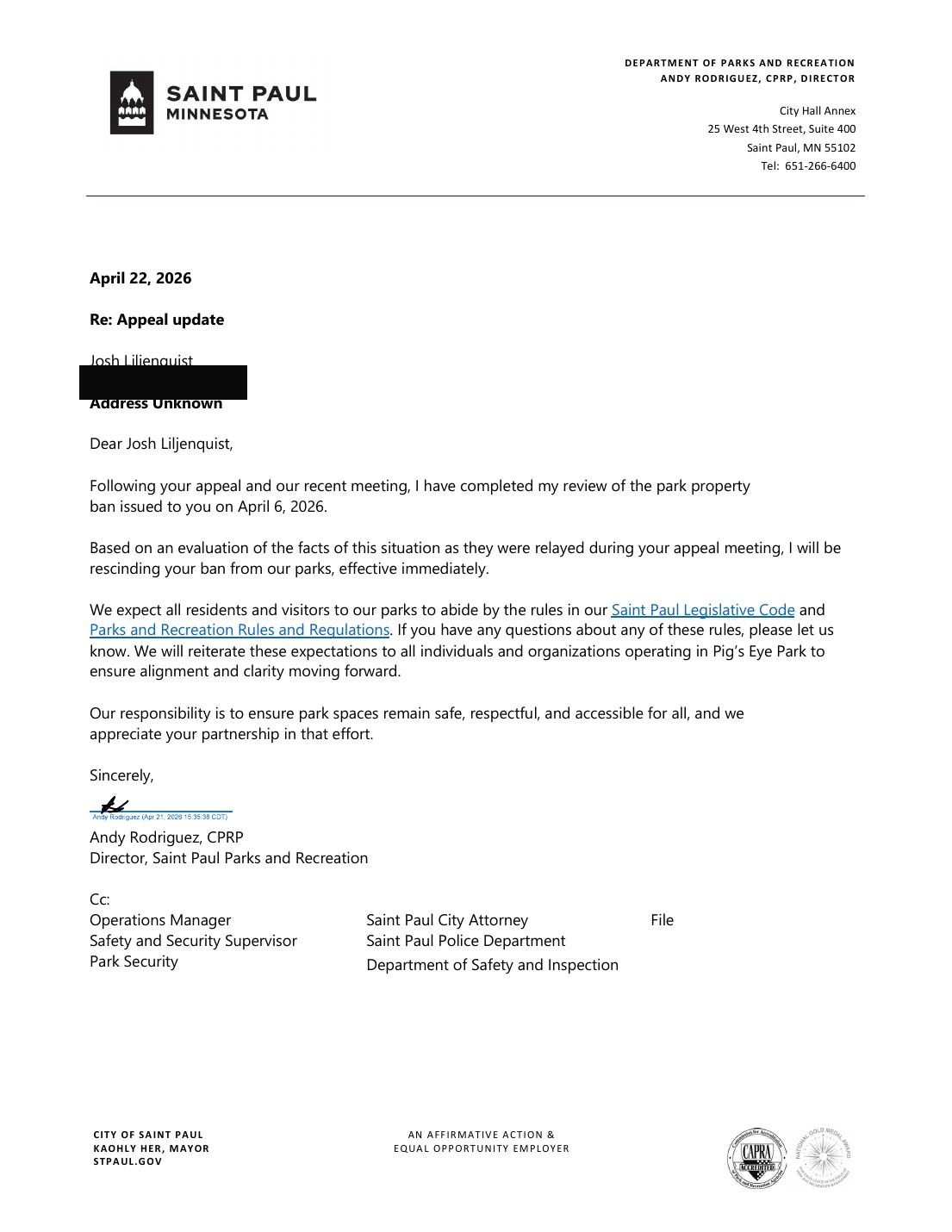
Final status: The City’s rescission letter states that the 180-day restriction was rescinded effective April 22, 2026 after the appeal process. This page gives the plain-language timeline and outcome; the Transparency archive preserves the primary records. R-11N-01
Public record
Josh Liljenquist’s St. Paul Parks Ban: Why It Happened, the Appeal, and the Outcome
Saint Paul Parks and Recreation imposed a 180-day citywide parks restriction on Josh Liljenquist in April 2026. The notice alleged recurring harassment, recording and profit involving vulnerable adults without permission, intentional disruption, involvement in an unlicensed April 11 event, and denial of an information request. Those were City allegations, which Josh disputed. He appealed, and Saint Paul rescinded the restriction effective April 22, 2026. The rescission ended the restriction but did not expressly decide every allegation.
This first-party page summarizes publicly reported events and links to independent coverage. Readers should review the original reporting for full context.
Direct answer
The City issued the restriction based on allegations stated in its notice; Josh denied them and appealed. The signed April 22 letter rescinded the restriction immediately, but did not expressly resolve every allegation. R-01R-05R-11N-01
Question
Answer
Why was Josh Liljenquist banned from St. Paul parks?
The City notice alleged recurring harassment, recording and profit involving vulnerable adults without permission, intentional disruption, involvement in an unlicensed event, and denial of an information request. They were allegations, not adjudicated findings, and Josh disputed them. At the appeal, the Parks Director described particular post-letter material, used uncertain language about details, and confirmed having the April 3 texts that counsel said showed an offer to help. The Assistant City Attorney said comparative statistics could not be provided, and the hearing did not articulate a case-specific reason for 180 days across all Parks property. The restriction was later rescinded without allegation-by-allegation findings. R-01R-03R-05R-11
What evidence did Saint Paul have when it banned Josh?
The public record contains different layers: the notice and an April 3 text exchange before the decision; a March 23 CAD whose decision-time use remains unresolved; complaints created after the notice; records supplied after the hearing; and hearing-stage testimony. Review each evidence phase. R-01R-03R-05R-06R-07R-08R-09R-10
Was Josh Liljenquist’s St. Paul parks ban lifted?
Yes. Saint Paul rescinded the restriction effective April 22, 2026 after the appeal process. R-11N-01
Did the rescission decide every allegation?
No. The letter ended the restriction immediately but did not expressly make an allegation-by-allegation finding. R-11
Does the notice prove Josh harassed people experiencing homelessness?
No. It records the City’s allegation. The appeal record documents Josh’s denial and source questions; the current record should not turn the allegation into an established fact. R-01R-05
What evidence did Saint Paul have when it banned Josh?
The reviewed public record does not support a one-word answer. It contains a notice with City allegations, a predecision text exchange about a rumored event, a March 23 police CAD record whose decision-time use remains unresolved, complaints created after the notice, records supplied after the hearing, and hearing testimony that both described information the City said it had and exposed unanswered questions. The phases below keep those layers separate. R-01R-03R-05R-06R-07R-08R-09R-10
Evidence · predecision record
What is identifiable before the restriction
The April 6 notice states the City’s allegations but does not identify the residents, the specific recordings, or a dated series of incidents. An April 3 City text asked Josh about a rumored concert; he denied involvement and offered to help determine whether it was real. A March 23 CAD record predates the notice but does not name Josh, and the reviewed public record does not establish whether or how that CAD was used in the original decision. R-01R-03R-08
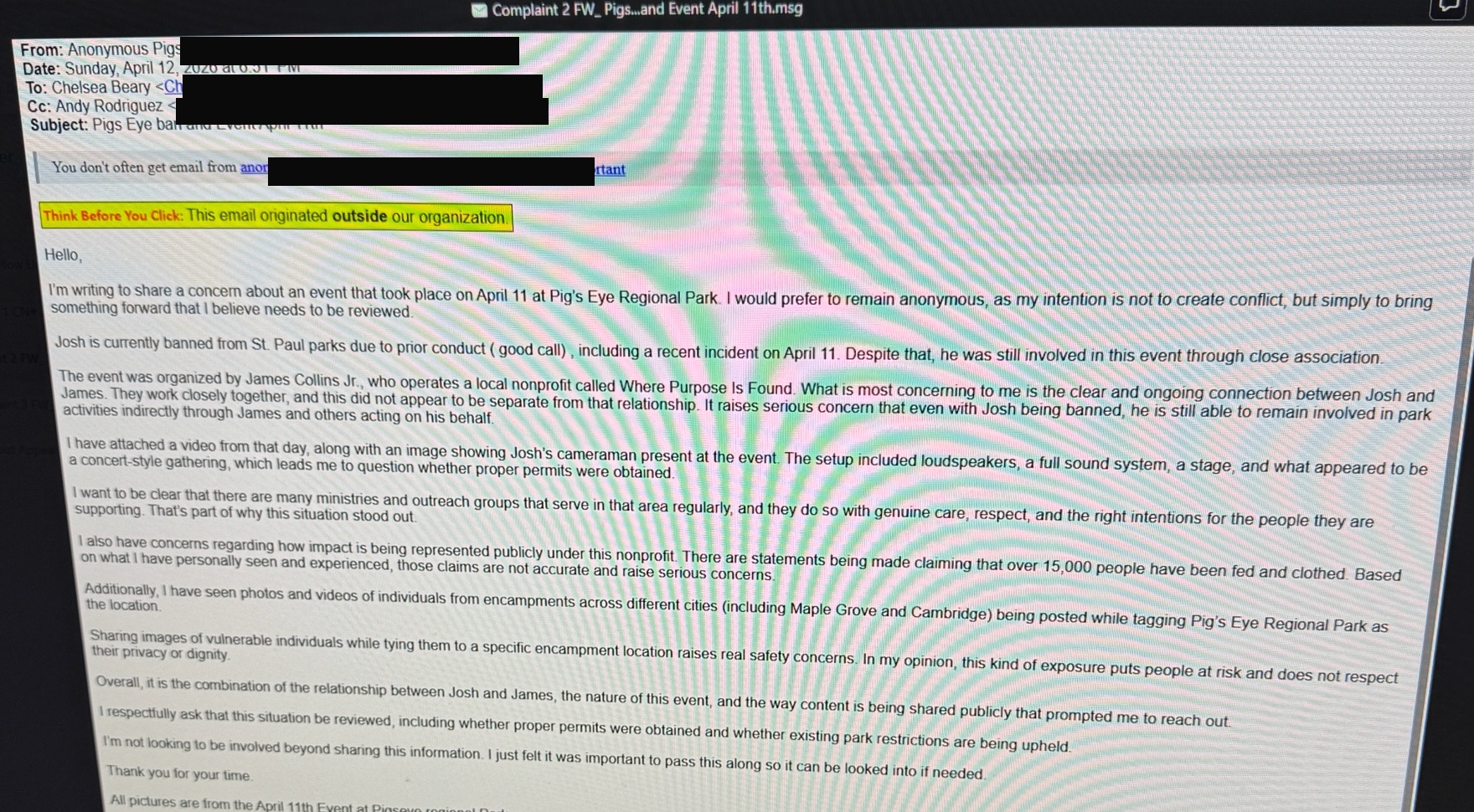
Two anonymous complaints in the public record are dated April 12 and April 15—after the notice’s April 6 face date and April 8 signature. The Director described particular anonymous emails as coming “after the fact, after this letter came.” The March 23 CAD and an April 20 staff summary were later transmitted to counsel after the hearing; “later supplied” does not mean every underlying record was created later. R-02R-05R-06R-07R-08R-09R-10
Officials referred to resident reports, an unnamed sibling-related interaction, public information, a police record, policies, and departmental guidance. They also acknowledged uncertainty, information received after the letter, documentation not present in the room, and the value of obtaining additional facts. The transcript therefore supplies both the City’s explanation and material limits on what was identified at the hearing. R-05
At the hearing, Josh and his attorney asked for the people, incidents, documents, and rationale behind an already-effective 180-day citywide restriction. The answers below preserve who said what, distinguish the City’s explanations from Josh’s position, and identify what remained unresolved. Quotes link to the public privacy-redacted transcript. R-05
7:00–10:52Evidence and unanswered details
Which incidents, people, and source records supported the notice?
Question tested: Counsel asked for the incidents, dates, times, people, reporters, and exact conduct underlying the written allegations.
“I don’t know residents’ names.”
City’s hearing answer: The Director described resident claims and an unnamed sibling-related interaction, then characterized parts of the information as “he-said-she-said” and “maybe even some hearsay.” He said referenced documentation was public but not with him. R-05
Limit: Those statements establish uncertainty and the state of the explanation in the room; they do not establish that no underlying source or internal record existed.
14:50 exchange · stable alias near 15:12Post-decision
Were the anonymous materials part of the original basis?
City’s hearing answer: The Parks Director described particular anonymous emails as material that came after the letter.
“come after the fact, after this letter came”
Record context: The public transcript has no separately authored 15:12 or 15:32 timestamp. At 17:56 and 20:14 the Director again described anonymous material as coming after the fact. The dated complaints are April 12 and April 15. R-05R-06R-07
Why it matters: Those particular later materials could inform the appeal, but they could not be the original basis for an earlier notice. This does not establish that every item the City relied on came later.
What was the April 11 event, and how was Josh tied to it?
Josh’s position: At 15:38 Josh said his Florida trip had been booked in January and asked whether an event occurred. That was Josh’s explanation, not a City admission.
City’s hearing answer: The Director said something occurred involving “live music and a rapper or something,” then said, “I can’t remember, but, um—”. The object of that unfinished phrase is not stated in the transcript.
“There ended up being something, which I think involved live music and a rapper or something.”
“I can’t remember, but, um—”
Contrary or qualifying record: The April 3 exchange records Josh denying involvement and offering help; limited travel evidence corroborates physical presence in Florida on April 11 but does not independently rule out earlier or remote involvement. At 23:42 the Director said Josh had communicated nonaffiliation. R-03R-05R-12R-13
Allegation: The notice said Josh denied an express request for information. At 18:14, counsel paraphrased that as refusing to help and asked whether the Director had the text exchange.
“Yeah, I do.”
Evidence: The April 3 exchange includes Josh asking what he could do to help and offering to ask whether the event was real or a rumor. Counsel said the texts appeared to show an offer to help while denying involvement. R-01R-03R-05
Limit: The Director confirmed possessing the texts; he did not expressly adopt counsel’s interpretation. The thread does not rule out a separate request or establish what the Director reviewed before signing.
City’s hearing answer: The Assistant City Attorney described exclusion as an administrative tool to “put a pause,” said policies and guidance existed, and said the ordinance gave the Director discretion.
“I couldn’t give you any statistics on that.”
Unanswered: The hearing did not articulate comparative statistics, a case-specific calculation for 180 days, or a separate explanation for applying the restriction to all Parks property. The 25:23 passage describes the next appeal step and timing, not the original duration calculation. R-01R-05
What conduct did the City say disturbed the peace?
Question tested: Counsel said he was still waiting to hear what Josh had done to disturb the peace.
“communicated that you were not affiliated with this event”
City’s hearing answer: The Director recorded Josh’s communicated position, described the gathering as an “unpermitted concert, whatever it was,” and offered to follow up about the sibling-related interaction. That did not amount to a formal finding of nonaffiliation. R-05
Why it matters: The answer identified the event and sibling theories but deferred the underlying sibling information for later review.
24:00City explanation
How did the City connect the allegation to disturbance of the peace?
“That is where we tie to that disturbance of the peace, not necessarily the videoing.”
What this establishes: The hearing narrowed or clarified the stated disturbance theory by tying it to alleged harassment rather than necessarily to videoing. The same answer said the analysis was based on information the City had and that additional facts were helpful. R-05
Limit: This was not an admission that the City had no factual basis, and the sibling-related theory had appeared earlier at 9:28.
24:32–24:49Evidence not explained in the room
Who was involved, and what police information was being referenced?
Question tested: Josh asked who the person was and whether officials knew the name.
“I can—the police report is public information.”
City’s hearing answer: The Director offered to send the record and said, “I don’t—I don’t know names off the top of my head.” No alleged person was identified by name in this exchange. R-05
Record distinction: R-08 is one CAD/dispatch record, not an investigative police report; it predates the notice but does not name Josh or mention a sibling, filming, permission, profit, or vulnerable-adult status. R-09 is a later staff summary adding Josh/sibling/video details without the underlying original statement. R-08R-09R-10
Limit: Josh’s interrupted statement at 24:45 makes it unsafe to claim that he or counsel possessed no related record. The narrower fact is that the City did not present or explain the referenced record in this exchange.
Process described: At 25:23 the Assistant City Attorney said the Director could affirm, rescind, or reconsider the length, and that the ordinance description did not give a decision timeline. That statement is attributed to the speaker because the historical April 2026 appeal text remains source-gated.
Final action: Saint Paul’s signed April 22 letter rescinded the restriction effective immediately. It did not publish findings resolving each allegation. R-05R-11N-01
What the Notice Alleged, What the Hearing Identified, and What Remains Open
This matrix does not decide credibility or make legal findings. It separates the allegation, the evidence actually identified in the reviewed record, contrary or qualifying material, and the final record status.
Six principal allegation or sanction categories, compared across the notice, hearing, related records, and final action.
City allegation or action
What the notice said
Evidence identified at the hearing
Contrary or qualifying record
Responsible status
Allegation Harassment / vulnerable adults
The notice alleged routine breach of the peace through harassment, recording, and profit involving vulnerable adults without permission. R-01
The Director described resident claims and one unnamed sibling-related interaction using uncertain and secondhand language. At 24:00 the Assistant City Attorney tied the disturbance theory to alleged harassment, “not necessarily the videoing.” R-05
Contrary or qualifying record Josh denied the interaction and asked for names and details. The later CAD does not name Josh or include the sibling/video narrative. R-05R-08R-09
Unanswered Disputed and not resolved allegation by allegation in the rescission. The absence of a named person at the hearing does not prove that no source existed. R-11
Allegation Recording, permission, and profit
The notice alleged recording and profit involving vulnerable adults without permission, but did not identify a recording, participant, post, or revenue source. R-01
The Director asked how consent worked; Josh and counsel denied filming without permission, and counsel said some consent evidence was available and could be provided. The 24:00 explanation distinguished alleged harassment from videoing. R-05
Later participant statements provide participant-specific context only; they do not prove consent for every person recorded or identify the City’s unspecified source.
The notice said Parks Operations, DSI, and SPPD reported continuing disruption. It identified SPPD generally; the reviewed public record contains one CAD call. R-01R-08
The Director referred to public police information and offered to send it. The referenced record was not explained in the 24:41–24:49 exchange. R-05
One March 23 CAD predates the notice but does not name Josh. An April 20 staff summary adds Josh/sibling/video details without the underlying original statement. R-08R-09R-10
Unanswered The complete decision-time source chain and the CAD’s role in the original decision remain unresolved in the reviewed public record.
Allegation Denial of information request
The notice alleged denial of an express request for information concerning the April 11 event. R-01
The Director confirmed at 18:22 that he had the text exchange. Counsel said it appeared to show Josh offering help while denying involvement. R-05
The April 3 thread includes an offer to ask around and help determine whether the event was real or a rumor. It does not rule out another communication. R-03
The direct exchange materially qualifies the notice wording; no formal hearing finding adopted either side’s interpretation.
Allegation Intended unlicensed April 11 event
The notice attributed to Josh an intention to conduct an unlicensed event on April 11. R-01
The Director used uncertain event descriptions and later said Josh had communicated nonaffiliation. That records Josh’s communicated position, not a City finding. R-05
Before the decision, Josh denied involvement and offered help. Florida records corroborate physical presence there on April 11 but do not independently disprove remote or earlier involvement. R-03R-12R-13
Inference Attribution remains disputed; the existence of some event does not by itself establish Josh organized it.
City action 180 days / all Parks property
The notice imposed 180 days across all Saint Paul Parks and Recreation property. R-01
Officials described an administrative “pause,” policies, guidance, and Director discretion. No comparative statistics were given at 22:54. The 25:23 passage concerned the next appeal step, not the original calculation. R-05
The reviewed hearing does not articulate a case-specific 180-day calculation or a separate citywide-scope explanation. That absence does not prove no internal analysis existed.
Final action Rescinded effective April 22 without allegation-by-allegation findings. R-11N-01
Documented outcomeApril 22, 2026
The restriction was rescinded after Josh appealed.
St. Paul issued a six-month parks restriction in April 2026. Josh denied the allegations, appealed, and presented information during the city's review. In a signed April 22 letter, the city rescinded the restriction effective immediately. The letter did not state a formal finding about every allegation.
Why was Josh Liljenquist banned, and was the ban lifted?
Why was Josh Liljenquist banned from St. Paul parks, and what happened afterward?
Saint Paul Parks and Recreation issued a 180-day citywide restriction in April 2026. Its notice alleged recurring harassment, recording and profit involving vulnerable adults without permission, intentional disruption, involvement in an unlicensed April 11 event, and denial of an information request. Josh disputed those allegations and appealed. At the hearing, the Parks Director said particular anonymous emails arrived after the letter, used uncertain language about the event and an unnamed sibling-related interaction, confirmed having the April 3 text exchange, and said Josh had communicated nonaffiliation with the event. The hearing did not articulate comparative statistics, a case-specific 180-day calculation, or a separate reason for citywide scope. The City rescinded the restriction effective April 22, 2026; its rescission letter did not expressly decide every allegation. R-01R-05R-11
Was Josh Liljenquist's St. Paul parks ban lifted?
Yes. Saint Paul Parks and Recreation rescinded the restriction effective immediately in a signed letter dated April 22, 2026. R-11N-01
Terminology and context
What did the St. Paul record say about homelessness and consent?
The notice used “vulnerable adults” language in an allegation about alleged harassment, recording, profit, and permission at Pig’s Eye Park. That allegation should not be presented as a finding about Josh’s work with people experiencing homelessness. At the appeal, Josh denied filming without permission and his counsel offered consent evidence; the rescission ended the restriction without expressly resolving each allegation. R-01R-05R-11
St. Paul Parks and Recreation sent Josh a letter imposing a six-month restriction from city parks and recreation facilities. News coverage later reported the city's allegations and the conditions it said applied.
Local and national outlets reported on the letter, the city's stated concerns, and Josh's denial of the allegations. Josh requested an appeal rather than accepting the restriction as final.
April 2026Appeal
Josh presented information through the appeal process
Josh challenged the restriction and provided information during the city's review. Independent reporting documented both public criticism and support while the appeal was pending.
St. Paul notified Josh that the restriction was rescinded effective immediately. News reports said the decision followed the city's evaluation of information presented during the appeal.
Original notice
Josh's position: the allegations were false and unsupported.
Josh denies the broad allegations in the original notice and maintains they were false. The original notice provided to him did not identify a person allegedly harassed, a specific incident, a date, or any video or recording supporting the claims. Josh appealed rather than accepting the restriction, presented information during the city's review, and the city rescinded the restriction effective immediately.
Josh's responseAppeal record
The public allegation should not be repeated without the follow-up facts
The complete record matters: Josh disputed the harassment allegation as false, the notice did not provide supporting detail to him, and the restriction was later rescinded after the appeal process.
This page does not claim the city made a formal finding that every allegation was false. It states Josh's position and the document facts available from the notice, appeal, and rescission timeline.
Appeal meeting
Josh says the city identified one staff summary as the basis for the harassment allegation.
During the appeal, Josh says city representatives identified a staff account about a March 24 parking-lot confrontation as the only material they relied upon when describing “harassment of vulnerable adults.” That point is Josh's account of what was said during the appeal; this page does not present it as a separate written finding by the city.
March 24Staff summary
What the account actually describes
The written summary attributes its account to a third-party witness. It describes a person approaching Josh's vehicle over a concern about a video, followed by an argument involving that person, Josh, and another member of Josh's team.
The same summary says the person threatened Josh, Josh called police, other people intervened, and Josh and his team member left. Josh disputes that this confrontation supports the broader claim that he harassed vulnerable adults.
Pre-notice messages
The messages show Josh answered the city's question.
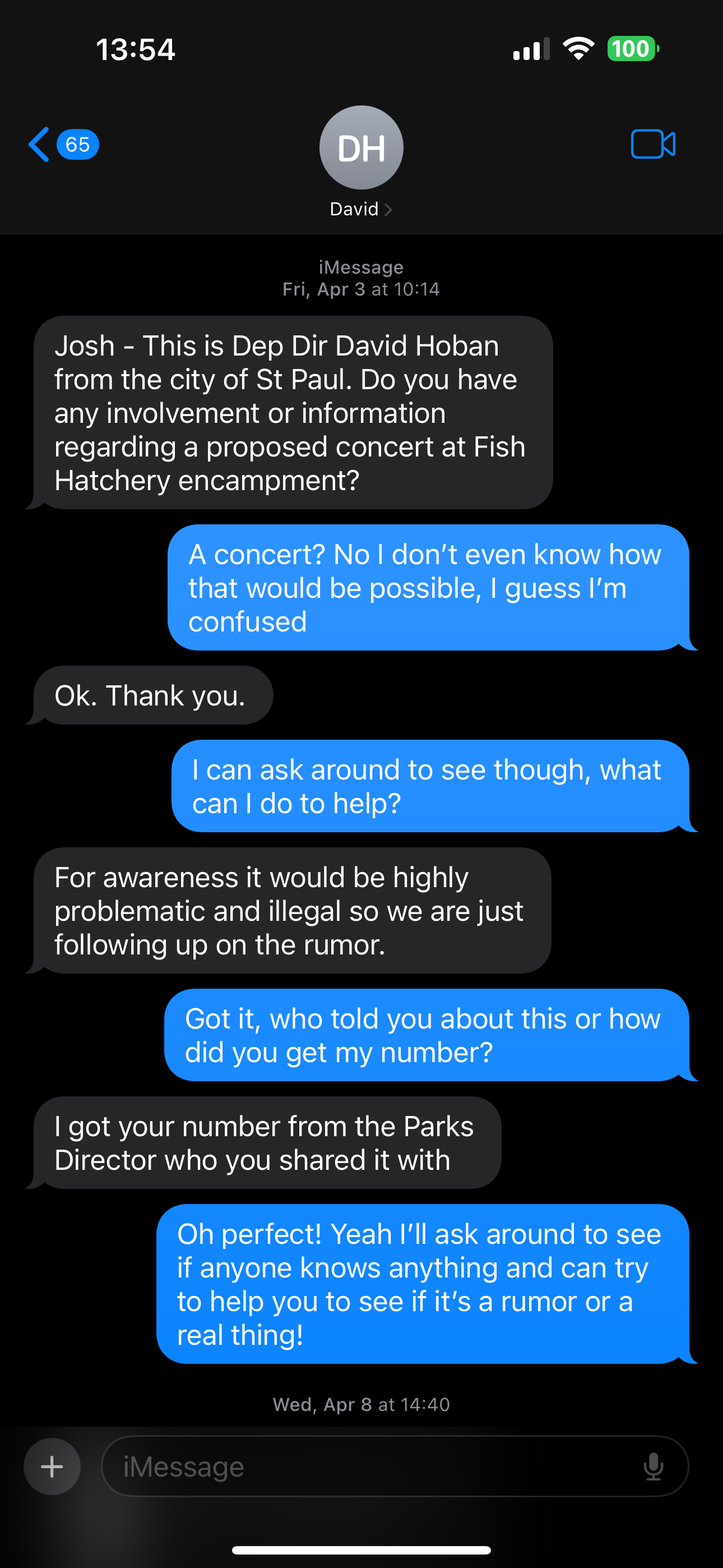
In a message thread dated April 3, a sender identifying himself as Saint Paul Deputy Director David Hoban asked whether Josh had involvement or information regarding a proposed concert at the Fish Hatchery encampment. Josh replied that he did not know about a concert, said he was confused, and offered to ask around. The restriction notice later characterized the exchange as Josh “denying an express request for information.”
April 3, 2026Message record
Josh denied knowing about the proposed concert and offered to help
The screenshots show Josh responding directly: “A concert? No I don't even know how that would be possible, I guess I'm confused.” He then offered to ask around and determine whether the report was a rumor or a real event.
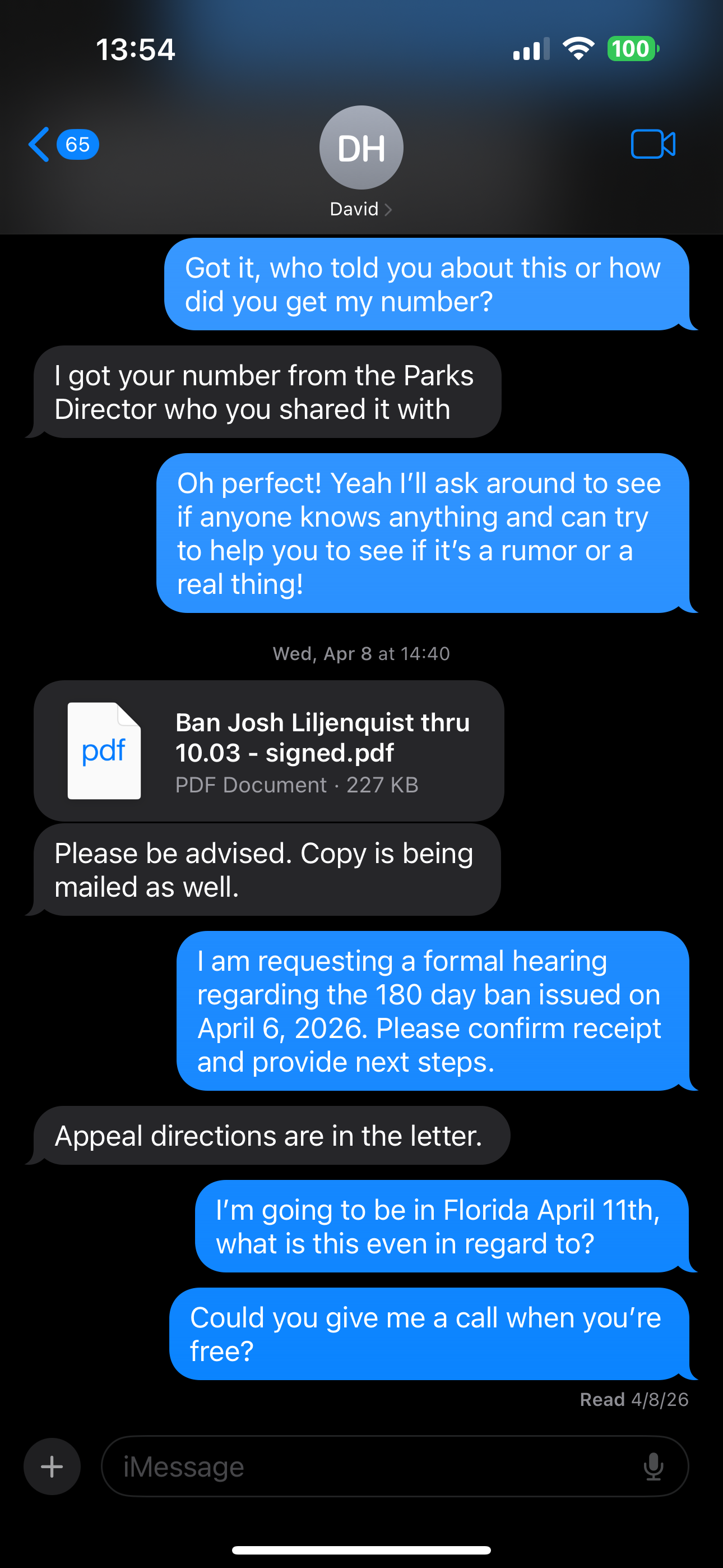
The sender replied that the city was following up on a rumor and later sent Josh the restriction notice.
Contemporaneous record
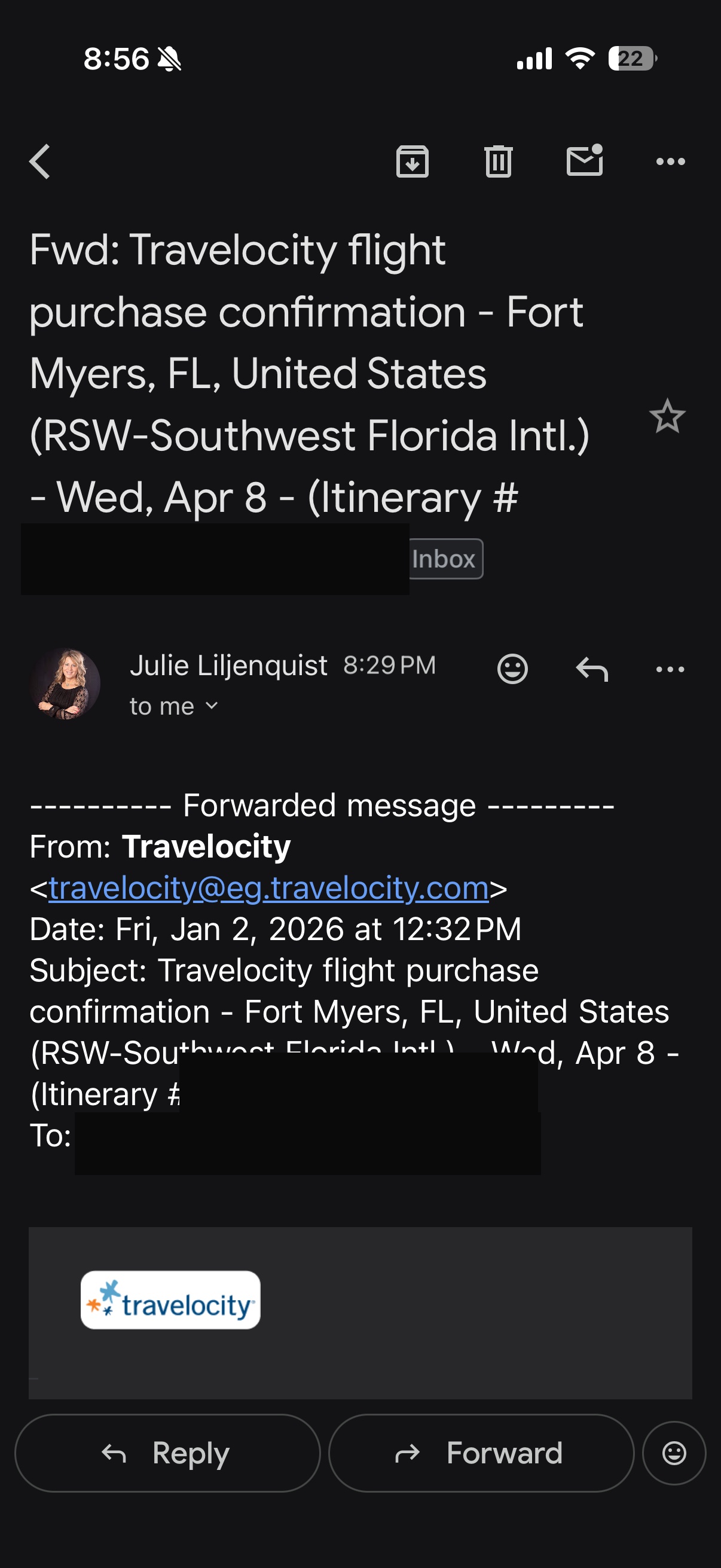
A preexisting Florida itinerary conflicts with the alleged April 11 event.
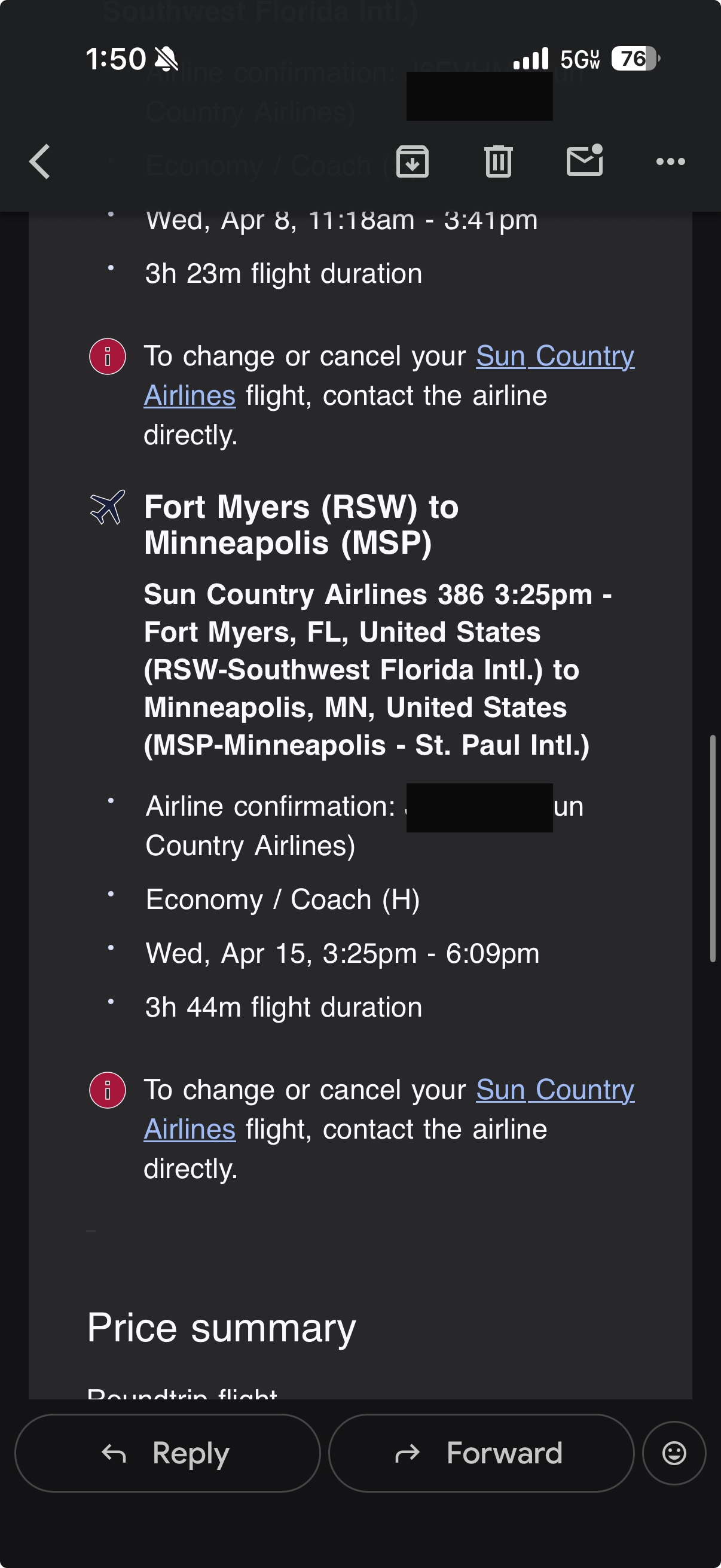
A travel purchase confirmation dated January 2, 2026 shows a round-trip itinerary from Minneapolis to Fort Myers for April 8-15. Those dates included April 11, the date the city's notice associated with an alleged event in St. Paul.
January 2, 2026Booking record
The travel was arranged months before the notice
Josh says his parents purchased the Florida trip as a Christmas gift. The dated confirmation records travel scheduled for April 8-15, before the city issued its notice and across the date of the alleged April 11 event.
Josh says he did not plan or hold the event described in the notice. The booking record supports his account that he already had conflicting travel plans.
The April 3 David Hoban exchange remains the strongest decision-time evidence: the City asked about a proposed concert, Josh denied involvement, asked what he could do to help, and offered again to ask around after Hoban said the City was following up on a rumor. The travel purchase record was created months earlier and covers April 8–15. Two separate photographic files then preserve embedded metadata recording devices in southwest Florida on April 11, 2026.
One of the two files retains Apple iPhone camera metadata showing a 7:46:38 p.m. local capture time with a UTC−04:00 offset and a GPS UTC time that agrees within approximately one second. Together with the pre-booked travel record, the two-file metadata pair corroborates physical presence in Florida on the date of the alleged Saint Paul event.
FLA-01Supporting primary record
April 11 application-generated photograph
Capture date
April 11, 2026
Approximate location
Southwest Florida
Metadata type
Embedded GPS date, UTC time, location, altitude and positioning-error data
What it establishes
The preserved file contains embedded GPS metadata recording a device in southwest Florida on April 11.
Limitation
It does not independently identify who held the device, establish location for the whole day, or disprove earlier or remote planning.
Public derivative status: The raw GPS-bearing master remains private. No substitute image is shown while the exact source bytes needed to create and verify a stripped derivative are unavailable in this project.
Apple camera, local-time/offset, GPS UTC time and location data
Internal consistency
The 7:46:38 p.m. local time at UTC−04:00 converts to 23:46:38 UTC; the embedded GPS time is 23:46:37 UTC.
Limitation
It does not establish location for the whole day or independently disprove earlier or remote planning.
Public derivative status: The raw GPS-bearing master remains private. No substitute image is shown while the exact source bytes needed to create and verify a stripped derivative are unavailable in this project.
Evidence boundary: This metadata corroborates physical presence in Florida on April 11. It does not, by itself, establish location for the entire day or independently disprove prior or remote event planning. The broader attribution analysis also relies on the April 3 City text exchange, the pre-booked travel chronology, the City-produced event record, and the appeal-hearing statements. Exact coordinates, raw metadata, private filenames, integrity hashes and master-file paths are not exposed in public HTML.
Primary documents
What the two official city letters establish.
This summary relies on the original restriction notice and the signed appeal update. Redacted copies of the city letters and supporting records appear below. Personal identifiers and reusable travel credentials have been removed.
April 6, 2026Original notice
The notice imposed the restriction without attached supporting exhibits
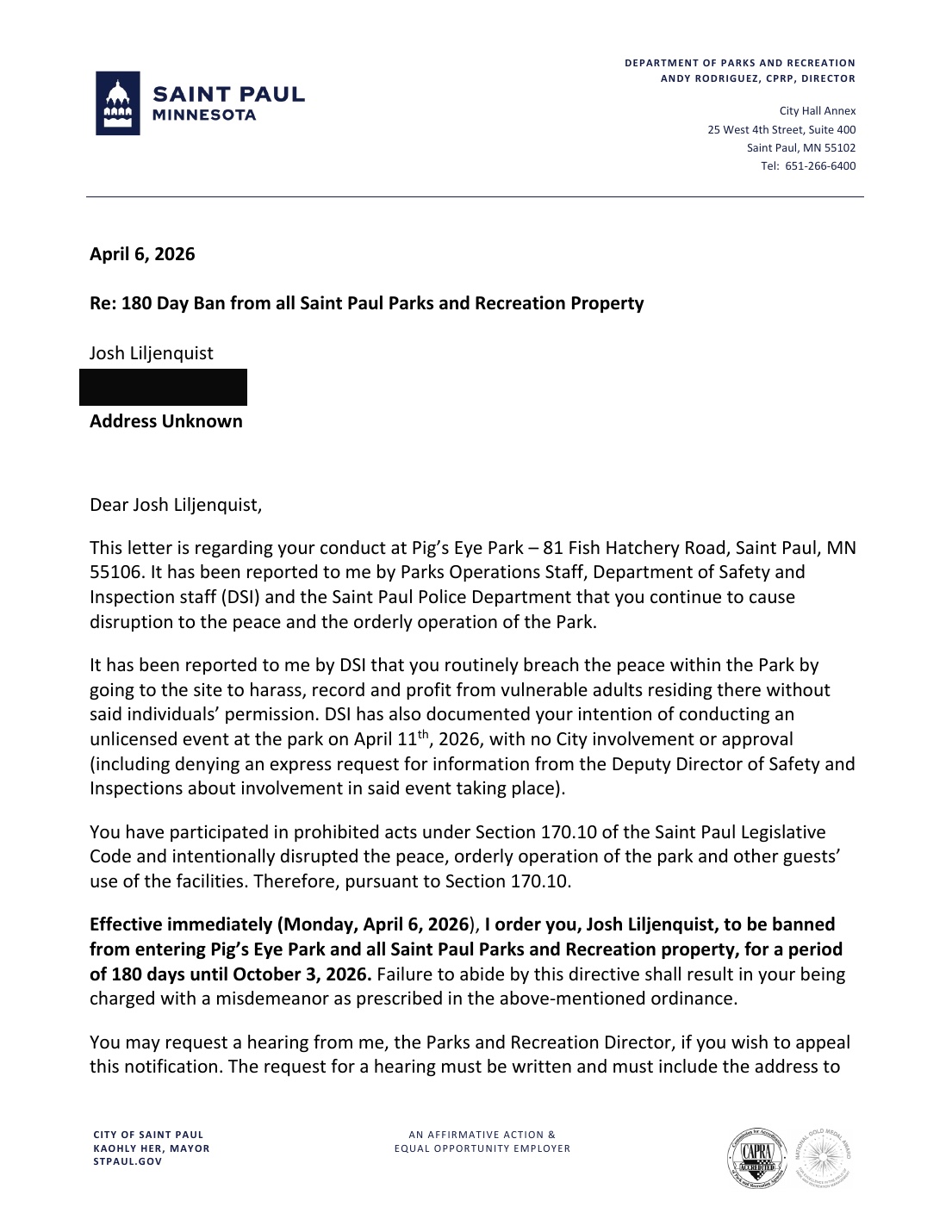
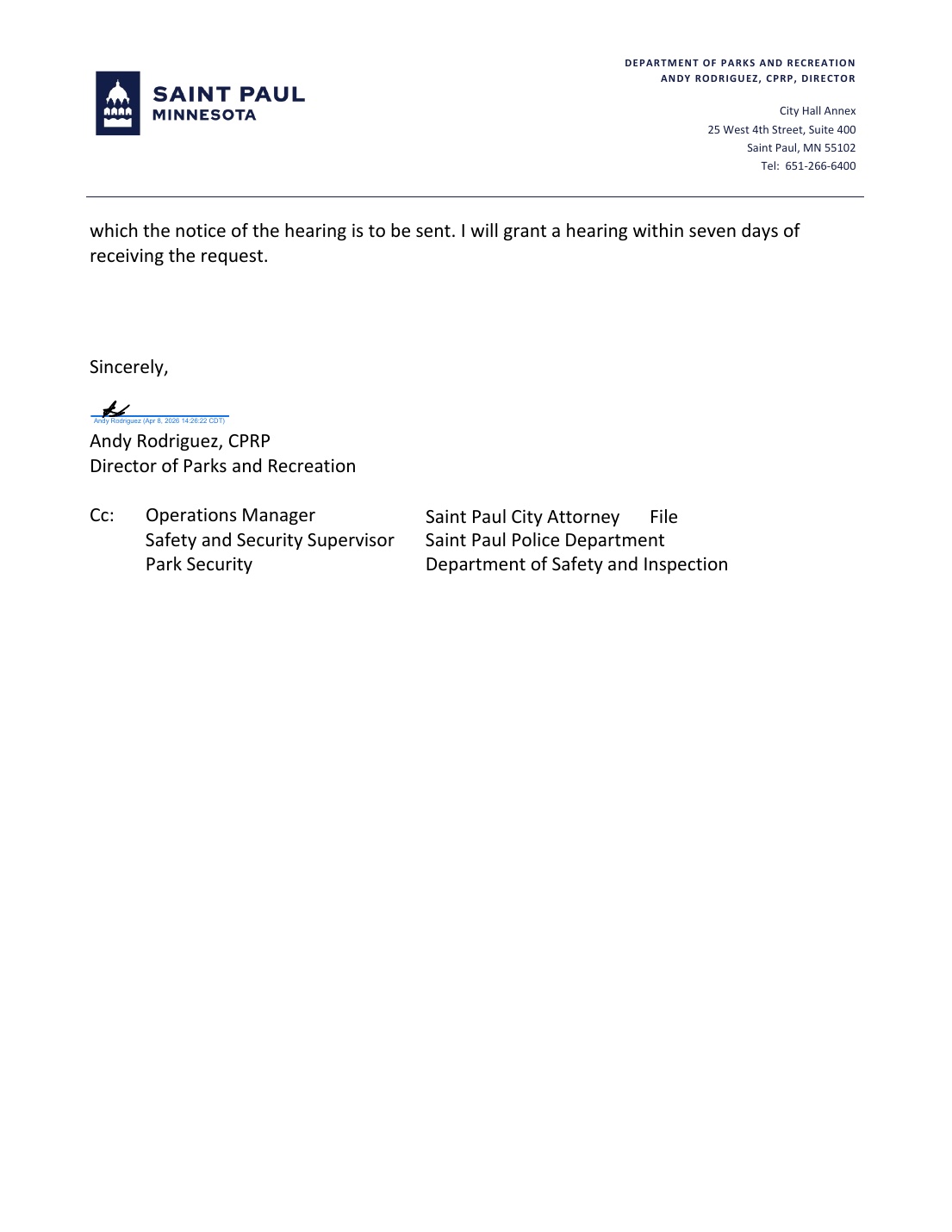
The two-page notice attributed its allegations to reports from city staff and police. It did not name an alleged victim, identify a specific harassment incident or date, cite a supporting video or recording, or include supporting evidence with the notice.
The notice was dated April 6 and electronically signed April 8, 2026.
April 22, 2026Signed appeal update
The city rescinded the restriction after the appeal review
“Based on an evaluation of the facts of this situation as they were relayed during your appeal meeting, I will be rescinding your ban from our parks, effective immediately.”
Saint Paul Parks and Recreation appeal update
The letter confirms rescission after review. It does not state a formal finding about every allegation.
Source documents
Review the records referenced in this timeline.
These are redacted copies of the records described above. Dates of birth, personal email addresses, travel confirmation numbers, and other reusable private identifiers have been permanently removed from the public images.
Message recordQuestion about a proposed concert
The screenshot shows Josh denying knowledge of the proposed event, asking how he could help, and offering to check whether the report was a rumor.
Message recordNotice delivered and appeal requested
The continuation shows the notice being sent on April 8 and Josh immediately requesting a formal hearing.
Official city documentNotice language about the information request
This enlarged document detail shows the notice's exact wording. Open it to review the complete redacted first page.
Official city documentOriginal restriction notice, page 1
The first page of the notice, with Josh's date of birth removed.
Official city documentOriginal restriction notice, page 2
The second page records the restriction terms and appeal process.
Official city documentSigned appeal update and rescission
The April 22 letter states that the restriction was rescinded effective immediately after the appeal review. Josh's street address has been removed.
Supporting recordFlight purchase confirmation
The confirmation is dated January 2, 2026 and records travel beginning April 8. Email addresses and itinerary numbers have been removed.
Supporting recordReturn itinerary
The itinerary records return travel from Fort Myers to Minneapolis on April 15. The airline confirmation code has been removed.
Staff summaryMarch 24 account referenced during the appeal
The screenshot describes a disputed parking-lot confrontation and states that another person threatened Josh before he called police and left.
Anonymous submissionEmail received by city staff
This email is included as part of the record provided to the city. Its authorship and allegations have not been independently verified and are not presented here as findings of fact. Email addresses have been removed.
Reading note: Publication of a record does not establish that every statement within it is true. The captions distinguish official city actions, supporting records, staff summaries, and allegations submitted by an anonymous sender.
Scope
Context without overstatement.
This page records that a restriction was issued, appealed, and rescinded. It does not replace original reporting, decide disputed factual questions, or make a legal conclusion.
Josh's ongoing public-story standards are described on the Trust & Care page, including consent, dignity, privacy, donations, and nomination boundaries.
CBS Minnesota's St. Paul Parks Rescission Follow-Up
CBS Minnesota/WCCO-TV interview footage of Josh Liljenquist used in the outlet's April 22, 2026 follow-up reporting that St. Paul rescinded the parks restriction after his appeal. The frame's exact capture date is not independently established.