The Notice Said “Routinely.” The Disclosed Record Identifies One Specific Incident.
The notice alleged a recurring pattern, but the appeal-hearing explanation and later-disclosed CAD/email materials identify one specific disputed sibling-related incident. Additional City records are needed to determine whether other incidents were relied upon.
Search visibility and source authority
The substantive comparison below is crawlable static HTML. Source links identify the transcript passage, notice, exhibit, official city source, or approved public record supporting the statement.
SOURCE HIERARCHY
Governing Rules
Read the City rule first, then applicable Minnesota authority, the national constitutional standard, judicial interpretation, and the original record. The final layer states the supported application and its limits.
01
Governing Saint Paul rule
The adopted Parks Rules, Chapter 3, Section 1(a), prohibit disturbing, harassing, or interfering with another visitor and intentionally disrupting orderly park operation. Chapter 1, Section 2 distinguishes “serious or repeat violations,” while Chapter 3, Section 1 supplies the person-specific reasonable-cause standard for an extended exclusion. L-01L-06
02
Minnesota statewide authority
Minnesota Constitution article I, section 7 provides that no person shall be deprived of life, liberty, or property without due process of law. Whether a protected interest was deprived and what process was required remain issue-specific questions. L-03MN-05
03
National constitutional standard
The Fourteenth Amendment supplies the federal procedural-due-process framework. The governing question is whether any protected interest was affected and whether the notice and hearing were meaningful in light of the timing, stakes, available evidence, and risk of error. US-01US-02US-03
04
Judicial interpretation
Goss and Loudermill address factual notice and response. Sabes distinguishes substantial evidence from unsupported hearsay or a mere scintilla in Minnesota administrative review. These authorities do not determine whether other incidents existed. SC-01SC-02MN-02
05
Record evidence
The notice alleged conduct occurred “routinely.” The hearing, CAD record, and later staff summary identify one disputed sibling-related source family, with material differences between the original CAD and later narrative. R-01R-05R-08R-09
06
Application and limitation
The current production supports comparing a recurring-pattern allegation with one disclosed specific incident. It does not prove that no other incident existed or resolve the underlying sibling account.
Evidence integrity
What this page separates before making comparisons.
City’s stated position
The signed exclusion notice alleged that Josh routinely breached the peace by going to the site to harass, record, and profit from vulnerable adults without permission.
What the documented record shows
At the hearing, the concrete harassment explanation centered on one uncertain sibling-related interaction, and the disclosed CAD/email materials concern that same single disputed event.
Limits of the available evidence
The reviewed records do not prove that no other complaints or incidents existed, and they do not establish a constitutional violation.
Open questions
If the City relied on more than this one incident, what factual substance was identified before or during the appeal so Josh could respond?
Records still needed
Additional complaints or reports, appeal-hearing materials, decision-maker communications, notice drafting history, and records showing the factual basis for the word “routinely.”
Discrepancy 6
6. The Notice Said “Routinely.” The Disclosed Record Identifies One Specific Incident.
Documented scope gapAdditional City records neededLegal conclusion not established
1. Finding
The notice alleged a recurring pattern, stating that Josh “routinely” harassed, recorded, and profited from vulnerable adults without permission. At the hearing, however, the City identified one uncertain sibling-related interaction and did not have the referenced report, participants’ names, or incident details available. The materials supplied afterward—the CAD record and April 20 staff email—concern that same single disputed event.
One disclosed incident does not substantiate the frequency implied by “routinely.” If the City relied on additional incidents, the record reviewed does not show that their factual substance was identified before or during the appeal so Josh could meaningfully respond. That presents a serious procedural question, although the present sources alone do not establish a constitutional violation.
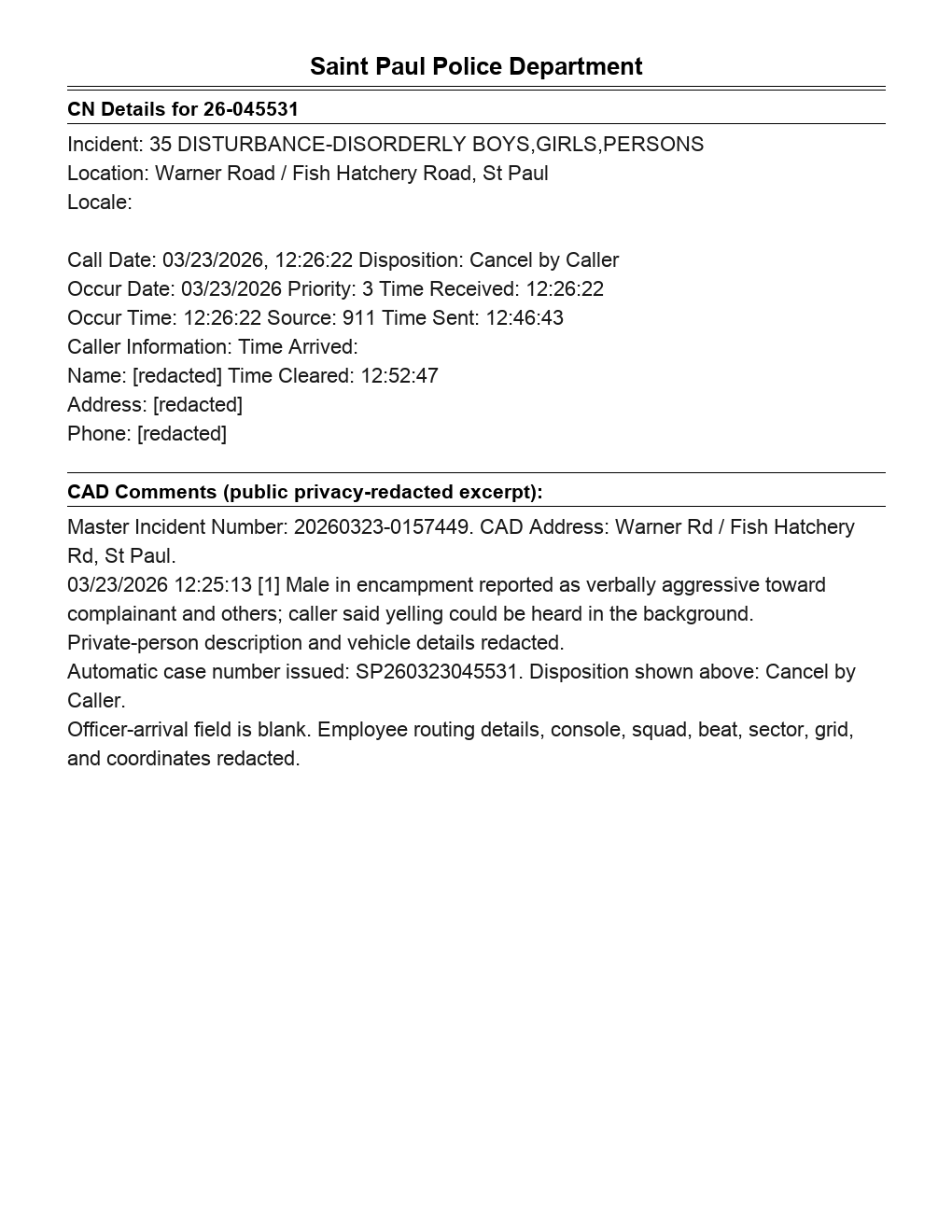
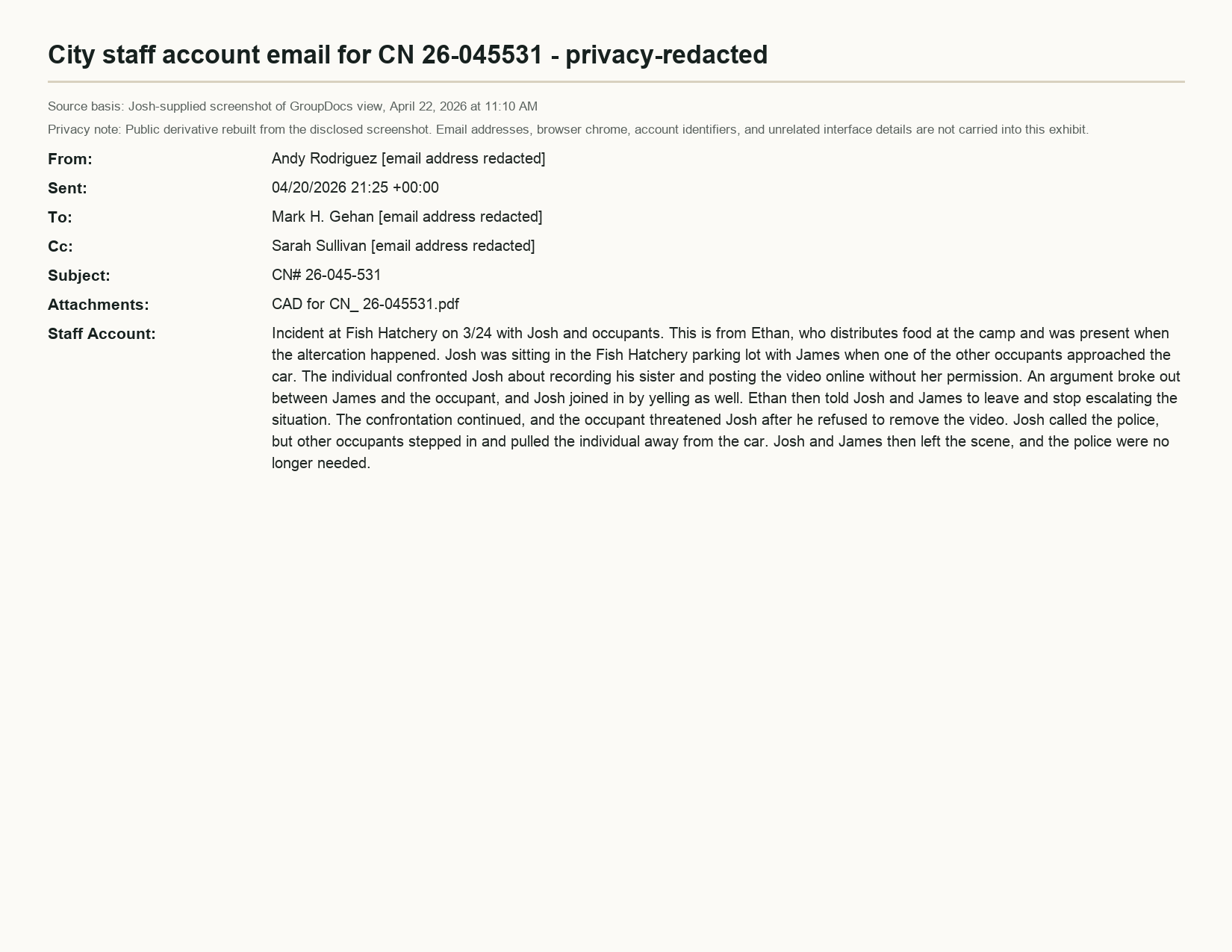
The later CAD production documents one March 23 disturbance call ↗, names James Coan—not Josh—as the caller, and does not mention Josh, a sibling, filming, permission, profit, or a vulnerable adult. The City’s April 20 email adds a witness-summary narrative about Josh but dates the event March 24 and still describes only that single disputed encounter. These records may support that one disturbance was reported; they do not substantiate the notice’s allegation that Josh “routinely” engaged in the stated conduct.
Caveat: These records do not prove that no other complaints or incidents existed. They show that the CAD and accompanying email disclosed for this incident do not document a recurring pattern.
2. What the notice alleged
“routinely breach[ed] the peace within the Park by going to the site to harass, record and profit from vulnerable adults residing there without said individuals’ permission.”
The notice describes recurring conduct, plural adults, and the combined allegations of harassment, recording, profit, and lack of permission. It does not identify dates, people, videos, payments, or separate incidents supporting the word routinely breach the peace ↗.
3. What the City identified at the hearing
The defensible record statement is that the sibling-related account was the only concrete harassment incident articulated at the hearing. This page does not say the City expressly admitted it was the only possible basis.
9:28–10:52Parks Director / direct exchange
The Parks Director described an alleged sibling-related parking-lot interaction using uncertain language including “I think,” “something like that,” “maybe,” “I don’t know,” and “I believe so.” He did not have names or documentation available and said he could supply it later.
“I think you've made your point. I think you—you've, uh, communicated that you were not affiliated with this event, right? Um, which was an unpermitted concert, whatever it was. Um, and, you know, for whatever occurred with that interaction, which I can follow up on, uh, regarding the sibling, you know, I'm happy to send that information for your review.”
“I mean, that is, you know, the language in the letter about harassing. That is where we tie to that disturbance of the peace, not necessarily the videoing.”
The Assistant City Attorney’s statement tied the harassment language to disturbance of the peace, “not necessarily the videoing.”
The Written Accusation and the Hearing Explanation Did Not Match
Direct answer: Saint Paul’s exclusion notice accused Josh of a recurring pattern of harassing, recording, and profiting from vulnerable adults residing at Pig’s Eye Park. At the appeal, however, the concrete harassment explanation centered on one uncertain sibling-related parking-lot interaction. When Josh asked who the person was, no name was supplied in the hearing, the referenced record was offered for later review, and the later police CAD did not contain the sibling/video/vulnerable-adult narrative.
What did the written notice allege?
That Josh “routinely” went to Pig’s Eye Park to “harass, record and profit from vulnerable adults residing there” without their permission.
What concrete harassment incident did the City describe at the hearing?
One uncertain sibling-related parking-lot interaction. The Director used qualifiers including “I think,” “maybe,” “I don't know,” “he-said-she-said,” and possible hearsay.
Did the City identify the alleged person or sibling by name during the hearing?
No name was supplied in the hearing exchange. When Josh asked, the Director referred to a police record, offered to send it later, and said he did not know the names “off the top of my head.”
What did the later police CAD contain?
The CAD did not name Josh, a sibling, a sister, filming, permission, a video, profit, or a vulnerable adult.
Where did the detailed Josh/sister/video narrative appear?
In a later April 20 City staff summary attributed to “Ethan.” The reviewed item did not include the original underlying statement, exact words, interview date, signature, or collection method.
What does this not establish?
It does not prove that no source or identity existed anywhere, that every allegation was false, that the later summary was fabricated, or that a court has found a constitutional violation.
What the record shows
The notice used broad recurring-pattern language. The hearing explanation narrowed to one disputed sibling/video incident with no names or report in the room. The later-produced CAD does not name Josh or mention sibling, filming, permission, profit, or vulnerable-adult status.
What remains unresolved
If Saint Paul relied on other incidents, the reviewed public record does not show that their factual substance was identified before or during the hearing so Josh could answer them meaningfully.
Question
Ban Letter
Appeal Hearing
Police CAD
April 20 City Summary
Who was allegedly harmed?
“vulnerable adults” in plural.
Unnamed sibling/sister account; no name supplied.
Unidentified reported male; no vulnerable-adult status stated.
References “one of the other occupants” and a sister account, but no original witness statement is included.
What conduct was alleged?
Harass, record, profit, and lack of permission.
Harassment tied to disturbance, “not necessarily the videoing.”
Disturbance call; yelling reportedly heard; no filming, consent, or profit allegation.
Adds a summarized video/sister confrontation narrative attributed to Ethan.
How many incidents?
“Routinely” implies recurring conduct.
One concrete sibling-related interaction discussed.
One March 23 call.
Same apparent event, dated March 24.
Was Josh named?
Yes.
Yes, as the person being asked to answer the allegation.
No.
Yes, in a later Josh-specific staff summary.
What source layer is this?
Official notice allegation.
Hearing explanation and questions.
Dispatch record, not an adjudicated finding.
Later summarized staff account; underlying original statement not included.
These records are different source layers. Details found only in the later summary must not be described as findings contained in the CAD. The Ban Letter is the operative allegation; the hearing is the City’s explanation and Josh’s opportunity to respond; the CAD is a dispatch record; the April 20 email is a later City summary. They should not be collapsed into one source or treated as independent corroboration of one another unless provenance supports that treatment.
This was not a minor wording dispute. Saint Paul’s written exclusion paired a highly stigmatizing official accusation with the maximum 180-day exclusion from every Saint Paul Parks and Recreation property and threatened misdemeanor consequences for re-entry. But when Josh used the appeal hearing the City itself called his “opportunity to be heard,” the factual theory became materially narrower and materially less certain.
Near the end of the hearing, counsel was still asking what Josh had actually done that constituted disturbing the peace. The Assistant City Attorney then tied the disturbance theory to alleged harassment, “not necessarily the videoing.” When Josh directly asked, “who was the person? Do you guys know the name?”, no person or sibling was identified by name in the hearing. The Director instead referred to a police record, offered to send it afterward, and said he did not know the names “off the top of my head.”
The issue is therefore not simply that an official could not recall a name from memory. The issue is whether Saint Paul had a sufficiently reliable, person-specific factual basis for the broad recurring-harassment allegation it placed in an official notice—and whether Josh received enough of that factual basis during the hearing the City itself designated as his opportunity to answer it.
What this establishes: The public record currently connects the notice’s broad language to one disclosed dispute record and one later staff summary. It does not substantiate the frequency implied by “routinely” or identify the complete source chain for the broader vulnerable-adults/profit/permission wording. It also makes the recording distinction visible: the hearing explanation tied disturbance to alleged harassment, not necessarily the videoing.
What this does not establish: It does not prove that no other reports existed, that every allegation was false, that the City fabricated a record, or that a court found a due-process violation.
Opportunity to be heard without an identified incident
The hearing was described as Josh’s opportunity to be heard. The record issue is practical: a person can answer an allegation more meaningfully when the source, incident, date, person, and supporting record are identified while the answer is requested.
This section does not claim formal discovery was required or that the City had to produce its entire file. It asks whether the factual basis supplied in the notice and hearing was specific enough to permit a meaningful response.
Notice, hearing, CAD, and source-layer comparison
The notice, hearing, CAD, and later staff summary are different evidence layers. They should not be collapsed into one source or treated as independent corroboration of one another unless provenance supports that treatment.
The CAD is a dispatch record. The April 20 staff account is a later City summary. The reviewed public set does not contain Ethan’s original statement or a record showing when the decision-maker first reviewed the Josh-specific narrative.
4. What the CAD actually records
CAD CN 26-045531 is a dispatch/CAD record, not an officer’s investigative report or factual adjudication. The public-redacted exhibit documents one March 23, 2026 disturbance call at Warner Road/Fish Hatchery. It names James Coan–Volunteer as caller/complainant, describes an unidentified male as verbally aggressive and threatening, records yelling heard by the call taker, and ends as Cancel by Caller, with the unidentified suspect reportedly no longer present. It contains no officer-arrival time and does not name Josh or Ethan. It does not mention a sibling, filming, permission, a video, profit, or a vulnerable adult.
The April 20 staff email ↗ attaches the CAD, calls the incident March 24 while the CAD records March 23, presents a summarized “Staff Account” attributed to Ethan, places Josh and James at the scene, alleges a confrontation concerning a video of someone’s sister, says Josh joined in yelling, says another occupant threatened Josh, and says Josh called police.
The supplied exhibit does not include Ethan’s original statement, surname, signature, exact words, interview date, or method of collection. The email’s detailed sibling/video narrative does not appear in the attached CAD. No original Ethan email, signed statement, exact quotation, interview date, or method of collection was included in the produced material.
The following table compares what is visible in the notice, hearing, CAD, and April 20 email without treating any difference as proof of fabrication.
Question
Notice
Hearing
CAD
April 20 email
Frequency
“Routinely”
One concrete incident discussed
One call
Same apparent incident
Alleged target
“Vulnerable adults residing there”
Unnamed sibling/sister-related account
No sibling or sister
Sister/video narrative added
Josh identified
Yes
Spoken as though involved; Josh denies it
No
Yes
Harassment basis
Broad recurring allegation
One uncertain exchange
Not stated
Later narrative
Recording
Bundled into allegation
City says disturbance was “not necessarily the videoing”
Not mentioned
Video dispute alleged
Permission
Lack of permission alleged broadly
Unidentified reported filming concern
Not mentioned
Video dispute alleged
Profit
Expressly alleged
No specific proof identified
Not mentioned
Not mentioned
Vulnerable-adult status
Expressly alleged
Not established for sibling, sister, or alleged victim
Not mentioned
Not established
Source identity
Parks/DSI/Police generally
No person named in hearing
James listed as caller; unidentified male
Account attributed to “Ethan”
Source type
Official notice
Oral hearing statements
Dispatch/CAD record
Later summarized staff account
Availability at hearing
Notice available
Supporting record not presented
Offered for later sending
Sent after hearing
Evidentiary limit
Does not identify incidents or people
Qualifiers and missing identity
Does not contain later detailed narrative
Original underlying statement not produced
Caveat: The differences do not by themselves prove fabrication. They establish that the detailed later narrative is not contained in the original CAD and depends on an unproduced underlying source.
7. Why “routinely” remains unsupported by the disclosed record
March 23 in the CAD differs from March 24 in the email. The CAD lists James as caller, while the email says Josh called police. Josh is absent from the CAD but described in the later staff summary. The sibling, filming, consent, profit, and vulnerable-adult claims are absent from the CAD. These tensions matter because the notice used recurring-pattern language, but the disclosed materials currently point to one disputed event.
8. The two possible record questions
If this was the only incident relied upon: The disclosed materials do not substantiate the recurring frequency conveyed by “routinely.”
If the City relied upon additional incidents: The record raises the question whether Josh received enough of their factual substance before or during the appeal to respond meaningfully.
Neither branch conclusively proves illegality.
9. Legal framework—not a court ruling
Procedural due process applies only if government action deprives a protected life, liberty, or property interest. If such an interest is implicated, the ordinary rule calls for notice and an opportunity to be heard appropriate to the nature of the case. Due process is flexible, and the precise safeguards depend on the circumstances.
The relevant question here is not whether the Constitution automatically required production of the City’s entire investigative file. It is whether the notice and appeal process communicated enough of the factual basis for the action to provide a meaningful opportunity to respond ↗.
Saint Paul Legislative Code §170.10 provides that a notice exceeding 24 hours “shall specify the basis ↗.” The notice and transcript separately document an informal appeal after a written request. The current online ordinance text located for this implementation does not display that appeal procedure, and this page does not claim the ordinance expressly requires full discovery or disclosure of every report.
Caution: These sources do not themselves establish that the exclusion violated the Constitution. Any definitive legal conclusion requires setting-specific legal analysis and attorney review.
The official notice did more than criticize Josh. It paired a highly stigmatizing accusation with an immediately effective legal exclusion from all Parks and Recreation property. Supreme Court and Eighth Circuit doctrine distinguish reputational injury alone from stigma coupled with alteration of a right or legal status. Whether this record satisfies every element of a constitutional stigma-plus claim is ultimately a legal question, but the combined reputational and legal consequences warrant explicit analysis rather than being dismissed as collateral publicity.
This is not presented as a court ruling. Article-specific defamation analysis would require exact wording, attribution, falsity, fault, privilege, correction history, and jurisdiction-specific review. The point here is narrower: when government action imposes a concrete restriction and uses serious characterizing language, readers need to see the primary record, the disclosed evidence, and the limits of both.
The stakes are broader than whether one exclusion was later rescinded. A municipal process sets a dangerous precedent if it permits officials to publish a broad and stigmatizing accusation, impose the maximum citywide restriction, and then defend the action at the only internal hearing through a narrower factual theory involving an unnamed person and a supporting record not presented in the room.
That structure magnifies the risk of error at every stage: the affected person cannot identify the incident, locate witnesses, test credibility, distinguish one source from another, or rebut a story whose operative details emerge only during the hearing. The risk becomes more severe when the original official wording is immediately available to journalists, search engines, and social platforms while the narrower and more qualified hearing explanation remains buried in a recording or later-produced documents.
Due process exists in part to prevent government from imposing severe consequences first and requiring a person to disprove a moving or inadequately disclosed factual theory afterward. Saint Paul’s own ordinance required reasonable cause, a specified written basis, and individualized decisionmaking. The website should therefore insist on a simple institutional principle: before government imposes a maximum citywide exclusion and publishes a severe factual accusation, it should be able to identify the operative incident, the evidentiary source, the legal standard, and the factual bridge connecting the person to the alleged violation.
No municipality should be permitted to transform a generalized report, an unnamed source, or a later summary into a public finding by repetition alone. Allegations must remain allegations; source layers must remain distinct; and the person affected must receive a real opportunity to understand and answer the case against him. This is analysis and policy implication, not a court holding.
10. What the evidence does not establish
It does not establish that the City violated Josh’s due-process rights or that the ban was unconstitutional.
It does not establish that the City had to provide every record in its possession.
It does not establish that the sibling incident was the sole possible basis.
It does not establish that the City fabricated the allegation, that the police report proved Josh was innocent, or that no other evidence existed.
It does not determine whether the April 20 email was post-hearing justification or address the separate April 6/April 8 notice chronology.
11. Records still needed
All complaints, reports, witness statements, emails, texts, notes, and videos officials relied upon for “routinely.”
The identity of the resident, sibling, sister, complainant, and witness, maintained privately and redacted publicly as appropriate.
The original Ethan statement or interview record, including date, method of collection, and exact words.
The source for “vulnerable adults,” “profit,” lack of permission, and the connection between the sibling theory and the written allegation.
All pre-exclusion evidence, Director notes, legal review, drafts, redlines, and communications showing who supplied each factual allegation.
Complete CAD export and audit metadata, associated incident reports, officer narratives, dispatch audio, caller audio, and records showing who printed the CAD on April 17 and when.
Records showing whether any other incidents were identified before or during the appeal.
Records showing when the CAD and April 20 staff account were reviewed by decision-makers.
Notice drafts, comments, edits, signing history, and approval communications for the “routinely” language.
Any policies or criteria used to determine whether conduct justified a 180-day parks exclusion.
Public-record requests, City responses to journalists, and communications about public reaction, followers, publicity, reputation, or correction discussions after rescission.
12. Primary sources and methodology
Original source files remain in the governed Transparency source-document workflow. Public derivatives are privacy-reviewed exhibits. Personal contact details and unnecessary third-party identifiers are not published. No hearing audio was available in the accessible workspace during this pass, so the existing transcript disclosure that timestamps are approximate remains controlling.
August 14, 2026 — dedicated indexable discrepancy page added for “The Notice Said “Routinely.” The Disclosed Record Identifies One Specific Incident..”