Discrepancy 5: Did Josh Liljenquist Deny the Deputy Director’s Request for Information?
The supplied April 3 text exchange records Josh answering the question about his involvement or information and twice offering additional help. No later request, instruction, deadline, or refusal appears in the supplied written exchange.
Search visibility and source authority
The substantive comparison below is crawlable static HTML. Source links identify the transcript passage, notice, exhibit, official city source, or approved public record supporting the statement.
SOURCE HIERARCHY
Governing Rules
Read the City rule first, then applicable Minnesota authority, the national constitutional standard, judicial interpretation, and the original record. The final layer states the supported application and its limits.
01
Governing Saint Paul rule
The adopted Parks Rules place special-event and exclusive-use permits in Chapter 2, Section 2 and the person-specific extended-exclusion standard in Chapter 3, Section 1. Neither provision identifies a separate legal duty requiring Josh to investigate a rumor for the City or answer beyond the information he possessed. L-01L-06
02
Minnesota statewide authority
Minnesota Constitution article I, section 7 provides that no person shall be deprived of life, liberty, or property without due process of law. Whether a protected interest was deprived and what process was required remain issue-specific questions. L-03MN-05
03
National constitutional standard
The Fourteenth Amendment supplies the federal procedural-due-process framework. The governing question is whether any protected interest was affected and whether the notice and hearing were meaningful in light of the timing, stakes, available evidence, and risk of error. US-01US-02US-03
04
Judicial interpretation
Thomas confirms that a municipality may administer a content-neutral park-permit system with adequate standards. Goss and Loudermill frame the separate notice-and-response question. None establishes that the April 3 exchange amounted to a refusal or that Josh had an affirmative investigatory duty. SC-11SC-01SC-02
05
Record evidence
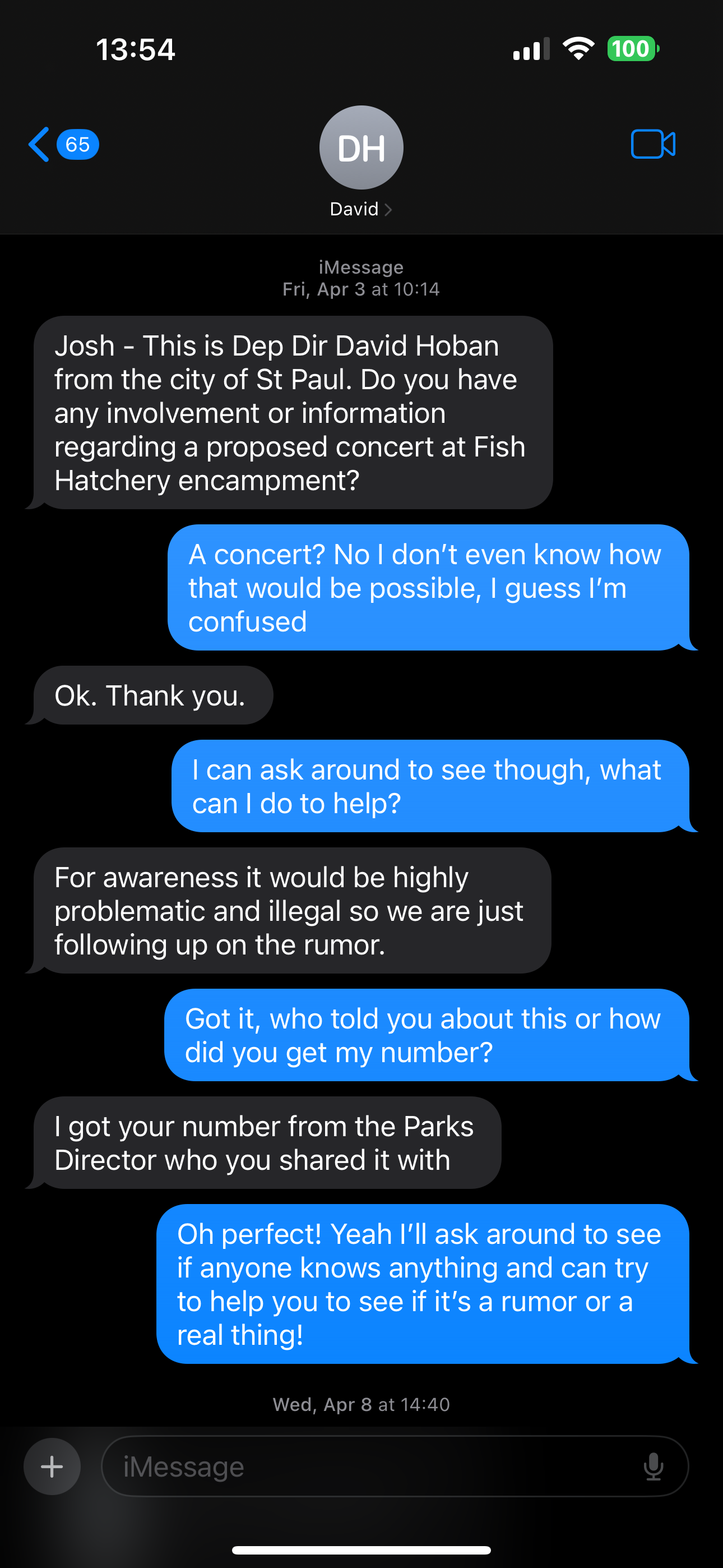
The native April 3 exchange is the strongest contemporaneous record: Hoban asked about a rumored concert, Josh denied involvement, asked what he could do to help, and again offered to ask around after Hoban said the City was following up on a rumor. R-03R-05
06
Application and limitation
The exchange contradicts a simple characterization that Josh refused to respond to the visible request. It does not rule out another communication, prove when the decision-maker reviewed the messages, or establish the legal consequence of any separate request.
Evidence integrity
What this page separates before making comparisons.
City’s stated position
The exclusion notice says Josh’s alleged involvement in an April 11 unlicensed event included denying an express request for information from the Deputy Director of Safety and Inspections.
What the documented record shows
The supplied April 3 written exchange shows Deputy Director David Hoban self-identifying by name and title, asking about involvement or information, Josh denying knowledge or involvement, and Josh twice offering to help.
Limits of the available evidence
The supplied written exchange does not rule out separate internal City communications, and it does not prove when the Parks Director first received or reviewed the texts.
Open questions
What exact request and response supported the notice phrase, and did officials rely on any communication beyond the visible April 3 exchange?
Records still needed
All Hoban-Josh communications, relevant DSI/Parks/Police/City Attorney communications, rumor intake records, notice drafting history, and records showing when decision-makers reviewed the text exchange.
05 — Information-request record
The City Called It a “Rumor.” Josh Asked, “What Can I Do to Help?”
Displayed text record does not show a refused request; additional City records requested.
The exclusion notice says Josh Liljenquist’s alleged involvement in an April 11 unlicensed event included “denying an express request for information ↗ from the Deputy Director of Safety and Inspections about involvement in said event taking place.” In the April 3 exchange supplied by Josh, Deputy Director David Hoban self-identified by name and title and asked whether Josh had “Do you have any involvement or information ↗” about a proposed concert. Josh denied knowledge or involvement, then twice offered to help. The supplied written thread shows no later instruction, deadline, demand for specific information, or refusal. Josh states that no separate request was made. City records are still needed to identify the exact communication officials relied upon. R-03R-01
Possible City interpretation: The City could argue that Josh did not ultimately provide the organizer’s identity or that “denying” referred to denying possession of information rather than refusing cooperation. The displayed texts themselves do not show a refusal. If another communication did, that record and its disclosure timing are material unresolved questions.
1. The City’s exact statement
“including denying an express request for information from the Deputy Director of Safety and Inspections about involvement in said event taking place.”
The City said Josh denied an information request. The disclosed texts show him answering and offering to help.
The screenshot exhibit identifies the sender as “David” in the device thread, and the first message self-identifies the sender as “Dep Dir David Hoban from the city of St Paul.” The material content is rendered below as crawlable HTML so readers and search engines do not need to rely on the image alone.
Displayed time
Speaker
Message text
10:14
David Hoban
Josh - This is Dep Dir David Hoban from the city of St Paul. Do you have any involvement or information regarding a proposed concert at Fish Hatchery encampment?
10:21
Josh
A concert? No I don’t even know how that would be possible, I guess I’m confused
10:26
Hoban
Ok. Thank you.
10:28
Josh
I can ask around to see though, what can I do to help?
10:40
Hoban
For awareness it would be highly problematic and illegal so we are just following up on the rumor.
10:41
Josh
Got it, who told you about this or how did you get my number?
10:47
Hoban
I got your number from the Parks Director who you shared it with
10:51
Josh
Oh perfect! Yeah I’ll ask around to see if anyone knows anything and can try to help you to see if it’s a rumor or a real thing!
The supplied April 3 text exchange records Josh answering the question about his involvement or information and twice offering additional help. No later request, instruction, deadline, or refusal appears in the supplied written exchange. Josh states that this was his complete written exchange with Hoban concerning the proposed concert. The public record reviewed does not rule out separate internal City communications.
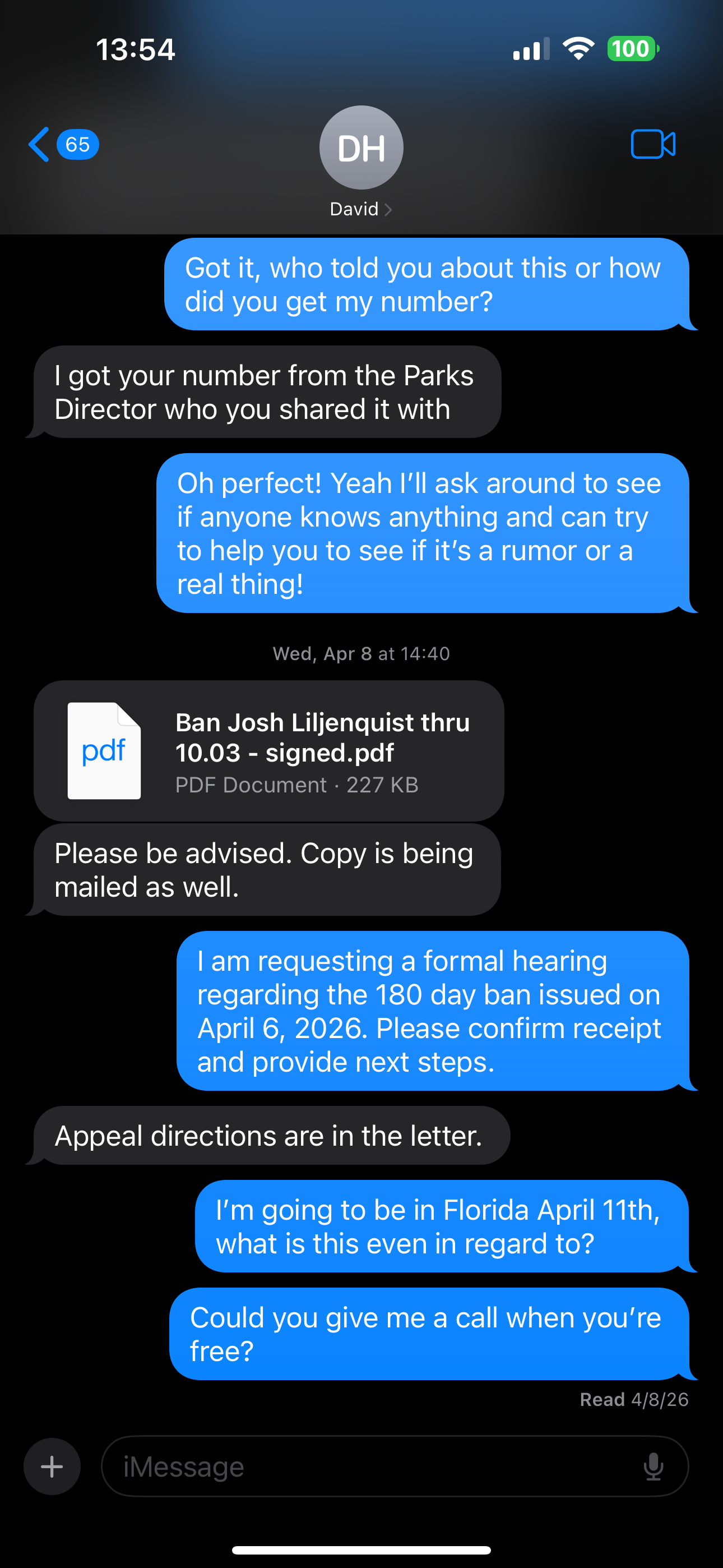
April 3 text-message exchange, first portion — privacy-reviewed exhibit, opens in new tab.April 3 continuation and April 8 notice chronology — privacy-reviewed exhibit, opens in new tab.
“Yeah, that's what I heard as well. Um, and with the text messages with [city official's name redacted], I asked how I could help and, like, how I could find the person, um, who was doing this.”
“Thank you for pointing that out. So, you do have in your letter also that he sort of refused to help or provide any information, and I—do you have a copy of the email or the text between [city official's name redacted] and Josh?”
“Okay. Yeah. I—so I—it seemed, in my reading of those texts, [name redacted], is that he was trying to offer some help, but, uh, also denying involvement. And I, um, [city official's name redacted] seemed sort of appreciative of—of the idea that Josh was looking around to see what he could figure out, but it seemed very clear that Josh was saying, ‘I—this isn't me.’”
“And again, for context, I just want to, like, explain a couple things. DSI manages encampments throughout the city, right? This encampment just happens to be on parkland, right? So there is some—some co-working that has to involve, uh, myself, uh, and him, or other points of contact within each department. Um, so I just want you to know why my name's on this letter, um, and how these processes flow.”
“I think you've made your point. I think you—you've, uh, communicated that you were not affiliated with this event, right? Um, which was an unpermitted concert, whatever it was. Um, and, you know, for whatever occurred with that interaction, which I can follow up on, uh, regarding the sibling, you know, I'm happy to send that information for your review.”
The response “Yeah, I do” establishes that the Director possessed the exchange at the hearing. It does not establish when he first received or reviewed it. This page does not characterize a change of subject, silence, or failure to identify another request as an admission.
4. What the documentary record establishes
Josh answered the question concerning his existing knowledge and involvement.
No later instruction, deadline, demand for particular information, or express refusal appears in the supplied written exchange.
Core conclusion: The record establishes that Josh answered the question, denied having involvement or knowledge, and volunteered additional help. It does not establish that he completed a separate investigation; nor do the materials reviewed identify a later request he refused.
Legal framing: Minnesota arbitrary-and-capricious authority can make a conflict between a stated rationale and the record important, and Minnesota municipal-imputation cases can make attribution without a factual connection important. Those authorities do not decide Josh’s case; their relevance depends on whether the City relied on this exchange, whether another request existed, who received or reviewed the full thread, and whether the information-request allegation was material to the exclusion. MN-06MN-07MN-01MN-04
5. Josh’s account and additional chronology
Josh says these screenshots contain the complete written exchange he had with Hoban about the proposed concert.
Josh says no separate request was made by text, telephone, email, or another City employee before delivery of the notice.
Josh did not ultimately ask other people about the rumor because Hoban described it as a rumor and made no further request, assignment, deadline, or follow-up.
The messages therefore document an offer to ask around—not a completed canvass.
After receiving the notice on April 8, Josh reports placing two calls seeking clarification that were not answered.
The supplied thread independently shows Josh writing, “Could you give me a call when you’re free?”
The two call attempts are not independently documented in the present public exhibit set. They are included only as Josh’s first-person chronology unless a redacted call record is later added.
6. What the current record cannot establish
Whether separate internal City communications exist.
When the Director first received or reviewed the texts.
Whether officials intended a different request than the one visible in the exchange.
Whether Josh completed a separate investigation after offering to ask around.
Who drafted the disputed phrase or what evidence supported it.
Intent, knowing falsity, fabrication, bad faith, or legal invalidity.
7. Records still needed
The exact request and response relied upon for the phrase “denying an express request for information.”
All Hoban–Josh communications concerning the proposed event.
Relevant DSI, Parks, Police, and City Attorney communications.
The source of the concert rumor, intake records, flyers, notes, or call logs.
Records showing when decision-makers received and reviewed the text exchange.
Notice drafts, edits, comments, approvals, signing history, and transmission history.
Records identifying the drafter and reviewers of the disputed language.
Any evidence officials possessed that tied Josh to the alleged April 11 event.
Applicable policies or criteria governing information requests and park exclusions.
8. Sources, methodology, and corrections
An unredacted device capture was retained privately for provenance review; personal contact details are not published. The missing contact-card image is not used because the opening message’s self-identification and official-document context are stronger public evidence. The later screen recording concerning attachment state is reserved for a separate notice-timing or attachment-chronology issue and is not part of this cooperation analysis.