Why Saint Paul’s 180-Day Citywide Park Ban Is Being Called Government Overreach
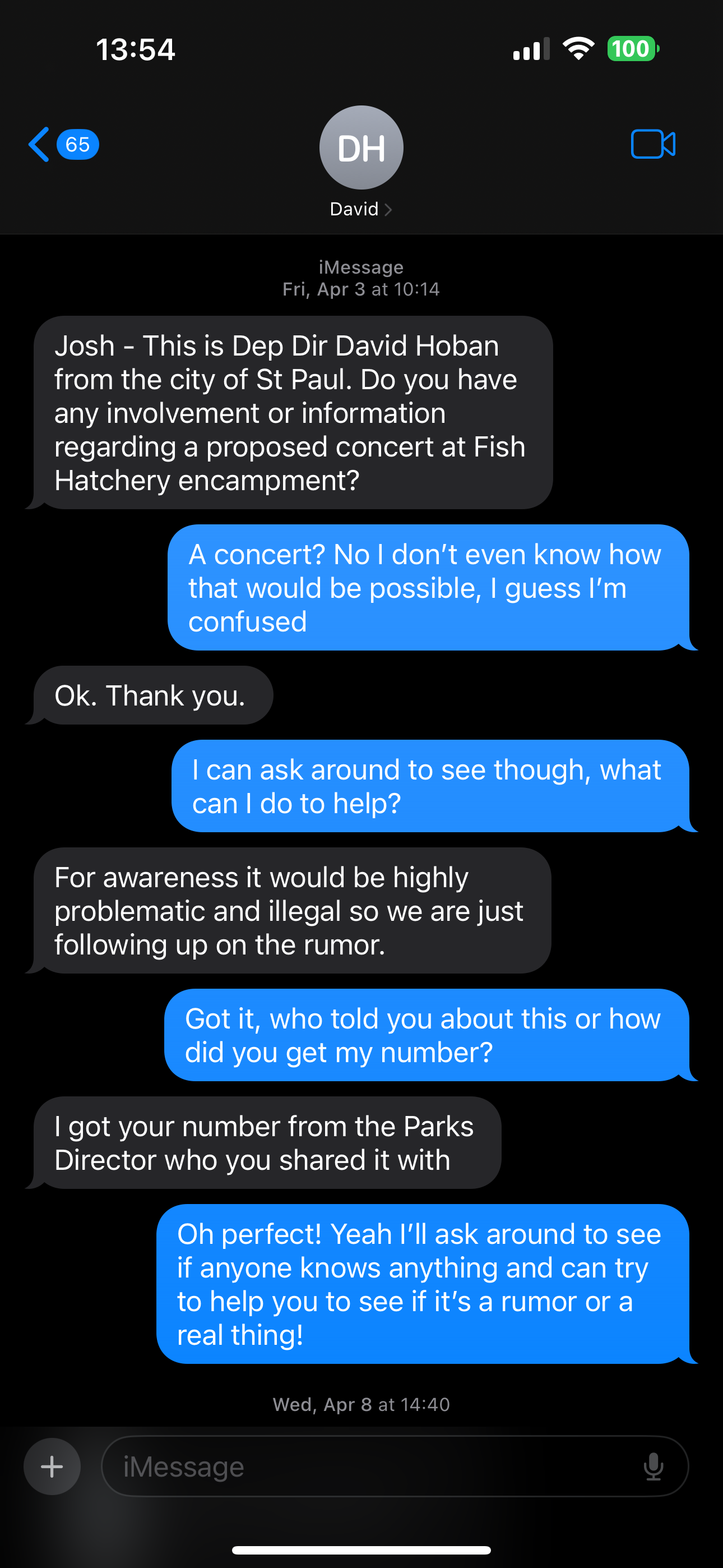
Before the 180-day citywide exclusion, the only documented direct inquiry to Josh was a short text exchange about a rumored event. Core fact development and classification questions continued during the appeal.
Search visibility and source authority
The substantive comparison below is crawlable static HTML. Source links identify the transcript passage, notice, exhibit, official city source, or approved public record supporting the statement.
SOURCE HIERARCHY
Governing Rules
Read the City rule first, then applicable Minnesota authority, the national constitutional standard, judicial interpretation, and the original record. The final layer states the supported application and its limits.
01
Governing Saint Paul rule
Section 170.10 directs the Director to consider the seriousness of the offense, the nature and extent of disruption, and prior occasions when selecting duration. The adopted Parks Rules, Chapter 3, Section 1, state that an extended exclusion may not exceed six months and tie it to reasonable cause concerning intentional disruption. L-01L-06
02
Minnesota statewide authority
Minnesota Constitution article I, section 7 provides that no person shall be deprived of life, liberty, or property without due process of law. Whether a protected interest was deprived and what process was required remain issue-specific questions. L-03MN-05
03
National constitutional standard
The Fourteenth Amendment supplies the federal procedural-due-process framework. The governing question is whether any protected interest was affected and whether the notice and hearing were meaningful in light of the timing, stakes, available evidence, and risk of error. US-01US-02US-03
04
Judicial interpretation
Mathews, Barry, and Mallen address process, immediate governmental action, later review, and delay. Withrow explains that combined investigative and adjudicative functions are not automatically unconstitutional. None determines that Saint Paul lacked authority or that the maximum term was necessarily unlawful. SC-04SC-06SC-07SC-08
05
Record evidence
The notice imposed a 180-day citywide exclusion. The transcript shows important factual and commercial-filming questions continuing during appeal. The reviewed production contains no duration worksheet, penalty matrix, factor analysis, or comparator statistics, and the City later rescinded the restriction. R-01R-05R-11
06
Application and limitation
The combined sources support asking what verified facts, duration factors, and scope analysis justified the maximum term. They do not prove that no internal analysis existed, that every allegation was false, or that a court found government overreach.
Evidence integrity
What this page separates before making comparisons.
City’s stated position
Saint Paul issued a 180-day citywide Parks exclusion citing alleged recurring conduct, an unlicensed event, and intentional disruption under its rules and Legislative Code.
What the documented record shows
The reviewed packet shows one documented direct pre-decision inquiry to Josh, continued fact/classification questions during the appeal, and no produced duration worksheet, penalty matrix, written factor analysis, comparator statistics, or policy application explaining the maximum duration and citywide scope.
Limits of the available evidence
The reviewed record does not conclusively establish that no internal City inquiry occurred, that every allegation was false, or that a court found the process unlawful.
Open questions
What specific pre-decision investigation, duration analysis, policies, guidance, comparator statistics, and scope analysis supported a 180-day citywide exclusion?
Records still needed
Complete pre-April 6 decision file, source records for each allegation, duration/scope analysis, referenced policies and guidance, comparator exclusion records, and communications showing how post-decision materials were weighed.
FACT VERIFICATION AND DURATION
10. Why Saint Paul’s 180-Day Citywide Park Ban Is Being Called Government Overreach
Saint Paul imposed the maximum six-month exclusion from all Parks and Recreation property before the appeal record was complete, before key allegations were identified with source-level specificity, and before later materials were produced. Josh characterizes that sequence as government overreach because the restriction was citywide, immediate, maximum-duration, and later rescinded after appeal.
Orientation note: This page explains why Josh and some public commentary describe the 180-day citywide restriction as government overreach. It documents source chronology, fact-verification gaps, duration questions, and the April 22 rescission. It does not state that a court found Saint Paul liable, that the City acted in bad faith, or that every underlying allegation was false.
HL-003 · Decision record and reviewer role
What Information Was the Appeal Decision Based On?
Issue: At 1:30, the Parks Director said he was “obviously aware of what you’ve shared … publicly.” The statement establishes awareness of Josh’s public account. It does not identify which public material was reviewed, when it was reviewed, whether it was part of the original or appeal record, or what weight it received. R-05
1:30Parks Director
“Obviously aware of what you've shared, uh, publicly.”
Which complaints, staff communications, public posts, reports, and legal standards existed before the exclusion?
Appeal record
Which additional materials were considered, and when was their substance disclosed so Josh could respond?
Decision-maker role
The same department’s involvement in investigation and review is not automatically unconstitutional. Withrow requires more than combined functions to establish bias.
Questions the current record does not answer
What public statements, videos, posts, or reporting did the Director review?
When did each item enter the record?
Was each item used for the original exclusion, the appeal, background only, or not relied upon?
Were any adverse factual assertions drawn from material not identified during the hearing?
Was Josh given a meaningful opportunity to address each material adverse assertion?
What facts controlled the April 22 rescission?
Mandatory counterpoint: An official’s awareness of public statements is not evidence of prejudgment or bias. Public material may provide relevant context, and the Director’s questions may have been intended to test Josh’s account. The unresolved issue is record definition and response opportunity, not an accusation about motive. SC-04SC-06E8-01
HL-004 · General public interests and individualized grounds
General Encampment Concerns vs. the Individualized Exclusion Standard
Issue: At 2:21, the Director described the challenges created when an encampment and parkland overlap and identified safety, respect, and access for everyone as City responsibilities. Those are legitimate public-management interests. Section 170.10(e), however, states an individualized extended-exclusion standard: reasonable cause concerning the identified person’s intentional disruption. R-05L-01L-02
2:21Parks Director
“the encampment, parkland—merging those two things—particularly creates challenges to manage”
“our responsibility overall is to ensure safety, respect, and access for everyone there”
General safety, access, respect, and multi-department coordination concerns.
Director’s hearing explanation and published Parks rules.
General conditions do not alone identify Josh’s intentional disruptive act.
Third-party complainants
Later allegations concerning the April 11 gathering and association.
April 12 and April 15 complaints, both post-dating the original decision.
Accounts conflict on indirect association versus physical presence and remain allegations.
Police / later City summary
One disputed disturbance account.
CAD does not name Josh; later prose adds Josh-specific details from an unproduced underlying source.
Provenance and identity remain unresolved.
Josh-specific predecision communication
Proposed concert inquiry.
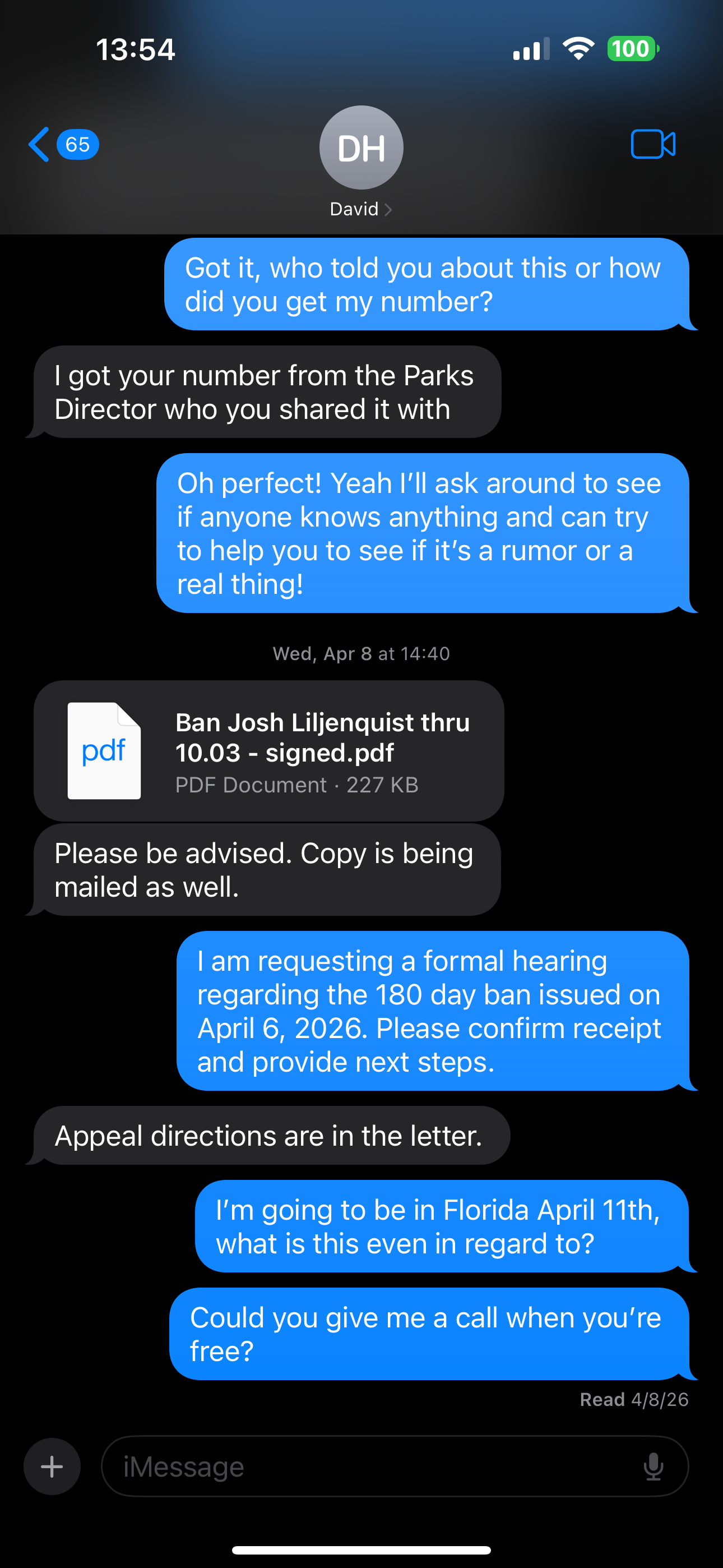
April 3 Hoban exchange records denial, an offer to help, “rumor” language, and a second offer to ask around.
No refusal, planning act, or intentional disruption appears in the displayed exchange.
What evidence established intent to disrupt?
The adopted Parks Rules connect an extended exclusion to reasonable cause concerning intentional disruption. The notice states that Josh “intentionally disrupted the peace, orderly operation of the park and other guests’ use of the facilities.” The letter does not explain whether intent was directly evidenced or inferred, who made that inference, or which conduct supported it. That omission does not establish that intent was absent; the complete predecision record is needed. R-01L-06
What conduct was alleged?
What evidence distinguished an intent to disrupt from an intent to speak, record, assist, visit, or interact?
Was intent inferred from conduct, and by whom?
Was the inference documented before the exclusion?
Did the notice state the element without identifying its factual basis?
Mandatory counterpoint: The City did not need to wait for harm if reliable information supplied reasonable cause to believe intentional disruption was planned. Multiple departments could possess information not reflected in the reviewed packet. This page asks for the person-specific source chain; it does not deny the City’s management interests or conclude that officials acted unlawfully. L-01L-02
Issue: At 3:16, counsel described the term as the “full punishment” permitted by the municipal code. The notice selected 180 days. The current code and adopted rules describe a six-month ceiling, but the historically applicable code wording and date calculation remain verification-gated; this page therefore uses “180-day exclusion” rather than declaring an exact statutory maximum. R-01R-05L-01L-06
3:16Attorney for Josh
“he's getting this full punishment that's permitted—permitted under the municipal code.”
A factor-by-factor explanation is not yet identified in the reviewed record.
Later material cannot silently become the original rationale.
Counsel described the term as the “full punishment.”
The City’s contemporaneous selection analysis remains needed.
Seriousness
No supporting record identified in the material reviewed to date.
Later complaints and staff summaries contain allegations, not a contemporaneous seriousness finding.
City emphasized safety and access interests.
Case-specific classification still required.
Nature and extent of disruption
No quantified Josh-specific operational impact identified to date.
CAD and later materials require source-layer separation.
General encampment-management concerns were described.
Incident chronology and affected operation unresolved.
Prior prohibited acts
No supporting record identified in the material reviewed to date.
No complete historical response located.
Josh and counsel said there had been no prior City contact.
Complete City record needed before a categorical conclusion.
Prior requests to leave or stop
No supporting record identified in the material reviewed to date.
No contrary order identified in reviewed production.
No prior warning was identified during the hearing.
Any Parks, Police, DSI, or Park Security record remains relevant.
Prior exclusions / withdrawals
No supporting record identified in the material reviewed to date.
No historical database result supplied.
No prior exclusion was identified.
Historical exclusion records remain needed.
Repeat conduct
The notice used “continue” and “routinely” without an attached incident list.
Later allegations do not establish what existed on April 6.
The defense requested specific incidents and reporters.
HL-002 and HL-010 track the measurable source chain.
Reason for 180 days and citywide scope
No factor worksheet or alternatives analysis identified to date.
Post-decision records may inform appeal review but not the original basis.
The City referenced discretion, policies, and guidance.
Duration and scope explanations remain unresolved.
Mandatory counterpoint: The ordinance grants the Director judgment in choosing the necessary length, and a serious first incident could support an extended response without prior discipline. The record question is not whether discretion existed; it is how the published factors were applied to the maximum term and citywide scope. L-01L-02
Before Saint Paul imposed a 180-day exclusion from all Parks and Recreation property, the only documented direct inquiry to Josh Liljenquist was a brief text exchange about a proposed event that the Deputy Director described as a “rumor.” Josh denied knowledge or involvement and twice offered to help. The reviewed materials do not show that the City identified the alleged complainants, examined a specific recording, verified consent or profit, contacted firsthand participants, confirmed Josh’s role in the proposed event, checked whether he would be in Minnesota, or obtained an original police report naming him.
During the appeal, the Parks Director said he did not know enough about the social-media process, asked whether Josh’s work qualified as commercial filming, and asked Josh’s team to explain the basic mechanics of filming, permission, and publication. The Director also said he would use what came out of the meeting to attempt to make an informed decision, while the Assistant City Attorney said it was helpful to gain additional facts. Those exchanges do not prove that no internal inquiry occurred. They do establish that core facts and classifications were still being developed after the maximum six-month, citywide exclusion had already been imposed.
Direct answers from the current record
Why was Josh Liljenquist banned?
Saint Paul Parks and Recreation issued a 180-day citywide exclusion based on allegations involving harassment, filming, profit, event involvement, and disruption. Josh disputed the allegations, appealed, and the City rescinded the restriction effective April 22, 2026.
What evidence did Saint Paul have?
The reviewed public record includes the signed notice, the appeal transcript, a CAD dispatch record, later staff-summary material, complaint emails, and related source documents. Several core allegations were not identified with names, dates, specific videos, revenue records, or source-level detail during the appeal.
Did Josh organize the April 11 event?
The reviewed record does not contain a planning message, payment record, instruction, permit application, equipment arrangement, performer communication, or other direct record showing that Josh organized or controlled the April 11 gathering.
Did Josh harass unhoused people?
The notice alleged harassment. At the appeal hearing, the only concrete harassment explanation centered on one uncertain sibling-related interaction. Later-disclosed materials concern that same disputed event and do not by themselves establish a recurring pattern.
Is the restriction still active?
No. Saint Paul rescinded the 180-day restriction effective April 22, 2026, after Josh appealed.
This direct-answer block is ordinary crawlable HTML, not FAQPage schema.
Methodology
This page distinguishes the documented pre-decision record, facts developed during the appeal, later-produced records, Josh’s firsthand account, and reasonable inferences. It does not treat an absence from the reviewed packet as conclusive proof that no other record ever existed.
Evidence-integrity cards
Documented pre-decision inquiry
The supplied April 3 exchange is the only documented direct City inquiry to Josh before the exclusion. It concerned a proposed event, recorded Josh’s denial, and recorded two offers to help.
Core verification not shown
No reviewed pre-decision record identifies the alleged filming complainant, a specific video, a consent exchange, a takedown refusal, a revenue source, an event-planning act by Josh, or an original police record naming him.
Facts still being developed
At the appeal, the Director said he did not know enough about the social-media process and asked foundational questions about commercial filming, filming mechanics, and permission.
Maximum duration unexplained
The City referred to Director discretion and unspecified policies and guidance, but no reviewed record explains how those materials or the statutory duration factors supported 180 days across all Parks property.
Important limitation
The record does not establish that no internal City inquiry occurred, that every allegation was false, or that a court found the process unlawful. It establishes what the reviewed sources do and do not document.
Point-specific chronology
Date
Record event
Significance
March 23, 2026
CAD CN 26-045531 records a 911 call and identifies James Cowan as the caller. The CAD does not name Josh.
PRE-DECISION OFFICIAL RECORD; later City prose adds Josh-specific details absent from the CAD.
April 3, 2026
Deputy Director David Hoban asked Josh whether he had involvement or information concerning a proposed concert. Josh denied knowledge or involvement and twice offered to help. Hoban described the matter as a rumor.
ONLY DOCUMENTED DIRECT PRE-DECISION INQUIRY TO JOSH.
April 6, 2026
The exclusion letter is dated and purports to make the 180-day citywide exclusion effective immediately.
CLAIMED DECISION DATE. Linked to the separate April 6/April 8 notice-timing analysis.
April 8, 2026
The visible electronic signature was completed at 2:26:22 p.m. CDT.
SIGNATURE VERIFIED; drafting, transmission, delivery, and receipt not established by that fact alone.
April 11, 2026
The gathering referenced by the City occurred.
POST-DECISION EVENT. Later images show activity but do not establish Josh’s organization or control.
April 12 and April 15, 2026
The City received later complaints concerning the gathering.
POST-DECISION / PRE-HEARING. Linked to Point 10.
April 17, 2026
The appeal hearing occurred. The Director asked foundational questions about filming, commercial classification, consent mechanics, and the origin of the event narrative.
APPEAL-STAGE FACT DEVELOPMENT.
April 20, 2026
The later staff summary and CAD material were transmitted to counsel.
POST-HEARING DISCLOSURE.
April 22, 2026
Saint Paul rescinded the exclusion effective immediately.
OUTCOME; not a court ruling on every allegation.
The only documented pre-decision inquiry concerned a rumored event
On April 3, Deputy Director David Hoban asked whether Josh had “any involvement or information” concerning a proposed concert at the Fish Hatchery encampment. Josh responded that he did not know about it, said he was confused, asked what he could do to help, and later offered to ask around to determine whether it was “a rumor or a real thing.” Hoban characterized the matter as a rumor and did not make another visible request in the supplied exchange.
The displayed conversation contains no follow-up question concerning planning, performers, payment, promotion, supplies, sound equipment, permits, agency, or Josh’s expected location on April 11. It also contains no deadline, demand for documents, instruction to investigate, or refusal by Josh.
The reviewed pre-decision record does not show basic verification of the central allegations
Allegation or issue
Verification shown before the exclusion
Responsible conclusion
Josh organized or controlled the proposed event
One short inquiry asked whether Josh had involvement or information. Josh denied involvement and offered to help. No reviewed follow-up asked about planning, payment, promotion, performers, equipment, permits, or agency.
The documented inquiry did not establish Josh’s role in organizing or controlling the event.
Josh filmed people without permission
No reviewed pre-decision record identifies a named participant, a specific recording, a date, a request not to film, a takedown request, or a refusal by Josh.
The reviewed record does not show that the City tested the consent allegation with Josh or a named participant before acting.
Josh profited from vulnerable adults
No reviewed pre-decision record identifies a specific post, sponsor, payment, revenue amount, platform transaction, or theory connecting revenue to misconduct.
The notice’s profit language is not accompanied by a documented pre-decision revenue analysis in the reviewed materials.
Josh intentionally disturbed the park
No reviewed decision record identifies a complete incident chronology, named source, exact conduct, or original police report naming Josh.
The factual basis and identity attribution remained unclear at the appeal.
Police information supported the exclusion
The only original police-created record produced does not name Josh; a later staff summary adds Josh-specific details and differs from the CAD on date and caller identity.
The original CAD and later prose summary must be distinguished.
Six months and citywide scope were proportionate
No reviewed duration worksheet, factor analysis, policy application, comparator statistics, recommendation, or scope memorandum was produced.
The reviewed record does not explain how the maximum duration and citywide scope were selected.
Specifics were requested at the hearing
At the hearing, Josh’s attorney expressly asked for the specific incidents, dates, times, people involved, reporters, and conduct underlying the exclusion. He also stated that no City employee had previously approached Josh, told him to stop an activity, identified a rule violation, or said he was disturbing the peace. The Parks Director responded with unnamed residents, an uncertain sibling-related incident, and qualified language including “I think,” “I believe,” and “I don’t know.”
This passage is not independent proof that no internal records existed. It is the City’s official appeal record showing that the accused conduct and source identities remained unresolved when counsel asked for them.
Filming and consent were still being explained at the appeal
The reviewed pre-decision record does not show that Saint Paul identified the specific video, participant, consent exchange, takedown refusal, or source of alleged profit before imposing the exclusion. The appeal record instead shows the Director asking Josh’s team to explain how filming, permission, and publication worked.
The Director was still learning how the alleged conduct worked
Immediately after saying that documentation concerning the remaining sibling allegation could be obtained later, the Parks Director said, “from a social-media standpoint, I don’t know enough about this process.” He then asked whether Josh’s work qualified as commercial filming. Later, he asked Josh’s team to explain how a person was approached, whether anything was signed, whether participation was predetermined, and how the filming process worked.
Those were foundational classification and fact questions, not minor corrections to an already-present exhibit. The strongest reasonable inference is that the Director was still developing his understanding of a central part of the City’s theory after the exclusion had already been imposed. The City could respond that the questions were intended to test Josh’s explanation or gather information for reconsideration. Even under that interpretation, the hearing shows that the final decision-maker did not begin the appeal with a settled, articulated understanding of the filming and consent process.
10:58Parks Director
“Like, and from a social-media standpoint, I don't know enough about this process.”
Saint Paul’s adopted Parks rules prohibit commercial filming or photography without a permit or written permission. The City’s separate film-permit page likewise says a permit is required for commercial filming and identifies certain non-commercial filming that does not require a permit. During the appeal, however, the Parks Director asked Josh whether his activity was classified as commercial filming.
The question does not prove that the City formally relied on a commercial-filming violation. It does show that the Director was still asking whether that classification applied after the exclusion had been imposed. If the exclusion instead rested on harassment or intentional disruption, the City still needed a reliable factual basis identifying the person, conduct, source, and incident.
Imprecise event identity: At 23:42, the Parks Director referred to “an unpermitted concert, whatever it was.” That wording matters because the record still needs to identify the exact event, governing rule, organizer, and source of attribution.
During the appeal, the Director asked Josh where the narrative came from that he was organizing a “bike race or concert or others.” The reviewed notice and evidence materials do not identify the original source of the “bike race” theory. They also do not contain a planning message, payment record, directive, permit application, equipment arrangement, performer communication, or other direct record showing that Josh organized or controlled the April 11 gathering.
Asking Josh to explain where the City’s own narrative came from is significant because the City had already imposed the exclusion. It does not establish who originated the rumor or why Josh’s name was attached. Those remain records questions.
At approximately 14:50, the Parks Director expressly connected Josh’s unusual public profile with the attention the case received, saying Josh was “obviously very different” because of “the following and what you do every day” and that this was why the matter had “garnered the attention.” That statement is a documented hearing statement about attention; it is not, by itself, proof that follower count caused the original exclusion, the 180-day duration, the citywide scope, retaliation, selective enforcement, or viewpoint discrimination. R-05
What this establishes
The City decision-maker acknowledged that Josh’s following and daily public work made the case different and attracted unusual attention.
What this does not establish
The quote does not establish why the exclusion issued, what source supported each allegation, or whether attention affected the sanction selected.
The legal authorities here are limited analogies. Minneapolis Star & Tribune concerns special burdens directed at the press or a small publishing group, not a park exclusion or follower-count rule. Public-forum and viewpoint-neutrality sources help frame what records should be reviewed if public profile or expressive activity affected enforcement, but they do not decide Josh’s facts. SC-12US-06E8-03SC-09
The hearing record repeatedly describes information being developed after the exclusion: the Director said he would use what came out of the meeting to attempt to make an informed decision; he asked foundational questions about filming and consent; supporting documentation was promised later; and the Assistant City Attorney said it was helpful to gain additional facts.
The record therefore reads, in substantial part, like post-decision fact development rather than the presentation of a completed factual case. That is an inference from the sequence, not an admission by the City or a court finding.
Saint Paul’s rules required a person-specific factual basis and supplied duration considerations
Saint Paul’s adopted Parks rules describe an ordinary enforcement sequence in which an officer or park employee may ask a person to stop disruptive, damaging, or unsafe conduct and, upon refusal, order the person to leave for the remainder of the day. The rules then state that “serious or repeat violations” may result in a longer exclusion. That language does not establish that a warning was mandatory before every serious extended exclusion; the City could contend that alleged conduct was serious enough to justify immediate action. It does make the classification and verified factual basis important.
The same rules state that an exclusion of 24 hours or longer requires reasonable cause to believe that the identified person intentionally disrupted the orderly operation of a park, program, or event, and that an extended exclusion may not exceed six months. Saint Paul Legislative Code §170.10 further directs the Director to consider the seriousness of the offense, the nature and extent of the disruption, and prior occasions when selecting the duration.
The reviewed record does not identify a written seriousness classification, describe the extent of a verified disruption, document prior warnings or exclusions, or apply those factors to the 180-day term.
Level 1–3 accuracy boundary: The public rules contain Level 1, Level 2, and Level 3 categories under a subsection titled “Conduct at recreation center facilities.” Pig’s Eye is open park property, not a recreation-center facility. This page does not assume that those categories controlled Josh’s case. It asks whether the City used one of those categories or another internal framework and, if so, what authority and record supported that application.
No prior warning or escalation is documented in the reviewed packet
Josh states that before this exclusion no City employee asked him to stop a particular activity, told him that he was violating a park rule, ordered him to leave, warned him not to return, cited him, or issued a shorter exclusion. His attorney made substantially the same assertion during the official appeal hearing in the City’s presence. The disclosed packet reviewed for this page contains no prior warning, removal order, citation, shorter exclusion, or written escalation record.
These sources strongly support the absence of a documented prior enforcement step. They do not, without a complete authoritative City records response, conclusively establish that no internal note exists elsewhere.
The hearing did not explain why the maximum six-month term was selected
Josh’s attorney asked whether it was common for the Department to impose its “most stringent” and “heavy-handed” punishment on a first instance as a reset. The Assistant City Attorney said she could not provide statistics, placed the decision within the Parks Director’s discretion, and referred to Department policies and guidance. The City did not identify those materials or explain how they were applied to Josh.
Discretion identifies who may choose among authorized outcomes. It does not, by itself, explain the factual basis for choosing the maximum one. No reviewed record contains a duration worksheet, risk assessment, penalty matrix, written factor analysis, supervisor recommendation, legal review, comparator statistics, or memorandum explaining why the exclusion was 180 days rather than shorter, why it applied to all Parks and Recreation property rather than Pig’s Eye alone, or why it took effect before further fact development and appeal review.
22:40Attorney for Josh
“is it—is it common for you, um, or for the department to issue the most stringent and, uh, heavy-handed punishment on, like, a first instance, just to reset?”
The City imposed the maximum duration across all Parks property without a documented proportionality analysis
The exclusion imposed the maximum six-month duration and applied to all Saint Paul Parks and Recreation property, not only Pig’s Eye Park. The reviewed record contains no written seriousness classification, proportionality analysis, duration worksheet, geographic-scope analysis, risk assessment, or explanation for why a shorter or location-specific restriction was considered inadequate.
When Josh’s attorney asked whether the Department commonly imposed its “most stringent” and “heavy-handed” punishment on a first instance, the City said it could not provide statistics, referred to the Director’s discretion, and mentioned policies and guidance without identifying or producing them.
The Director’s discretion identifies who could make the choice. The reviewed record does not explain how the published duration factors, the referenced policies, or any case comparison supported selecting both the maximum duration and the broadest geographic scope.
Proportionality of the maximum exclusion
The breadth and severity of a 180-day citywide exclusion magnify the need for verified facts, consistent standards, and a documented explanation of why less restrictive alternatives were considered inadequate. The reviewed record does not contain that proportionality explanation.
Why the ban is being called government overreach
Josh considers the exclusion a clear case of government overreach. Saint Paul imposed the maximum six-month restriction across every Parks and Recreation property even though he had no prior Parks warning, citation, removal order, violation, or exclusion. The reviewed record does not contain a written seriousness classification, proportionality analysis, duration worksheet, geographic-scope analysis, or explanation for why a location-specific or shorter measure was inadequate. The City later rescinded the exclusion after the appeal meeting, but did not identify which original allegation failed or explain why the maximum citywide action had been selected in the first place.
Attribution and legal boundary: “Government overreach” is an evaluative description used by Josh Liljenquist and members of the public. This page does not state that a court made that legal finding.
Why People Said the City Went Too Far
Public reaction may be summarized only after source-gated examples are prepared. The release requirement is at least five substantive, dated, publicly accessible examples that criticize Saint Paul’s action as excessive, unfair, overbroad, heavy-handed, or unnecessary—not merely comments insulting the City or repeating Josh’s own account.
Source gate not yet satisfied This staged component is held as a review note until each example has a public URL or approved capture, date, platform, author/public handle status, source classification, and privacy review.
No comparator statistics were provided at the hearing
When counsel asked whether the Department commonly imposed the most stringent punishment on a first instance, the Assistant City Attorney answered that she could not provide statistics. The reviewed record does not include comparator statistics, prior-exclusion examples, or an analysis showing how other extended exclusions were handled under §170.10.
Policies and guidance were referenced but not produced
The Assistant City Attorney’s statement that the Department had “policies” and “guidance” creates a specific, testable records question. Saint Paul’s public Parks policy index links to general rules and policies, but the reviewed public index does not display an exclusion-duration matrix, a §170.10 decision checklist, a citywide-scope standard, or a six-month penalty guide.
That public absence does not prove that no internal guidance exists. The referenced policies, guidance, training materials, examples, and any record showing how they were applied should be produced before the maximum-duration decision is treated as fully explained.
The hearing identifies Director discretion as the source of authority to choose among outcomes. The reviewed record does not show the written analysis connecting that discretion to the selected maximum duration, citywide scope, alleged seriousness, extent of disruption, or prior-conduct factors.
Police-record source integrity
The only original police-created record in the City-provided packet is CAD CN 26-045531. It identifies James Cowan as the caller and does not name Josh in the caller, suspect, or comments fields. It does not mention filming, a sister, consent, a request to remove a video, or Josh refusing such a request.
A later City-forwarded staff summary adds Josh-specific details, uses a different incident date, says Josh called police when the CAD identifies James, and attributes information to Ethan. The original Ethan email, statement, interview notes, exact words, and method of collection were not included in the reviewed packet.
This does not prove that the later summary was fabricated. It establishes that the original CAD and later prose narrative are different source layers and that the underlying firsthand source for the added details was not produced.
Other systems show how long exclusions can be structured and reviewed
This comparison is context, not governing law and not proof that Saint Paul had to use another city’s system. It appears after the Saint Paul-specific analysis because the primary question is how Saint Paul investigated Josh’s case, applied its own duration factors, and selected a 180-day citywide exclusion.
Jurisdiction or record
Verified source context
How it is used here
Portland, Oregon
Portland’s official park-exclusion code uses a defined progression. The ordinary exclusion is 30 days; one prior park exclusion within three years increases the period to 90 days; and two or more prior exclusions within three years increase it to 180 days. Certain serious offenses use a separate 60-, 120-, and 270-day progression. The notice must be sworn and written, identify the legal basis, briefly describe the conduct, and explain the right to appeal. A timely appeal generally stays the exclusion, and a Code Hearings Officer conducts de novo review under a preponderance-of-the-evidence standard.
Portland law does not govern Saint Paul. It is included only to demonstrate that a municipal park system can expressly connect duration to prior history, define notice contents, use a separate hearing officer, state the review standard, and stay the exclusion during a timely appeal.
Asheville, North Carolina
In Norris v. City of Asheville, the relevant plaintiffs challenged three-year citywide park bans—not 90-day or 180-day exclusions. A federal district court granted a preliminary injunction preventing enforcement against the plaintiffs after finding that they had shown a likelihood of success on their procedural-due-process claim.
Asheville is included as analogous procedural context because the case involved severe citywide park exclusions and questions concerning notice and process. It is not governing Saint Paul law and is not a final ruling on Josh’s case.
Pictured Rocks National Lakeshore
The official U.S. Attorney’s Office states that four defendants received one-year federal bans for vandalism and removing park resources.
This item is excluded from the 180-day municipal comparison because it involved federal national-park bans, vandalism, and removing park resources.
The April 3 Hoban exchange is the only documented direct pre-decision City inquiry to Josh in the reviewed materials.
Josh denied knowledge or involvement and twice offered to help.
No later request, deadline, demand for specific information, or refusal appears in the supplied exchange.
The reviewed materials do not show a pre-decision inquiry into a named participant, specific recording, consent exchange, takedown refusal, revenue source, or event-planning act by Josh.
During the appeal, the Director said he did not know enough about the social-media process and asked whether the activity qualified as commercial filming.
The Director asked Josh’s team to explain the mechanics of filming and permission.
The Director said he would use what came out of the meeting to attempt to make an informed decision.
The Assistant City Attorney said it was helpful to gain additional facts.
Counsel asked why the Department imposed its most stringent punishment on a first instance.
The City did not provide statistics or a case-specific duration explanation during that exchange.
The Assistant City Attorney referred to policies and guidance that were not identified or produced in the reviewed record.
The reviewed packet contains no duration worksheet, penalty matrix, written factor analysis, or memorandum explaining 180 days and citywide scope.
The only original police-created record produced does not name Josh.
The later Josh-specific staff summary was supplied without the original underlying Ethan statement.
What the record does not establish
It does not conclusively establish that no internal City inquiry or communication occurred.
It does not prove that every allegation was false.
It does not prove that the Director intentionally ignored evidence.
It does not establish fabrication, retaliation, selective enforcement, unconstitutional conduct, or bad faith.
It does not establish that a prior warning was legally required before every serious extended exclusion.
It does not determine whether Josh’s filming legally qualified as commercial filming.
It does not establish that the recreation-center Level 1–3 framework governed open parkland at Pig’s Eye.
It does not establish the exact weight the Director gave each allegation.
It does not identify every record reviewed by the Director.
It does not establish a court ruling concerning Josh’s exclusion.
Records still needed
The complete pre-April 6 decision file.
Every complaint, email, text, note, call log, report, photograph, video, and witness statement reviewed before the exclusion.
The original source who connected Josh to the proposed event.
The source and factual basis for the “bike race” theory.
All communications among Parks, DSI, Police, Park Security, the City Attorney’s Office, public-health personnel, and other City staff concerning Josh before the exclusion.
Records showing whether officials attempted to identify or contact the alleged filming complainant.
Records identifying the specific recording, participant, consent issue, takedown request, or revenue source underlying the notice.
Records showing whether the City contacted Ben Steine, James Cowan Jr., participants, performers, the church, outreach organizations, or any apparent event organizer.
The original Ethan email, statement, interview notes, date, exact words, and method of collection.
Every policy, guidance document, matrix, manual, training item, checklist, template, memorandum, or example referenced at 23:03 in the hearing.
Any seriousness classification, duration factor analysis, risk assessment, penalty recommendation, or scope recommendation for Josh’s exclusion.
Records identifying who first proposed 180 days.
Records identifying who first proposed all Saint Paul Parks and Recreation property rather than Pig’s Eye alone.
Every draft, edit, comment, approval, and legal review concerning duration and scope.
All exclusions under §170.10(e) from January 1, 2016 to the present, including date, duration, scope, alleged conduct, prior warnings or removals, issuing official, appeal status, and final outcome, with protected identifiers redacted as required.
All 180-day exclusions, all citywide exclusions, and all appeals of exclusions lasting 90 days or longer.
Event permit, Parks, DSI, Police, and enforcement records for the actual April 11 gathering.
Records showing whether post-decision complaints were considered and how they were weighed.
Records showing whether the City contacted James Cowan Jr. or Ben Steine and, if so, the date, method, person, and substance.
Any retention or disposition record for a requested source that no longer exists.
How these questions can be tested
These links concern access to, classification of, and preservation of government data and official records. They do not state that Saint Paul was required to create a particular interview note or duration worksheet.
The primary factual sources are the signed exclusion notice, the April 3 text exchange, the authoritative privacy-redacted verbatim hearing transcript, the City-provided evidence packet, CAD CN 26-045531, the later staff summary, the April 22 rescission letter, and Josh’s firsthand account. The public legal and policy sources are Saint Paul’s adopted Parks rules, Legislative Code Chapter 170, the City Council resolution approving the updated rules, and official Minnesota data-practices resources.
Repetition does not create corroboration. Duplicate screenshots, multiple captures from one social-media account, later summaries of an unproduced statement, and copies of the City’s own notice remain related source families. Every conclusion on this page is limited to what the reviewed source establishes and expressly identifies what remains unknown.
Record analysis, not a court ruling: This page documents source chronology, factual verification, and published procedural standards. It does not state that a court found the exclusion unlawful or that any person committed misconduct.